Screen Printing Sweat Suits Manufacturer
Screen Printing Sweat Suits Manufacturer Where Bold Coverage Works Across Both Pieces
As a screen printing sweat suits manufacturer based in Sialkot, Pakistan, we build a genuinely separate screen setup for the top and the bottom — even for a matching design, a flat chest panel and a curved leg need their own screens burned to fit each surface correctly. MOQ starts at 50 complete sets with sizes split however you need, your sample takes 6–10 days and its full cost is credited against the bulk order, and production runs 12–15 days once you approve it.
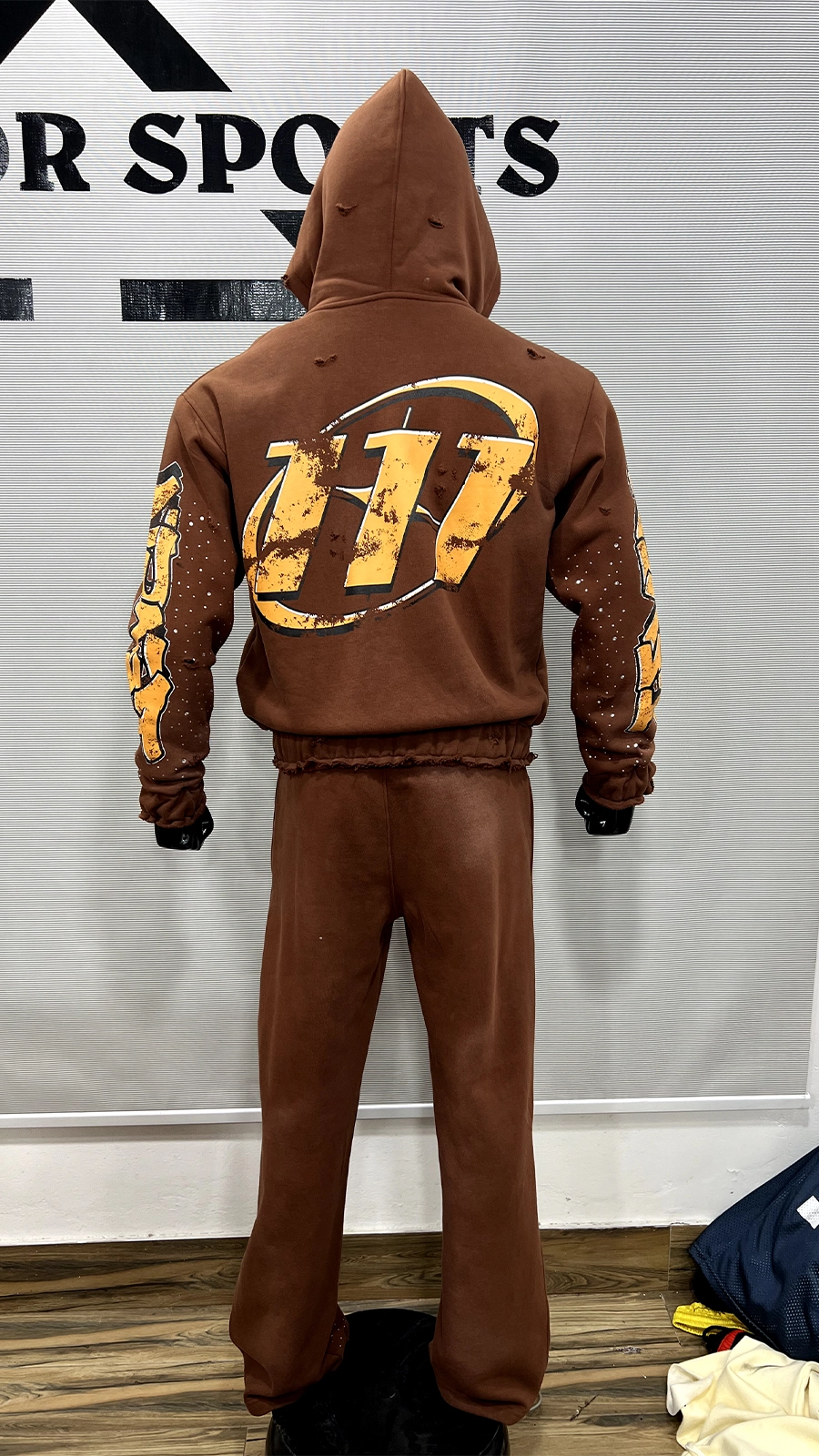
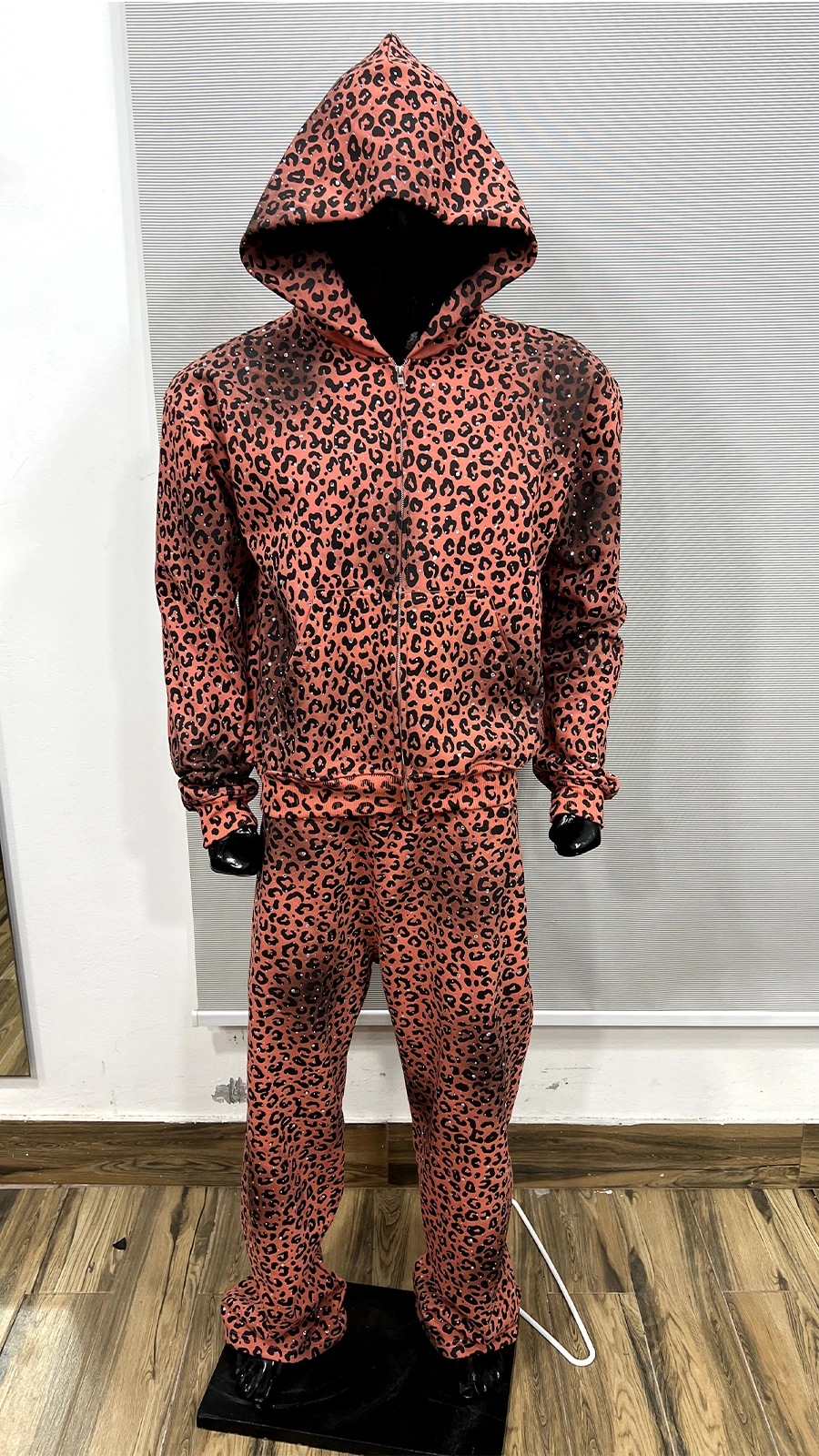
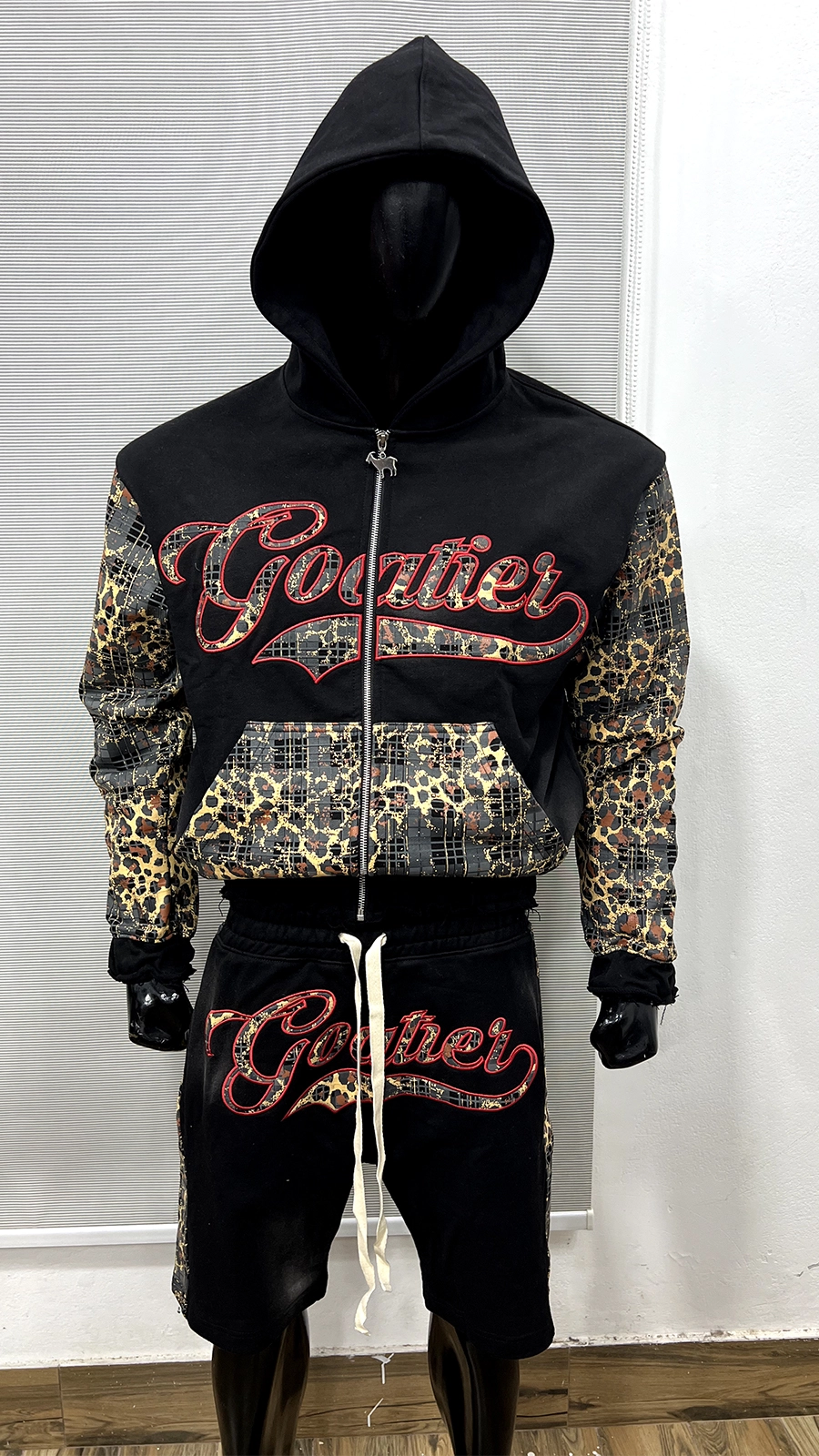
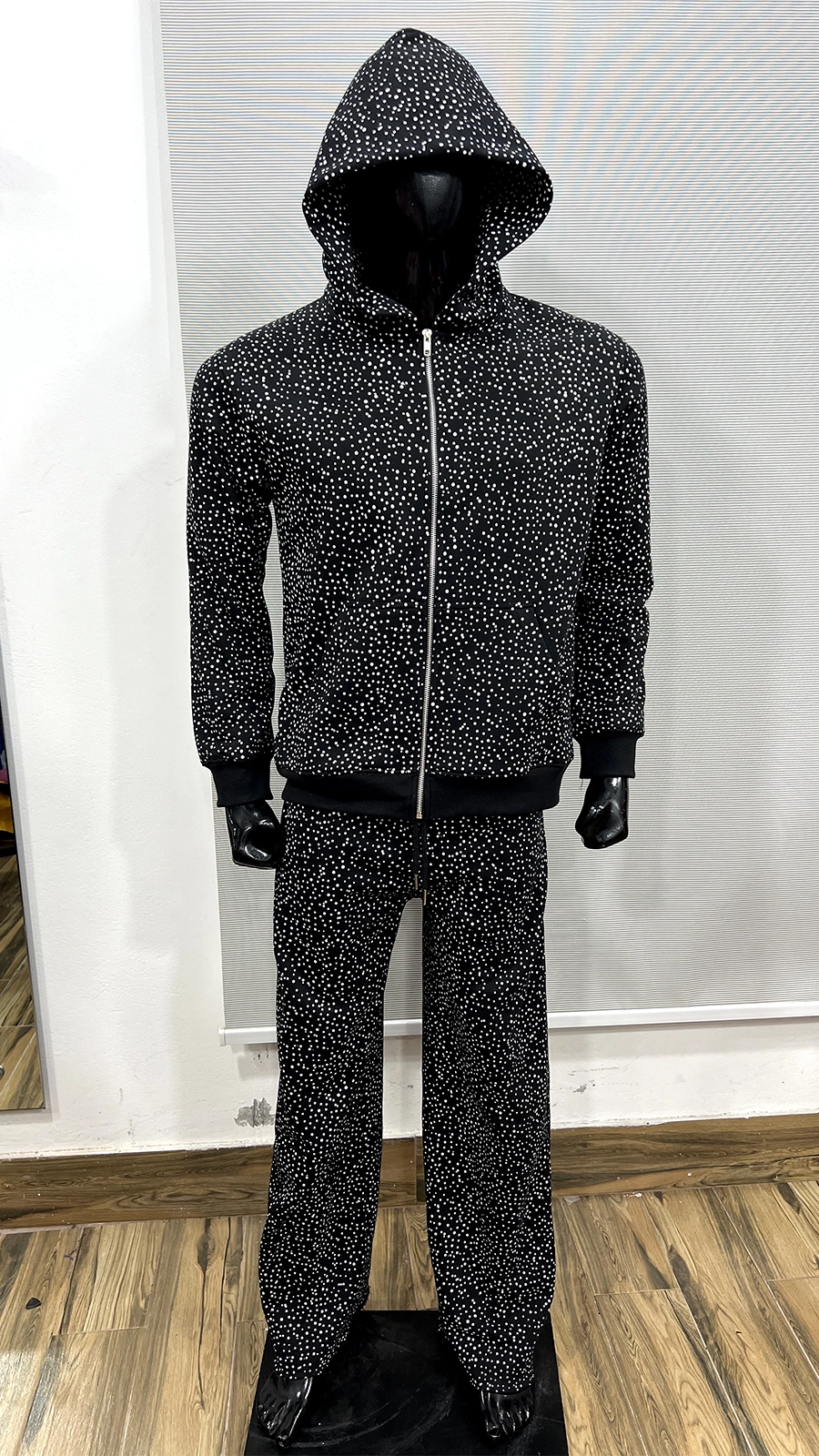
The pieces below are our own production samples, shot on the factory floor — not stock photos. Every order we run is fully custom to your spec, sizes, and branding.
01 — Why a Matched Set Needs Two Separate Screens, Even for One Design
What a Screen Printing Sweat Suits Manufacturer Actually Sets Up
Our embroidery sweat suits page covers a genuine coordination challenge specific to a matched set — combining two different technical jobs into one consistent-looking product. Screen printing has its own version of that same problem, and it’s worth understanding before you assume printing a "matching" design across a top and bottom is as simple as reusing one file twice.
A hoodie or sweatshirt prints on a flat board platen — the same equipment we use for a standalone chest logo. Sweatpants need the leg-shaped platen we cover on our screen printing sweat pants page, built specifically to slide inside the leg and hold it flat and taut. Even when the design is conceptually identical across both pieces, the screens themselves aren’t interchangeable — a screen burned for a flat chest panel doesn’t fit the curved, tapered proportions of a leg placement, so each piece genuinely needs its own screen setup regardless of how similar the artwork looks.
This is worth stating plainly because it’s a genuine source of confusion for buyers new to ordering matched sets: "same design, two garments" doesn’t mean "one screen setup, two print runs." The screen preparation itself is duplicated work, even when the creative concept is unified. It’s not a hidden fee — it’s simply how the physical printing process has to work when the surface geometry differs this much between a flat panel and a curved leg.
02 — Fabric and Construction: One Consistent GSM Across Both Pieces
Fabric and Construction: One Consistent GSM Across Both Pieces
| Weight | GSM | Screen Print Result Across the Set |
|---|---|---|
| Midweight fleece | 320–360 GSM | Workable for both pieces |
| Heavyweight fleece | 380–450+ GSM | The most reliable support for both pieces at once |
The same fabric advantage we cover on our embroidery sweat suits page applies here — a hoodie-and-sweatpants set can share one heavier fleece weight range across both pieces without the lighter-weight compromise our shorts pages describe. Ink deposit and mesh count calibration stay consistent between the top and bottom for exactly this reason, since neither garment is forcing a different fabric weight than the other.
That consistency is worth appreciating specifically because it’s not guaranteed across every product combination we build — a hoodie paired with sweat shorts, for instance, needs separate GSM and ink calibration for each piece given the weight difference our shorts pages cover. A hoodie-and-sweatpants set sidesteps that extra calibration step entirely, which is one less variable to manage across the whole order.
03 — Placement, Large-Format Coordination, and File Requirements
Placement, Large-Format Coordination, and File Requirements
Here’s where screen printing genuinely differs from embroidery on a matched set: this technique’s cost scales with color count and coverage rather than stitch density, which means a large, bold graphic across both the top and the bottom stays economical in a way it wouldn’t with embroidery. If you want a coordinated design that reads as one visual story spanning a big front chest graphic and a matching large leg print, screen printing is the more practical route to get there without the cost climbing the way it would stitching that same coverage in thread.
The top can be either a hooded style or a crewneck sweatshirt, the same spec decision we cover on our embroidery sweat suits page. If the design repeats or complements itself across both garments, ink color needs to match precisely between the two separate print runs — the top and bottom are genuinely different production passes, even within the same order, so color consistency isn’t automatic just because they’re printed by the same factory on the same day. Send us reference artwork for both pieces together so we can plan registration and color matching from the start.
A large coordinated graphic doesn’t have to mean identical artwork on both pieces — a genuinely effective set design often uses a bold front chest graphic paired with a smaller, complementary leg accent, or a design that continues thematically rather than repeating exactly. Whatever the relationship between the two pieces, plan it as one unified concept from the start rather than designing the top and bottom independently and hoping they read as coordinated once they’re both printed.
04 — What Separates a Set That Prints Consistently From One That Doesn’t
What Separates a Set That Prints Consistently From One That Doesn’t
Check each piece against its own individual standard first — the top’s registration should show clean edges with no fringing, the bottom’s registration should hold across the leg’s taper, the same checks we cover on our standalone hoodie and sweatpants pages.
Then check the set together, under the same light. Does the ink color actually match between the two garments, or is there a subtle shift between the two separate print runs? Does the cure feel consistent — same hand-feel, same flexibility — across both pieces? This set-level comparison is the check that determines whether a customer perceives the product as one coordinated design or two separately printed items that happen to ship together.
Check the two pieces’ base fabric color and finish too, separate from the ink itself — a top and bottom cut from slightly different fabric batches can carry a subtle shade difference that has nothing to do with the printing but still undermines the coordinated impression the whole set is meant to deliver. This is worth checking specifically since it’s easy to overlook when your attention is focused on ink color and registration alone.
05 — MOQ and Sampling: What to Expect
MOQ and Sampling With Your Screen Printing Sweat Suits Manufacturer
MOQ is 50 complete sets per style — 50 tops and 50 matching bottoms, split across whatever size run you need. Sampling takes 6–10 days, and the full cost is credited against your bulk order once you move forward. That same credit policy applies here as it does across every technique and category we offer.
Sample both pieces together rather than approving them separately, the same principle we cover on our embroidery sweat suits page — ink color and cure consistency differences between two separate print runs are much easier to catch side by side than reviewing each garment in isolation.
If you’re ordering a large coordinated design that spans both pieces, it’s worth reviewing the sample specifically for how the visual story reads across the two garments together, not just checking each print’s individual quality — lay the top and bottom out side by side or on a mannequin if possible, since that’s much closer to how a customer will actually experience the set than viewing each piece flat on its own.
06 — What Actually Moves Your Price
What Actually Moves Your Price
Because the top and bottom genuinely need separate screens, a matching design across a set doesn’t halve the setup cost the way you might expect — you’re paying for two screen preparations, not one shared across both pieces. Number of colors, coverage size on each garment, fabric GSM, and total order volume (in complete sets) all factor in from there.
Where you do see real efficiency in a matched set is on the fabric and production side rather than the screen side — sourcing one consistent fleece weight for both pieces, running them through compatible curing standards, and coordinating the whole order as one project rather than two separate purchase decisions. That efficiency shows up more in reduced back-and-forth and a more predictable timeline than in a direct discount on screen costs.
We don’t publish flat pricing because those variables interact too much to be useful as a single number. Run your spec through our Instant Quote tool instead — it gives you a price estimate in 5 seconds, a downloadable PDF quote, and a direct line to WhatsApp with your quote pre-filled. Final pricing is confirmed by our team within 24 hours.
07 — Shipping to the UK and EU Duty-Free
Shipping to the UK and EU Duty-Free
Manufacturing in Pakistan carries a trade advantage worth factoring into your landed cost. Apparel made here enters the UK at 0% duty under the Developing Countries Trading Scheme, and the EU at 0% duty under GSP+, versus roughly 12% on equivalent goods sourced from China.
Details on eligibility and the current tariff schedule are on the UK government’s own guidance page: Developing Countries Trading Scheme (DCTS) — GOV.UK. This matters on a matched set order too, since landed cost applies across both pieces of the set rather than a single garment.
08 — When Screen Printing Isn’t the Right Call
When Screen Printing Isn’t the Right Call
Screen printing isn’t the right call for a very small, highly detailed logo on either piece, where the screen setup cost isn’t justified relative to the placement size — our Embroidery Sweat Suits page handles that more economically. It’s also worth reconsidering if you’d rather mix and match separately branded pieces than commit to a fixed set, in which case ordering the top and bottom independently gives you more flexibility.
If your design leans toward a small, precise mark rather than bold coverage, it’s worth comparing both techniques directly before committing — the two-screen cost structure this page covers matters much less for a small logo than it does for a large coordinated graphic, so the size of your design should genuinely drive the technique choice more than any general preference for one method over the other.
Table of Contents
Simple Process
From Spec to Shipped, in Four Steps
01
Quote & Spec
Run your GSM, top style, color count, and coverage on both pieces through the Instant Quote tool; get a price estimate and a downloadable PDF in 5 seconds.
02
Sample
We prepare separate screens for the top and bottom and print a matched sample in 6–10 days; you can join a live video call from the floor before it ships.
03
Approve & Bulk
Approve the sample (its cost is credited to your order) and we run your full size and quantity — production takes 12–15 days.
04
Ship
Finished sets go out via DHL/FedEx air (3–7 days) or sea freight for larger volumes, landing duty-free in the UK and EU.
Our Advantage
Why Brands Choose Malinor
Floor Video Call Before You Pay Anything
See your actual matched set in production, not a stock photo, before you commit to bulk.
Sample Cost Credited in Full
Nothing you spend on sampling is wasted once you move to bulk.
In-House Ink Mixing and Curing for Both Pieces
No subcontracting any decoration step to a third shop, so your timeline doesn’t depend on someone else’s queue.
Fast, Direct Replies
Most quote and spec questions get answered within 2 hours during business hours.
Common Questions
Frequently Asked Questions
Do the top and bottom need separate screens even for the same design?+
Yes. A screen burned for a flat chest panel doesn’t fit the curved, tapered proportions of a leg placement, even when the artwork is conceptually identical, so each piece needs its own screen setup. That’s a genuine cost consideration worth knowing about before assuming a matching design halves your screen costs.
Can I get a large coordinated graphic across both pieces economically?+
Yes — this is one of screen printing’s real advantages over embroidery on a matched set. Since cost scales with color count and coverage rather than stitch density, a bold design spanning a large front graphic and a matching leg print stays economical here in a way it wouldn’t stitched in thread.
Does the MOQ mean 50 sets or 50 pieces?+
50 complete sets — that’s 50 tops and 50 matching bottoms. It’s worth clarifying this upfront for any two-garment product, since "50 pieces" could otherwise be read either way.
How is ink color matched across the two pieces?+
The top and bottom are genuinely separate print runs, even within the same order, so we calibrate ink mixing specifically to match between them rather than assuming color consistency happens automatically. We check this specifically on the sample, comparing both pieces under the same light before approving for bulk.
What’s the minimum order quantity?+
50 complete sets per style, with sizes split however your size run needs. A screen-printed sweat suit and an embroidered sweat suit in the same order each need their own 50-set minimum, since they’re different styles.
How long does shipping take?+
DHL or FedEx air freight takes 3–7 days worldwide once your order is finished. For larger volumes, sea freight is available at a lower cost per unit but a longer transit time — we’ll walk you through both options once your bulk order is confirmed and ready to move.
Run Your Spec Through the Instant Quote Tool
Get a price estimate in 5 seconds, a downloadable PDF, and a straight line to WhatsApp with your quote pre-filled. Before you pay anything, we’ll get you on a live video call from the production floor.