Distress Hoodie Manufacturer
Distress Hoodie Manufacturer With Reinforced, Controlled Wear
As a distress hoodie manufacturer based in Sialkot, Pakistan, we place every rip, sanded spot, and frayed edge at a real wear zone and reinforce it so the tear stops where it’s supposed to — not wherever the wash cycle decides. MOQ starts at 50 pieces per style with sizes split however you need, your sample takes 6–10 days and its full cost is credited against the bulk order, and production runs 12–15 days once you approve it.
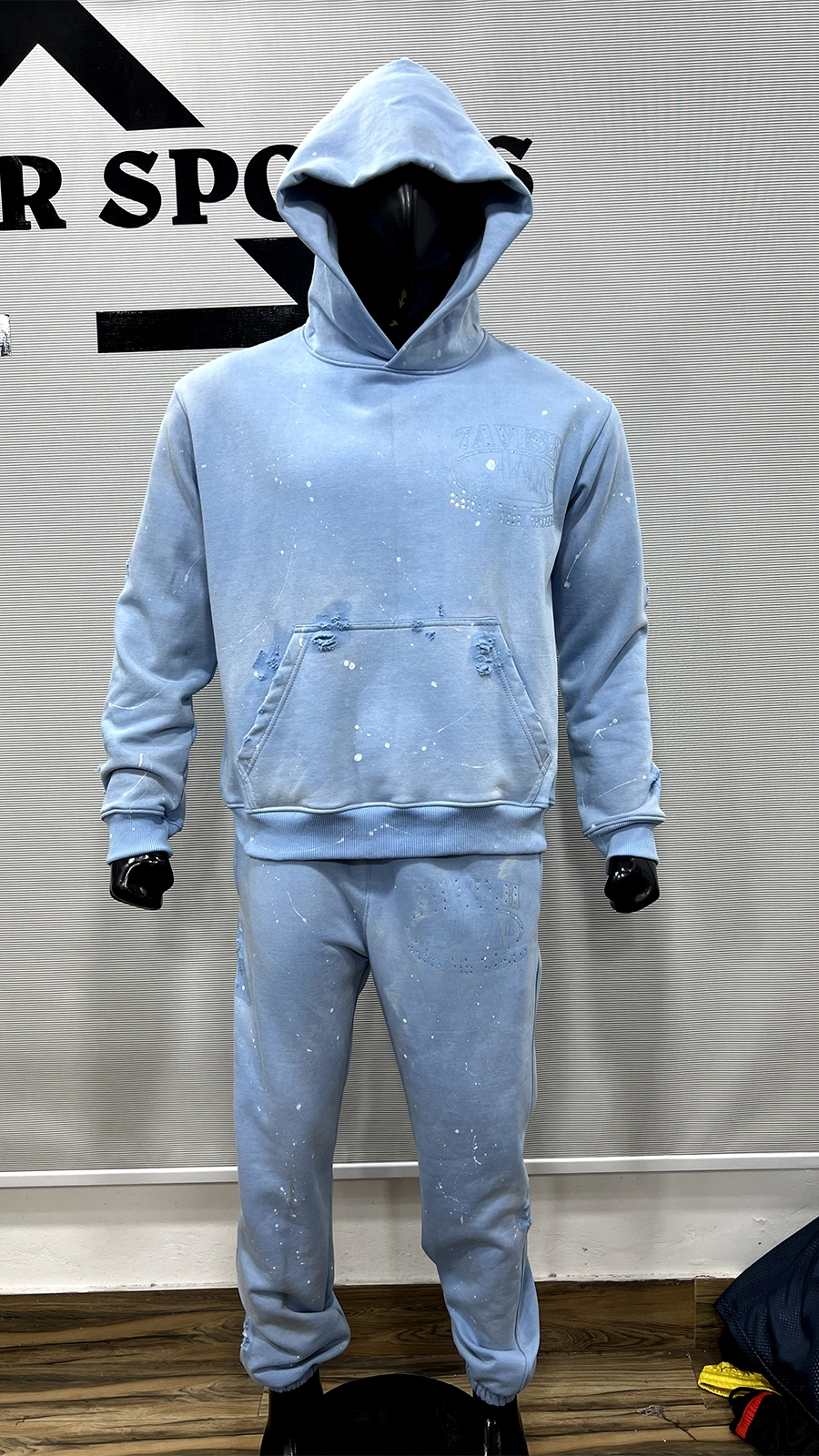
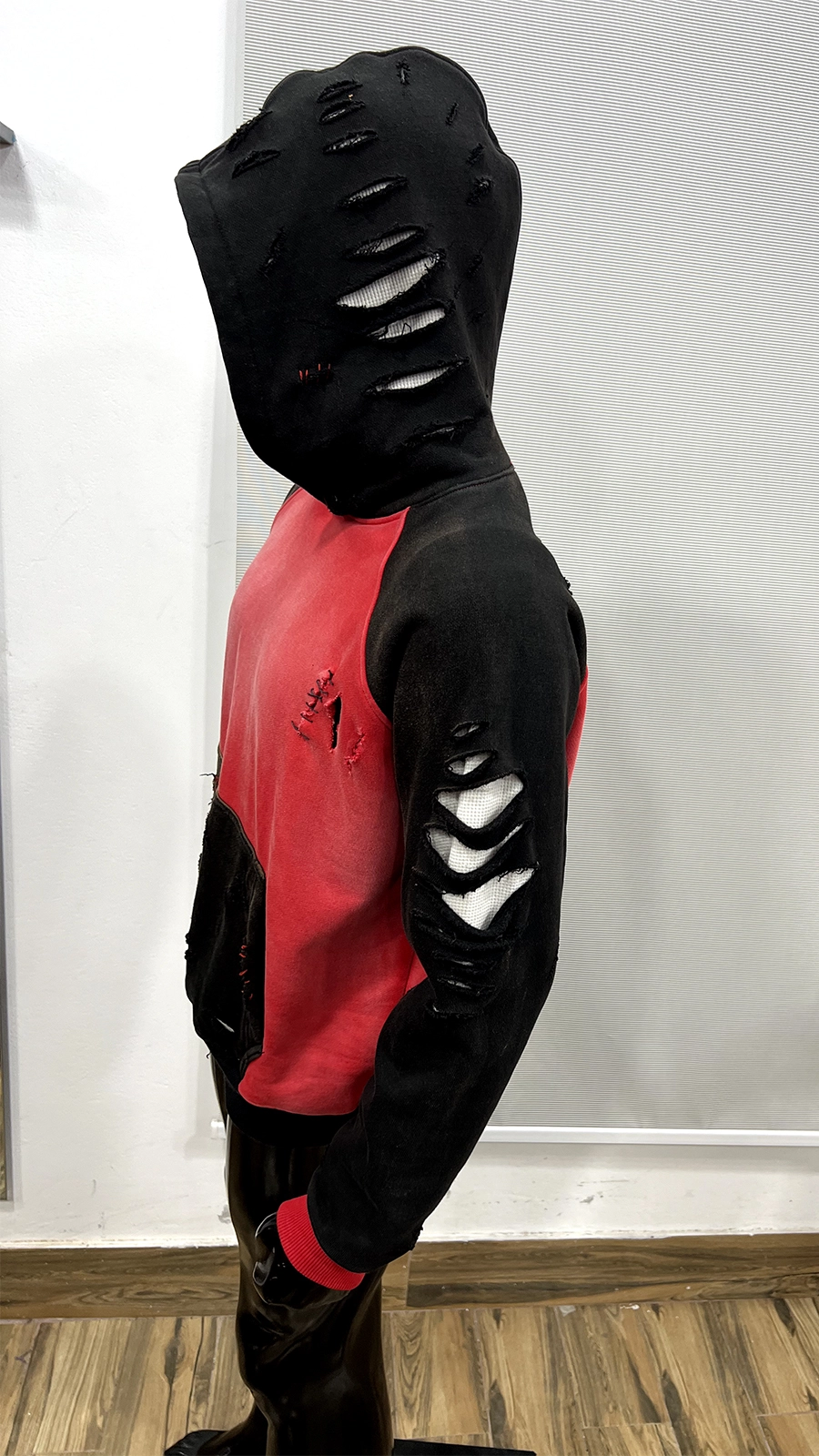
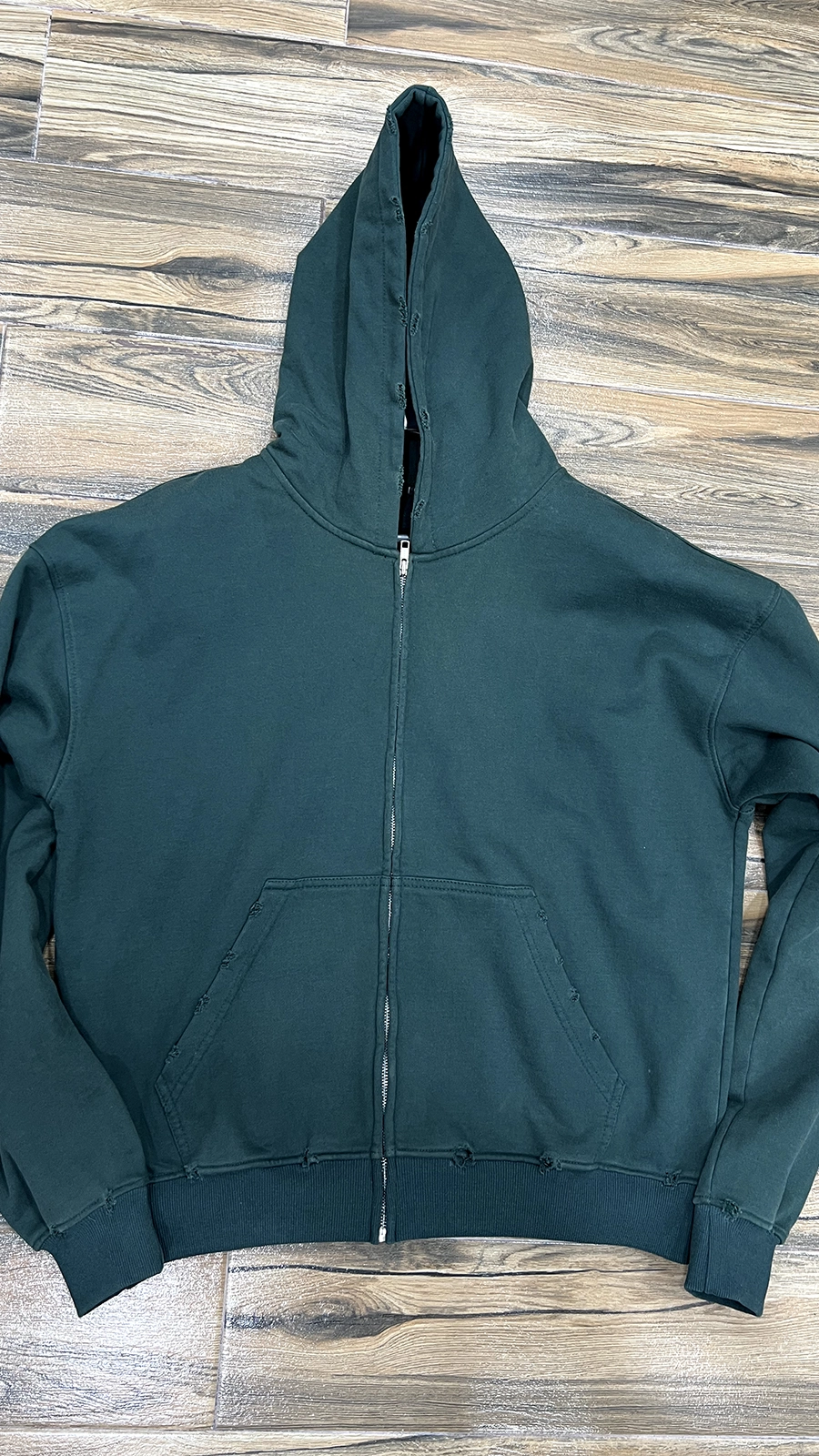
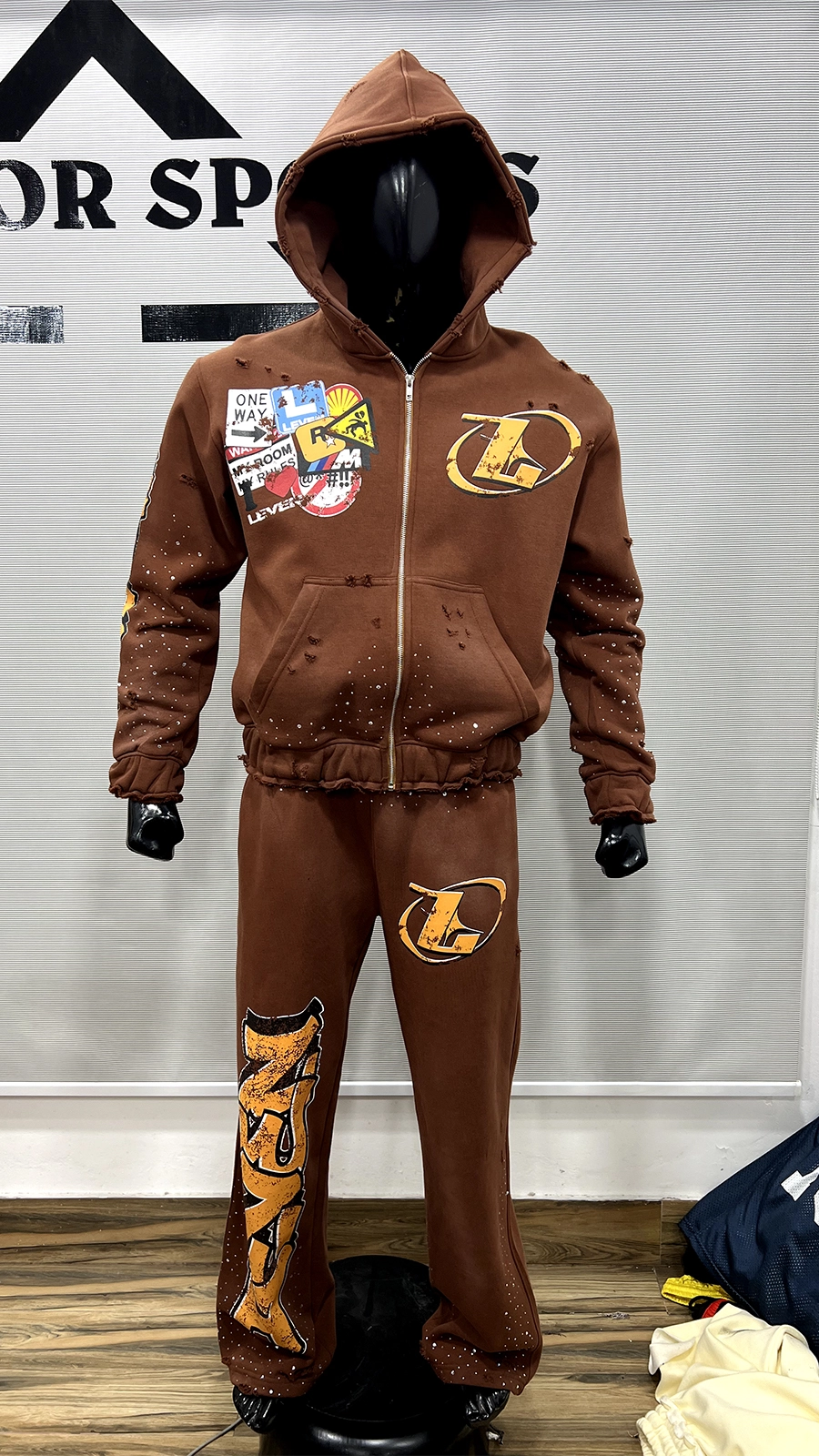
The pieces below are our own production samples, shot on the factory floor — not stock photos. Every order we run is fully custom to your spec, sizes, and branding.
01 — What Distressing Actually Involves — Sanding, Tears, and Holes
What a Distress Hoodie Manufacturer Actually Does to the Fabric
Distressing covers a few different techniques, and most real designs combine more than one. Sanding creates a thin, worn-through look at a specific spot without breaking the fabric entirely. Deliberate rips and tears open the fabric up further, and every one of ours gets reinforced with a small bar tack or catch-stitch at each end so the tear stops exactly where it’s meant to instead of running further with normal wear. Holes go a step past that, usually left with a raw or frayed edge on purpose. Whiskering — faint fade lines that mimic the creases a garment develops from years of wear — shows up less often on fleece than on denim, but we can apply it where it fits the design.
All of this happens after the garment is sewn, and it’s often finished with a wash cycle — stone wash or enzyme wash — that softens the edges of any rips or holes so they blend into the rest of the fabric instead of looking freshly cut.
02 — Fabric and Construction: Why Heavier GSM Distresses More Predictably
Fabric and Construction: Why Heavier GSM Distresses More Predictably
| Weight | GSM | Best For |
|---|---|---|
| Midweight fleece | 320–360 GSM | Light distressing — sanded spots, subtle wear |
| Heavyweight fleece | 380–450 GSM | Reinforced rips, deeper holes, heavier distress |
Heavier GSM holds a torn or frayed edge in a more predictable shape and doesn’t unravel as unpredictably as lighter fabric does. Lighter fleece distresses "faster," since there’s less fabric to sand or tear through, but that makes it genuinely harder to control cleanly — a light sanding pass that’s perfect on 380 GSM can go straight through to a hole on something lighter. For anything beyond a light, subtle sanded spot, we recommend staying toward the heavier end of the range.
03 — Placement and Spec Requirements for a Distress Order
Placement and Spec Requirements for a Distress Order
Distressing reads as authentic when it shows up where a garment would actually wear first — elbows, cuffs, hem edges, the front pocket area, occasionally a shoulder seam. Scattering rips and sanded spots randomly across a garment tends to look staged rather than lived-in, even though it’s obviously not a natural process either way.
One decision worth making upfront: do you want tight consistency across your run, with every piece distressed in the same places to the same intensity, or natural piece-to-piece variation, where no two hoodies are identical? Both are legitimate choices — some brands want the reassurance of consistency, others want the variation because it makes each piece feel genuinely one-of-one. Since there’s no artwork file for a distress spec the way there is for a print or embroidery job, send us reference photos marking the zones, tear direction and length, hole size, and sanding intensity you’re after, and we’ll build a repeatable spec from that — even a rough sketch or a handful of reference images from other pieces you like gets us most of the way there.
04 — What Separates Controlled Wear From an Uncontrolled Tear
What Separates Controlled Wear From an Uncontrolled Tear
Give any reinforced tear a gentle tug — it should hold firm at the reinforced ends without spreading further. That’s the single most important check on a distressed piece, since an unreinforced or poorly reinforced tear is a real defect waiting to get worse, not a stylistic choice.
Beyond that: check that sanded spots stopped at "thin" rather than accidentally going all the way through, unless a hole was specifically requested. Check frayed edges for loose threads that could keep catching and pulling with wear rather than staying where they’re meant to sit. And if you asked for consistency across the run, check that the distress pattern actually landed in the same places at a comparable intensity piece to piece — if you asked for natural variation instead, confirm it still reads as "worn," not just randomly damaged.
05 — MOQ and Sampling With Your Distress Hoodie Manufacturer
MOQ and Sampling With Your Distress Hoodie Manufacturer
MOQ is 50 pieces per style, split across whatever size run you need. Sampling takes 6–10 days, and the full cost is credited against your bulk order once you move forward.
Sampling matters as much for durability as it does for look here. Review the sample for both — does the distress placement and intensity match what you pictured, and does a reinforced tear actually hold up to a gentle tug test. Agreeing on both before bulk saves you from a 50-piece run where the look is right but the construction underneath it isn’t.
06 — What Actually Moves Your Price
What Actually Moves Your Price
Distressing is a manual or semi-manual step, so price scales mainly with the number of distress points and how complex each one is — a single sanded cuff costs a lot less than multiple reinforced rips plus deliberate holes across the same garment. Combining distress with a full wash treatment adds another production step on top of that, along with the usual factors of fabric GSM and total order volume.
We don’t publish flat pricing because those variables interact too much to be useful as a single number. Run your spec through our Instant Quote tool instead — it gives you a price estimate in 5 seconds, a downloadable PDF quote, and a direct line to WhatsApp with your quote pre-filled. Final pricing is confirmed by our team within 24 hours.
07 — Shipping to the UK and EU Duty-Free
Shipping to the UK and EU Duty-Free
Manufacturing in Pakistan carries a trade advantage worth factoring into your landed cost. Apparel made here enters the UK at 0% duty under the Developing Countries Trading Scheme, and the EU at 0% duty under GSP+, versus roughly 12% on equivalent goods sourced from China.
Details on eligibility and the current tariff schedule are on the UK government’s own guidance page: Developing Countries Trading Scheme (DCTS) — GOV.UK.
08 — When Distress Isn't the Right Call
When Distress Isn’t the Right Call
Distress isn’t the right call for activewear or performance pieces, where deliberate thin spots and holes work directly against what customers expect from athletic gear, or for budget-conscious high-volume basics, since the manual labor involved adds real cost per unit. If what you actually want is a faded, worn-in look without structural rips or holes — something that still feels durable — our Acid Washed Hoodie page delivers that vintage color and texture without the tear-and-hole tradeoffs.
Table of Contents
Simple Process
From Spec to Shipped, in Four Steps
01
Quote & Spec
Run your GSM, distress zones, and intensity through the Instant Quote tool; get a price estimate and a downloadable PDF in 5 seconds.
02
Sample
We sand, tear, and reinforce a physical sample in 6–10 days; you can join a live video call from the floor before it ships.
03
Approve & Bulk
Approve the sample (its cost is credited to your order) and we run your full size and quantity — production takes 12–15 days.
04
Ship
Finished hoodies go out via DHL/FedEx air (3–7 days) or sea freight for larger volumes, landing duty-free in the UK and EU.
Our Advantage
Why Brands Choose Malinor
Floor Video Call Before You Pay Anything
See your actual distress run in production, not a stock photo, before you commit to bulk.
Sample Cost Credited in Full
Nothing you spend on sampling is wasted once you move to bulk.
In-House Sanding, Distressing, and Reinforcement
No subcontracting a decoration step to a third shop, so your timeline doesn’t depend on someone else’s queue.
Fast, Direct Replies
Most quote and spec questions get answered within 2 hours during business hours.
Common Questions
Frequently Asked Questions
How do you keep a deliberate rip from tearing further?+
Every tear gets a small bar tack or catch-stitch at each end before the garment ships. That reinforcement is what stops the tear at the intended point instead of letting it spread further with normal wear or washing — without it, a "styled" rip is really just an unfinished construction defect waiting to get worse.
Where do you place distressing so it looks natural, not random?+
At real wear zones — elbows, cuffs, hem edges, the front pocket area, occasionally a shoulder seam. Those are the places a garment would actually show wear first over years of use, and distressing concentrated there reads as authentic in a way that rips scattered randomly across the body don’t.
Can I get consistent distressing across 50 pieces, or will each one look different?+
Either, depending on what you want — both are legitimate choices. We can build a repeatable spec so every piece shows wear in the same places at the same intensity, or we can distress with intentional natural variation so no two pieces are identical. Tell us upfront which you’re after, since it changes how we approach the run.
Are distressed holes actually holes, or just thin sanded spots?+
Both exist as separate options. Sanding creates a thin, worn-through look without fully breaking the fabric. A true hole goes further, usually finished with a raw or frayed edge. Specify which you want per placement — a design might mix light sanding at the cuffs with an actual hole at the elbow, for example.
What’s the minimum order quantity?+
50 pieces per style, with sizes split however your size run needs — you’re not locked into 50 of one size. A distressed hoodie and an acid-washed hoodie in the same order each need their own 50-piece minimum, since they’re different styles.
How long does shipping take?+
DHL or FedEx air freight takes 3–7 days worldwide once your order is finished. For larger volumes, sea freight is available at a lower cost per unit but a longer transit time — we’ll walk you through both options once your bulk order is confirmed.
Run Your Spec Through the Instant Quote Tool
Get a price estimate in 5 seconds, a downloadable PDF, and a straight line to WhatsApp with your quote pre-filled. Before you pay anything, we’ll get you on a live video call from the production floor.