DTG Printing Sweat Suits Manufacturer
DTG Printing Sweat Suits Manufacturer Where the Top and Bottom Play by Different Rules
As a DTG printing sweat suits manufacturer based in Sialkot, Pakistan, we’ll tell you plainly that the top piece can carry almost any coverage you want while the sweatpants leg is genuinely capped by our platen’s reach — an asymmetry worth knowing before you design a set. MOQ starts at 50 complete sets with sizes split however you need, your sample takes 6–10 days and its full cost is credited against the bulk order, and production runs 12–15 days once you approve it.
The pieces below are our own production samples, shot on the factory floor — not stock photos. Every order we run is fully custom to your spec, sizes, and branding.
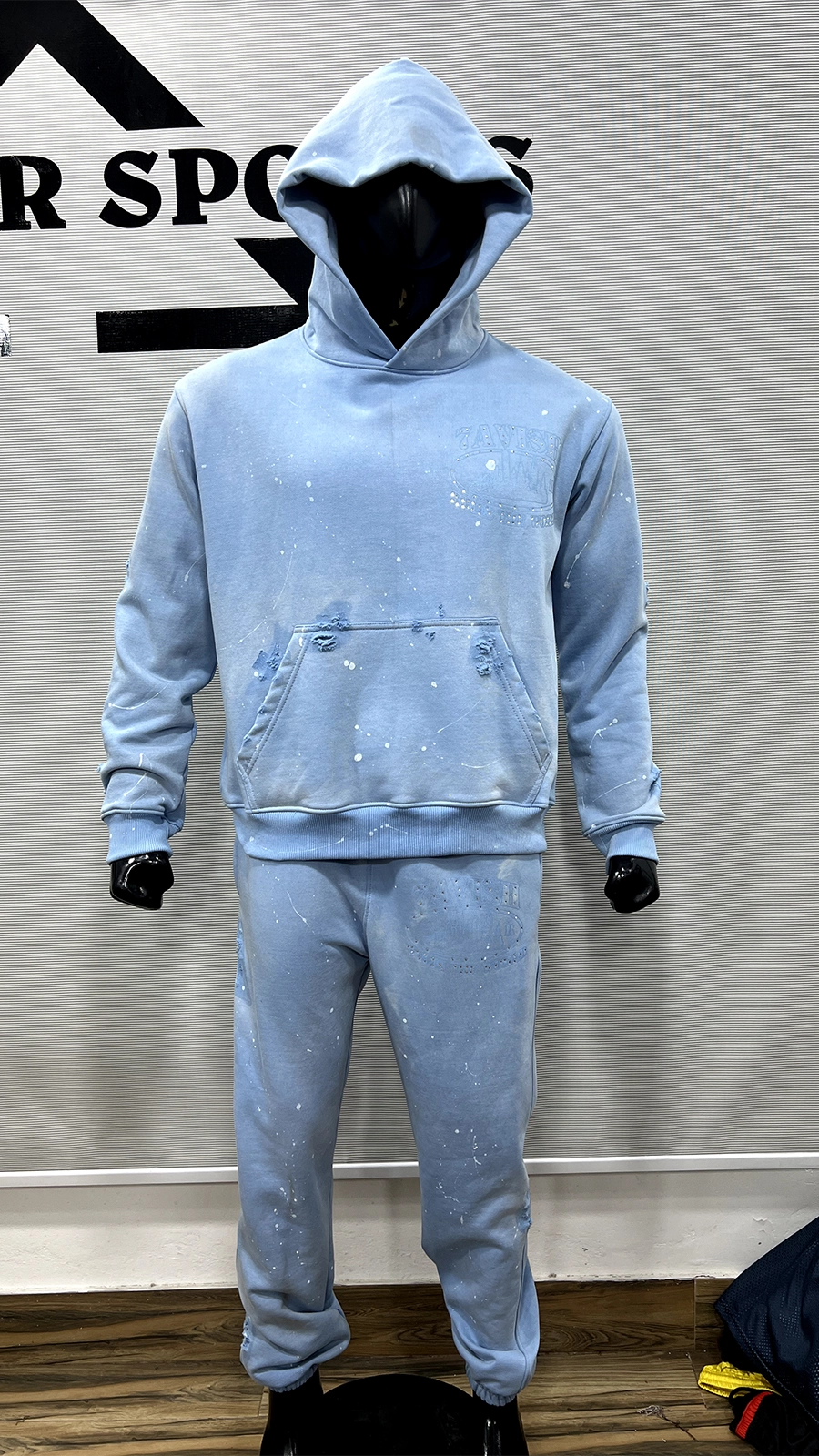
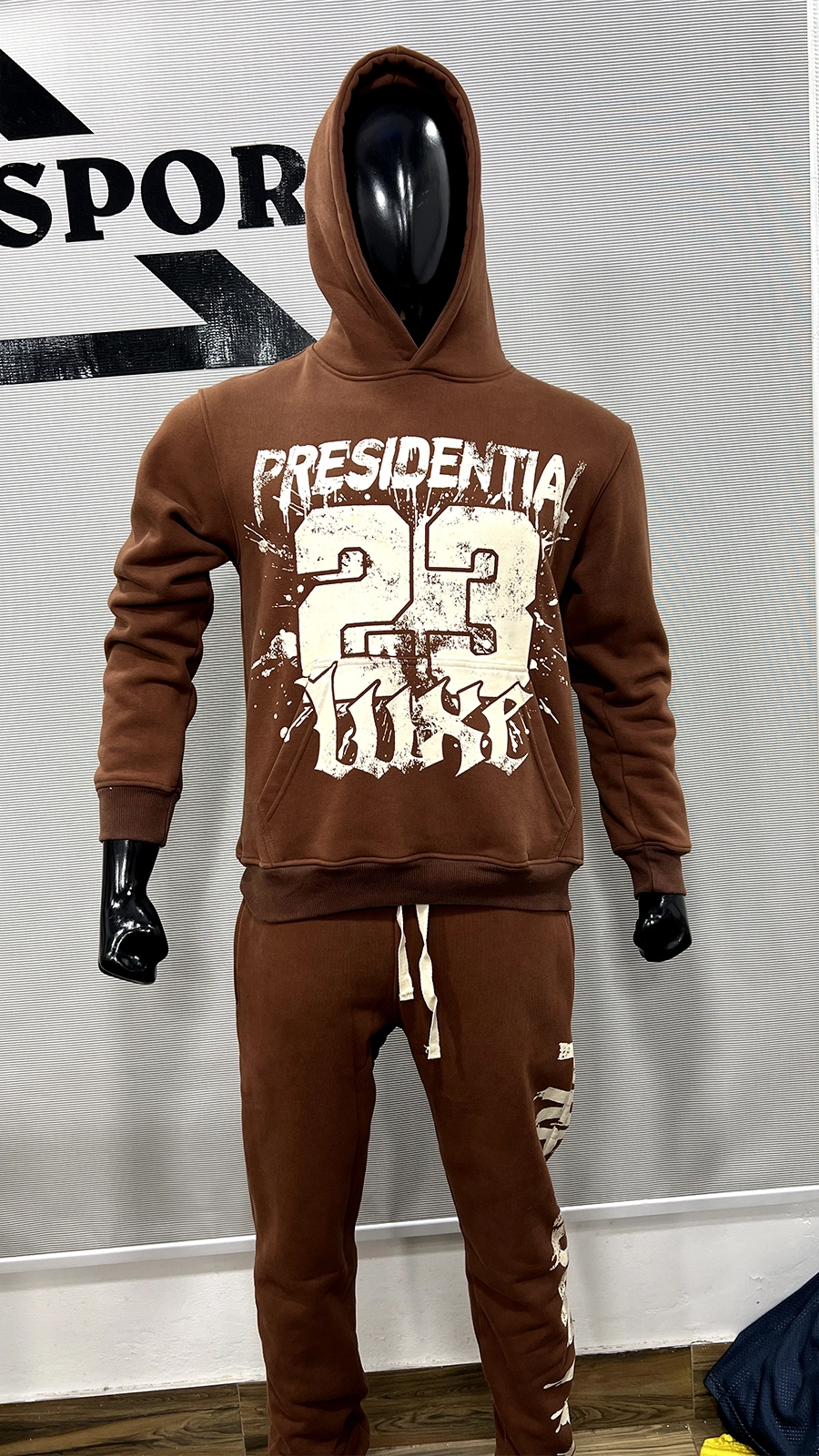
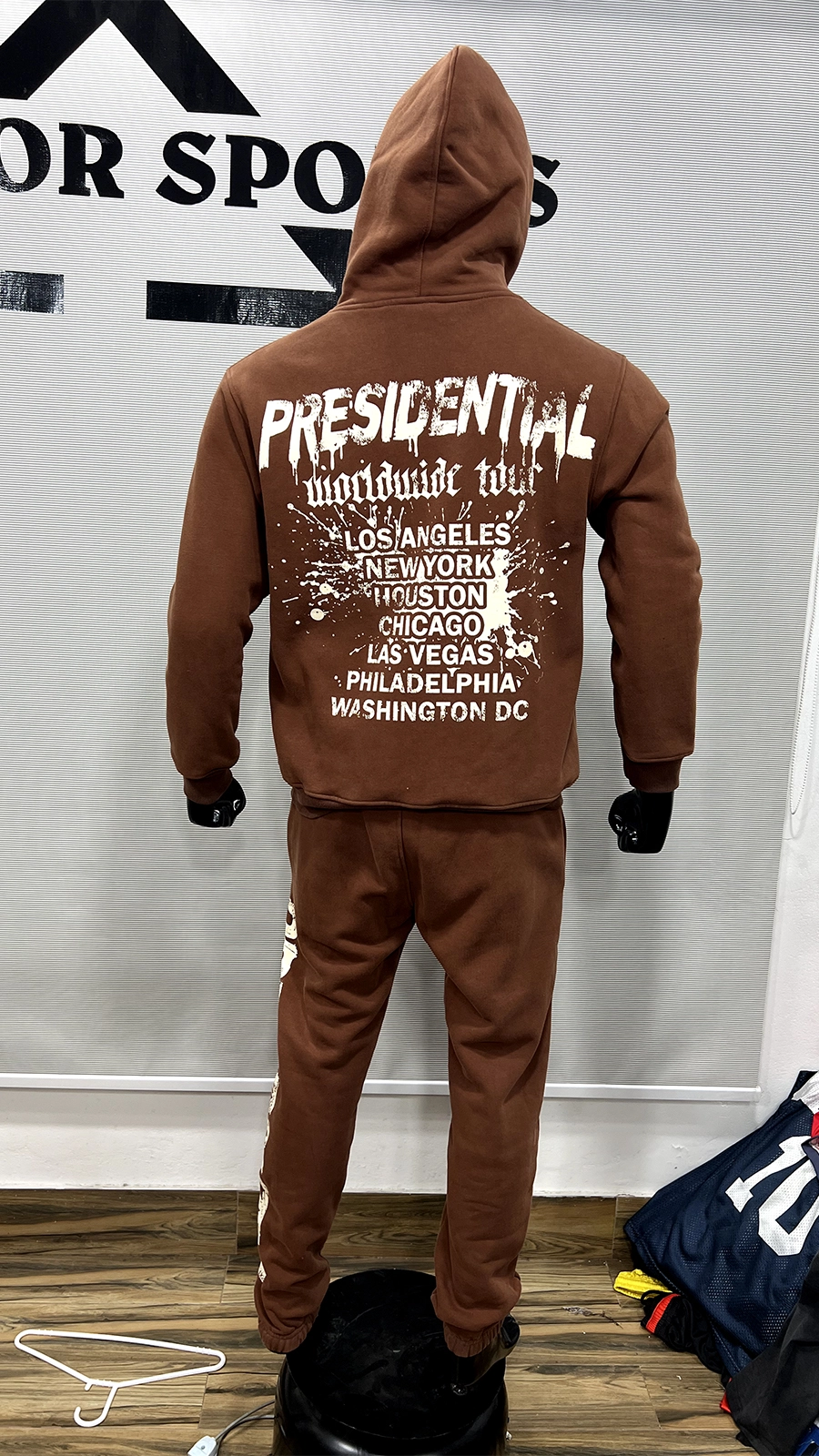
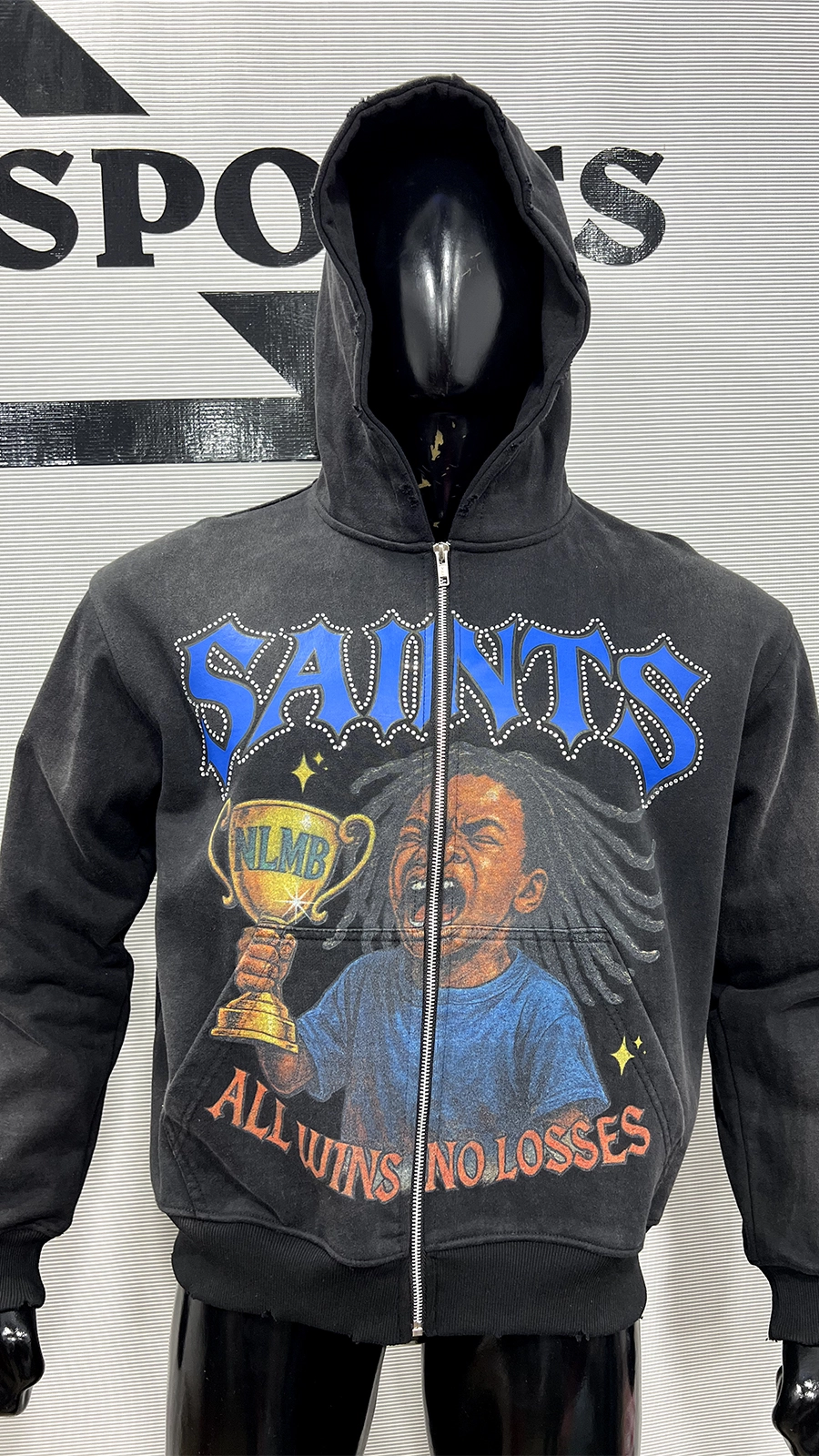
01 — Why the Top and Bottom Play by Different Rules Here
What a DTG Printing Sweat Suits Manufacturer Can and Can’t Promise
Our embroidery and screen printing sweat suits pages both cover how a matched set combines two genuinely different jobs. DTG has its own version of that split, and it’s worth being upfront about it since it’s a real constraint rather than a minor detail: the top piece is flat, and our platen — roughly 40x50cm — handles it without any real size ceiling, the same freedom we cover on our DTG hoodie page. The bottom piece is a full sweatpants leg, which exceeds that platen’s reach, the limitation we cover in detail on our DTG sweat pants page.
That’s a real asymmetry worth understanding before you design a set. Unlike our DTG sweat shorts page, where the shorter leg actually fits within the platen and near-full coverage becomes practical, a full-length sweatpant in a suit keeps that constraint fully in play. If your vision is a bold, large-format graphic across both pieces equally, DTG genuinely can’t deliver that ambition on the bottom the way it can on the top — that’s worth knowing upfront rather than discovering after a design’s been finalized around an assumption that doesn’t hold on both garments.
We’d rather flag this at the quoting stage than let a buyer design a matched concept assuming symmetry that isn’t there. If large coverage on the sweatpants specifically matters to your product, it’s worth having that conversation with us before finalizing artwork — we can suggest realistic placement options for the bottom piece, or point you toward a technique better suited to that ambition.
02 — Fabric and Construction: One Consistent Cotton Requirement Across Both Pieces
Fabric and Construction: One Consistent Cotton Requirement Across Both Pieces
| Fabric | Cotton Content | DTG Result Across the Set |
|---|---|---|
| Cotton-rich fleece | High | Vivid, well-bonded print on both pieces |
| Cotton/poly blend | Medium-low | Weaker, less vibrant on both pieces |
| Heavy poly-blend | Low | Not recommended |
The same fabric advantage we cover on our embroidery and screen printing sweat suits pages applies here too — a hoodie-and-sweatpants set shares one consistent fabric weight range without the calibration mismatch our shorts pages describe. Cotton content matters equally on both pieces for DTG specifically, since the ink needs cotton fiber to bond into regardless of which garment it’s landing on — confirm fabric composition for the whole set, not just the top.
Curing standards need to stay consistent between both pieces too, even though the placements differ in size — the same temperature and dwell time principles apply whether we’re curing a large chest graphic or a compact hip logo, and we calibrate both runs to the same underlying standard rather than treating the smaller placement as a lower-stakes step.
03 — Placement, the Platen Ceiling on Sweatpants, and File Requirements
Placement, the Platen Ceiling on Sweatpants, and File Requirements
On the top, coverage is genuinely flexible — a small logo, a large chest graphic, even a design that spans most of the front panel, all within our platen’s single-pass reach. On the sweatpants, plan for a contained placement instead: a hip or thigh logo, similar in scale to what we cover on our DTG sweat pants page, rather than assuming the leg can carry the same scale of design the top can.
Because these two pieces genuinely operate under different size ceilings, it’s worth designing the set with that asymmetry in mind from the start — a bold top paired with a smaller, complementary bottom mark tends to read more intentionally than a design that was clearly meant to be equally large on both pieces and had to be scaled down on one of them. Pretreatment and color calibration need to match between the two separate print runs, the same coordination concern we cover on our screen printing sweat suits page, just applied to DTG’s process instead.
Send us high-resolution artwork at 300dpi minimum at actual print size for both pieces, and be specific about the intended scale for each — the top’s file should reflect the larger canvas it can realistically use, and the bottom’s file should be built for the more contained placement from the outset rather than a shrunk-down version of the top’s design.
04 — What Separates a Set That Prints Consistently From One That Doesn’t
What Separates a Set That Prints Consistently From One That Doesn’t
Check color vibrancy on both pieces individually first, the same standard as any DTG job — a properly pretreated, well-cured print looks saturated and true to the file on whichever garment it’s printed on. Feel the print on both pieces too, confirming it stays soft and flexible with no stiff or plasticky texture.
Then check the set together, under the same light. Since the top and bottom are separate print runs with genuinely different placement scales, color consistency between them is worth confirming specifically rather than assuming it carries over automatically just because both pieces came from the same production batch.
Check edge sharpness on the bottom placement especially closely, given how compact it is relative to the top graphic — a small logo has less room to absorb a slightly soft edge than a large chest design does, so a print quality issue that might read as minor on the top can be more noticeable on the more contained bottom placement.
05 — MOQ and Sampling: What to Expect
MOQ and Sampling With Your DTG Printing Sweat Suits Manufacturer
MOQ is 50 complete sets per style — 50 tops and 50 matching bottoms, split across whatever size run you need. Sampling takes 6–10 days, and the full cost is credited against your bulk order once you move forward.
Sample both pieces together, the same principle we cover on our other sweat suits pages. Given the genuine size difference between what’s achievable on each piece, it’s also worth confirming during sampling that the smaller bottom placement still reads as intentional and coordinated next to the larger top graphic, rather than looking like an afterthought.
If this is your first matched set and you’re not sure how a smaller bottom placement will actually look next to a bold top graphic, ask us to send photos of the sample laid out together or worn, rather than judging each piece from a flat product shot alone. The relative scale between the two pieces reads very differently in context than it does when each is photographed in isolation.
06 — What Actually Moves Your Price
What Actually Moves Your Price
Pricing on the top scales with coverage extent, the same as any DTG job on a flat panel — bigger designs cost more, but there’s no platen-imposed ceiling stopping you from going as large as your budget allows. Pricing on the bottom is naturally capped by the placement size the platen can actually reach, so cost there tracks more closely with design complexity than with any ambition toward larger coverage.
Worth being clear about, since it affects how you’d budget a matched set: you can’t spend your way past the platen ceiling on the sweatpants leg the way you sometimes can with other cost constraints. A bigger budget gets you more detail or more color complexity within that fixed placement size, not a larger placement — that’s a hard equipment limit, not a pricing tier.
We don’t publish flat pricing because those variables interact too much to be useful as a single number. Run your spec through our Instant Quote tool instead — it gives you a price estimate in 5 seconds, a downloadable PDF quote, and a direct line to WhatsApp with your quote pre-filled. Final pricing is confirmed by our team within 24 hours.
07 — Shipping to the UK and EU Duty-Free
Shipping to the UK and EU Duty-Free
Manufacturing in Pakistan carries a trade advantage worth factoring into your landed cost. Apparel made here enters the UK at 0% duty under the Developing Countries Trading Scheme, and the EU at 0% duty under GSP+, versus roughly 12% on equivalent goods sourced from China.
Details on eligibility and the current tariff schedule are on the UK government’s own guidance page: Developing Countries Trading Scheme (DCTS) — GOV.UK. This matters on a matched set order too, since landed cost applies across both pieces of the set rather than a single garment.
08 — When DTG Isn’t the Right Call
When DTG Isn’t the Right Call
DTG isn’t the right call if you want equally bold, large-format coverage on both the top and the bottom — the platen ceiling on the sweatpants leg makes that genuinely impractical here, unlike on our Screen Printing Sweat Suits page, where large coverage stays economical on both pieces. It’s also not the right choice for a poly-heavy fabric, on either garment.
If you’re deciding between the two techniques for a matched set, ask yourself whether both pieces genuinely need equal visual weight. If the top is meant to carry the bolder statement and the bottom just needs a smaller coordinating mark, DTG works well as-is; if you want both pieces to feel equally dominant, screen printing is the more realistic path to that specific goal.
Table of Contents
Simple Process
From Spec to Shipped, in Four Steps
01
Quote & Spec
Run your fabric composition and coverage plans for both pieces through the Instant Quote tool; get a price estimate and a downloadable PDF in 5 seconds.
02
Sample
We pretreat and print both pieces as a matched sample in 6–10 days; you can join a live video call from the floor before it ships.
03
Approve & Bulk
Approve the sample (its cost is credited to your order) and we run your full size and quantity — production takes 12–15 days.
04
Ship
Finished sets go out via DHL/FedEx air (3–7 days) or sea freight for larger volumes, landing duty-free in the UK and EU.
Our Advantage
Why Brands Choose Malinor
Floor Video Call Before You Pay Anything
See your actual matched set in production, not a stock photo, before you commit to bulk.
Sample Cost Credited in Full
Nothing you spend on sampling is wasted once you move to bulk.
In-House Pretreatment and Printing for Both Pieces
No subcontracting a decoration step to a third shop, so your timeline doesn’t depend on someone else’s queue.
Fast, Direct Replies
Most quote and spec questions get answered within 2 hours during business hours.
Common Questions
Frequently Asked Questions
Can DTG cover the whole sweatpants leg the way it covers the top?+
No, and it’s worth knowing this upfront. Our platen reaches roughly 40x50cm in a single pass, which the top’s flat panel fits within easily but a full sweatpants leg exceeds. The top can carry near-full coverage; the bottom is genuinely limited to a contained placement like a hip or thigh logo.
Why is there a size limit on the bottom piece but not the top?+
It comes down to garment geometry against our equipment. The top is a flat surface that fits inside the platen’s reach regardless of design size. The sweatpants leg is a long, curved tube that runs longer than the platen can cover in one pass, which caps how much of it we can print at once.
Does the platen limit apply differently on a sweat suit’s sweatpants vs standalone sweatpants?+
No — the constraint is identical either way, since it’s driven by the garment’s own dimensions, not by whether it’s part of a set. If you’ve read our standalone DTG sweat pants page, the same placement guidance applies directly to the bottom half of a sweat suit.
Can DTG color match precisely between the two pieces?+
Yes, with proper calibration — but it’s worth confirming specifically, since the top and bottom are genuinely separate print runs even within the same order. We check color consistency between both pieces on the sample under the same light before approving for bulk.
What’s the minimum order quantity?+
50 complete sets per style, with sizes split however your size run needs. A DTG-printed sweat suit and a screen-printed sweat suit in the same order each need their own 50-set minimum, since they’re different styles.
How long does shipping take?+
DHL or FedEx air freight takes 3–7 days worldwide once your order is finished. For larger volumes, sea freight is available at a lower cost per unit but a longer transit time — we’ll walk you through both options once your bulk order is confirmed.
Run Your Spec Through the Instant Quote Tool
Get a price estimate in 5 seconds, a downloadable PDF, and a straight line to WhatsApp with your quote pre-filled. Before you pay anything, we’ll get you on a live video call from the production floor.