DTG Printing Sweat Shorts Manufacturer
DTG Printing Sweat Shorts Manufacturer Where the Platen Limit Basically Disappears
As a DTG printing sweat shorts manufacturer based in Sialkot, Pakistan, we can put a detailed, full-color design across nearly the whole leg here — the platen-size limit that restricts DTG to small placements on sweatpants simply doesn’t apply once the leg itself is short enough to fit in one pass. MOQ starts at 50 pieces per style with sizes split however you need, your sample takes 6–10 days and its full cost is credited against the bulk order, and production runs 12–15 days once you approve it.
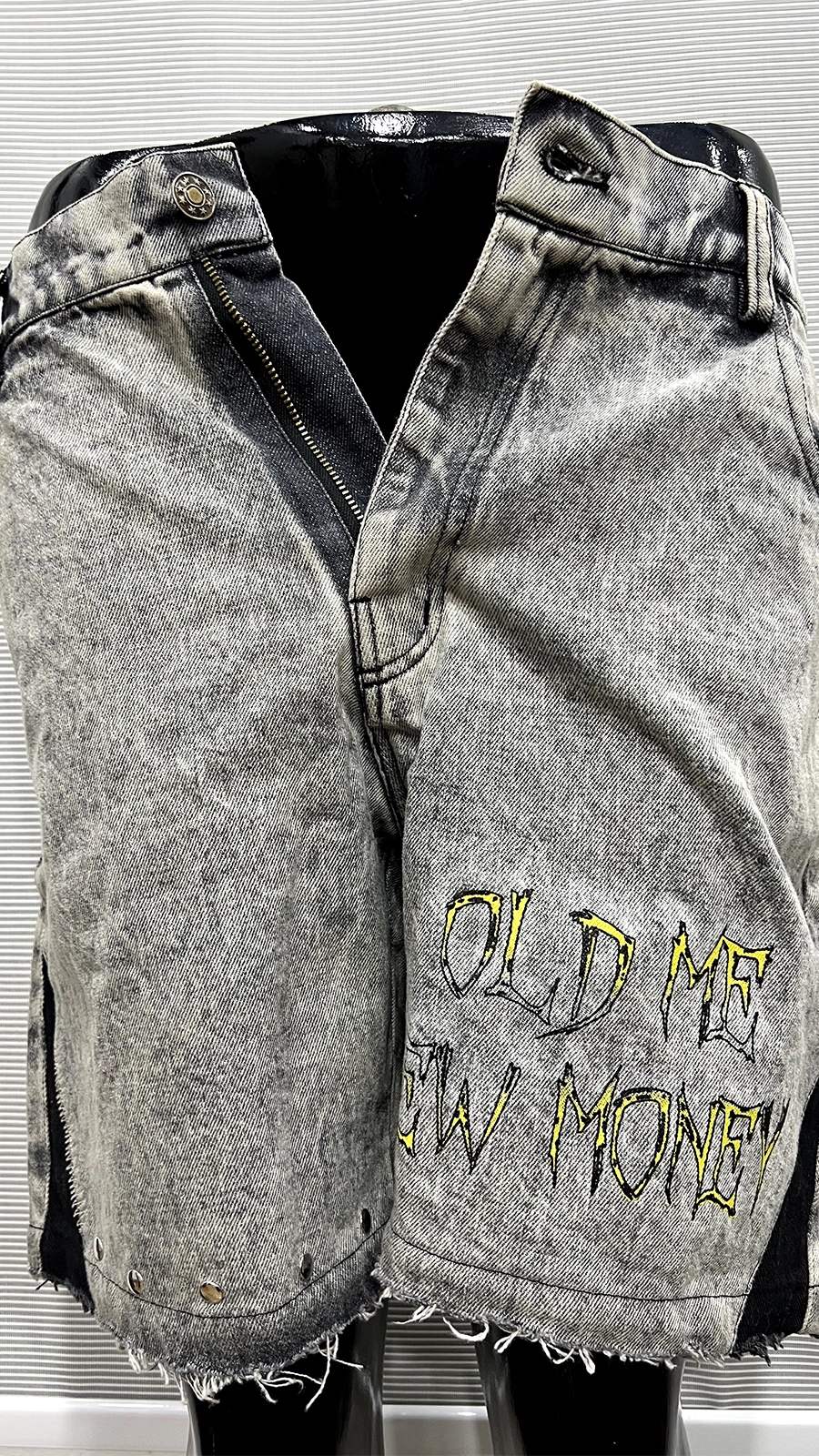
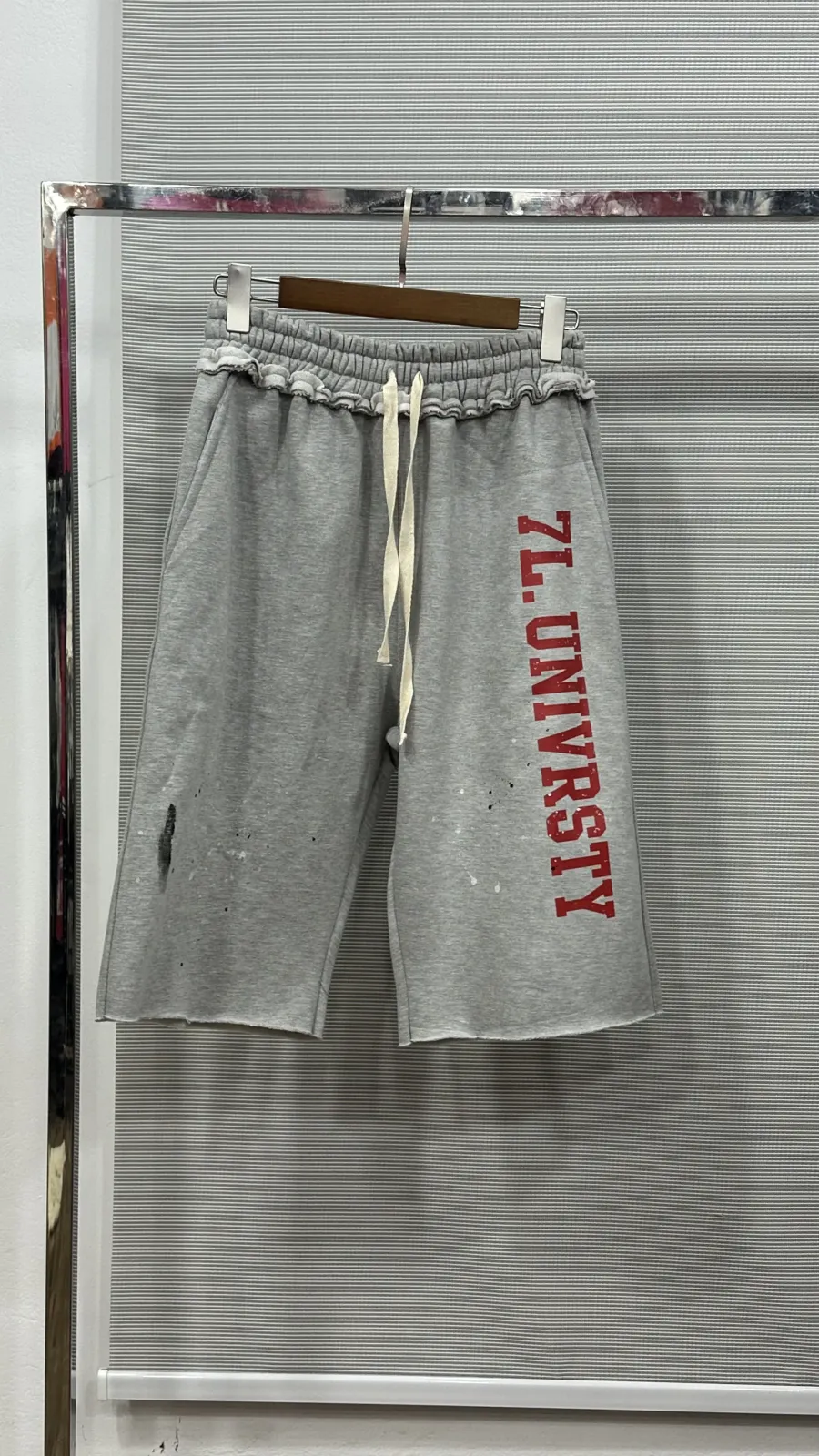
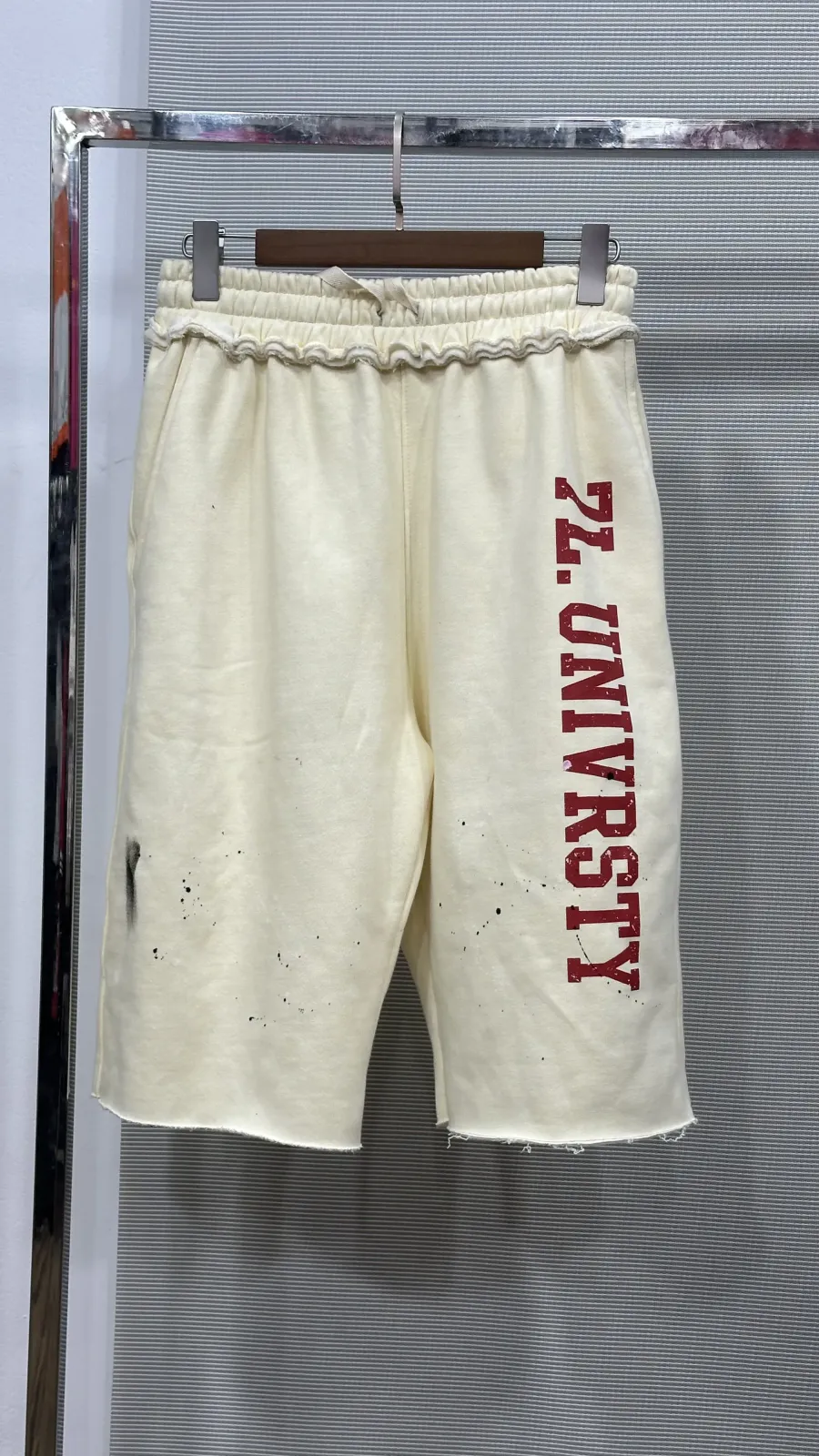
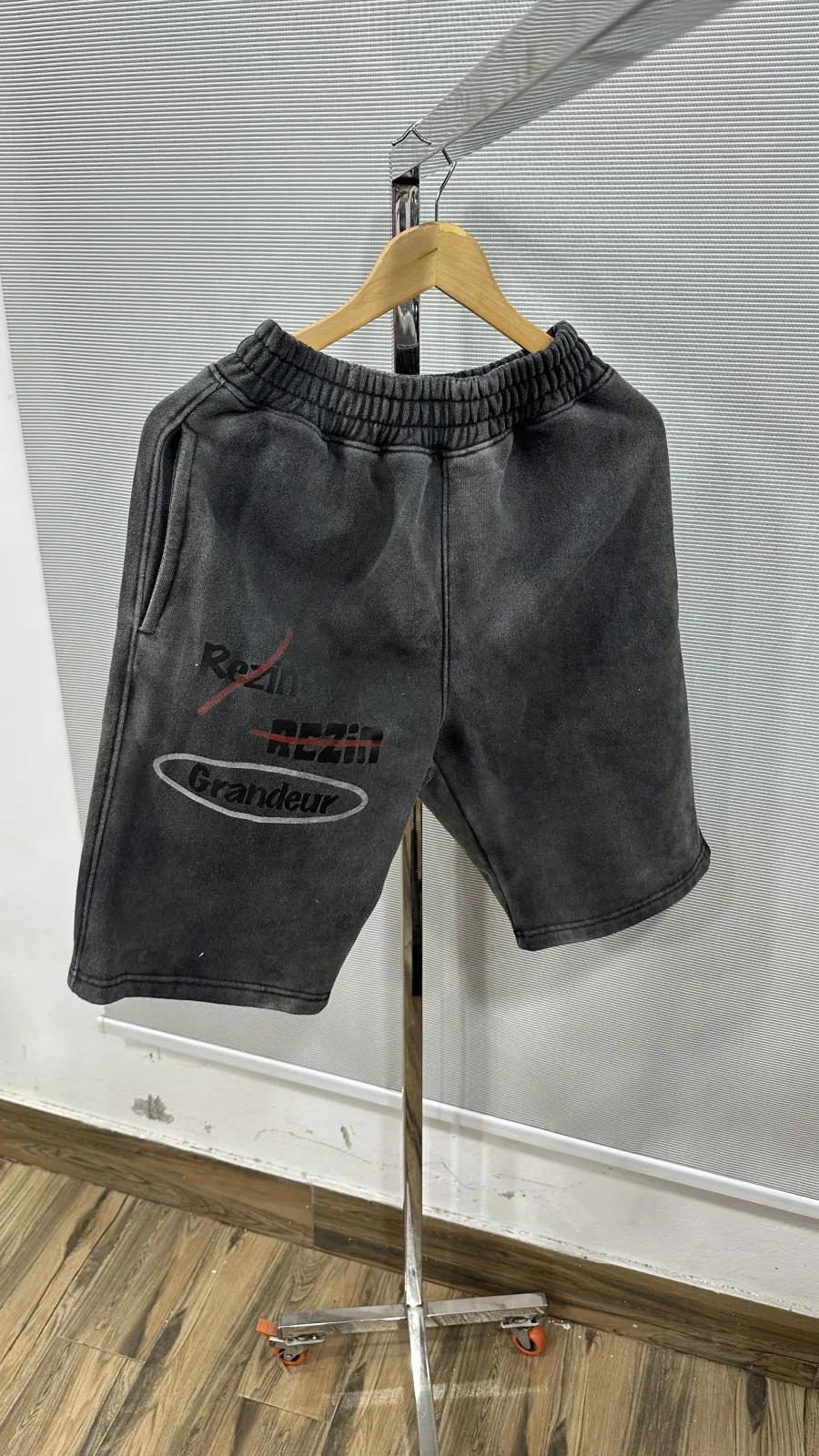
The pieces below are our own production samples, shot on the factory floor — not stock photos. Every order we run is fully custom to your spec, sizes, and branding.
01 — Why the Platen Limit That Constrains Sweatpants Basically Disappears Here
What a DTG Printing Sweat Shorts Manufacturer Can Cover That Sweatpants Can’t
Our DTG printing sweat pants page is upfront about a real constraint: our printer’s platen tops out around 40x50cm per pass, and a full sweatpant leg runs longer than that reach, which limits DTG on that garment to small, localized placements. Sweat shorts change that equation entirely. A 5- to 9-inch inseam leg fits comfortably within the platen’s single-pass reach, which means DTG can cover nearly the whole leg here in a way it simply cannot on a full-length sweatpant.
That’s worth knowing if you’ve read our sweatpants DTG page and assumed the same coverage limit carries over. It doesn’t. A detailed, full-color, photographic-style design that we’d redirect to screen printing on sweatpants is genuinely practical with DTG on shorts, precisely because the garment itself is short enough to work within our equipment’s real constraints rather than up against them.
Worth being precise about the boundary here too — “fits within the platen” means the leg panel itself, not necessarily including the waistband and every seam allowance depending on your exact inseam and rise. For most standard shorts inseams, the working leg area comes in comfortably under our platen’s reach, but if you’re at the longer end of what we’d still call “shorts” — closer to our Long Short category — it’s worth confirming coverage specifically rather than assuming the same freedom automatically extends.
02 — Fabric and Construction: Cotton Content and a Slightly Lighter Cure
Fabric and Construction: Cotton Content and a Slightly Lighter Cure
| Fabric | Cotton Content | DTG Result on Sweat Shorts |
|---|---|---|
| Cotton-rich fleece | High | Vivid, well-bonded print |
| Cotton/poly performance blend | Medium-low | Weaker, less vibrant — common in athletic gym shorts |
| Heavy poly-blend fleece | Low | Not recommended |
The same cotton-content principle applies here as on any DTG job — the ink needs cotton fiber to bond into. It’s worth flagging with extra emphasis on this specific garment: gym and athletic shorts are one of the most common places you’ll find a genuine poly-blend fabric, chosen specifically for moisture management during exercise. If your shorts lean toward performance use, confirm the actual fabric composition before committing to DTG, since that’s the single most likely reason a sample would disappoint here.
Curing calibration shifts slightly compared to sweatpants too — shorts commonly run a lighter GSM, so cure time and temperature need adjusting for a thinner fabric rather than assuming the same settings that work for heavier sweatpants fleece apply directly.
Pretreatment evenness matters more here in a specific way: since near-full-leg coverage is genuinely achievable on shorts, a larger share of the garment is at stake if pretreatment application isn’t consistent across the whole panel. On sweatpants, a small placement means an uneven spray affects a small area; on a fully covered shorts leg, the same inconsistency shows up across much more of the visible garment.
03 — Placement, Near-Full Coverage, and File Requirements
Placement, Near-Full Coverage, and File Requirements
Because the whole leg fits within our platen’s reach, a standard flat platen handles shorts designs at a scale that simply isn’t possible on sweatpants — from a small hip logo up through a design that covers most of the visible leg. This is the one DTG page in our lineup where “how much coverage can you actually give me” gets a genuinely different answer than on the full-length garment.
If your shorts include a side slit or a mesh liner, plan ink placement to stay clear of both, the same consideration we cover on our embroidery and screen printing sweat shorts pages. Send us high-resolution artwork at 300dpi minimum at actual print size, and mark placement relative to the waistband, side seam, and any slit or liner attachment point.
Since near-full-leg coverage is realistic here, it’s worth thinking about your design as covering a specific panel shape — tapered, curved at the hip, bounded by the waistband above and the hem below — rather than as a flat rectangle you’re placing somewhere on the garment. A file built with that panel shape in mind from the start translates more cleanly than one designed as a generic rectangle and then fitted to the shorts afterward.
04 — What Separates a Sharp DTG Short From a Faded or Stiff One
What Separates a Sharp DTG Short From a Faded or Stiff One
Color vibrancy is the first check, the same as on any DTG job — a properly pretreated, well-cured print looks saturated and true to the file. If a sample looks washed-out, that usually traces back to cotton content or uneven pretreatment on the curved hip area rather than the printer itself.
Feel the print — it should stay soft and flexible, particularly important if these are athletic shorts where breathability matters. Check that any placement near a side slit or liner hasn’t affected how either functions. And run a wash test, since shorts built for athletic use tend to see frequent, less delicate washing — a properly cured print should hold its color and edge sharpness through that.
If your design covers a large share of the leg, check edge sharpness at the outer boundaries of the print specifically, not just the center — a large-coverage print occasionally shows slightly softer edges at its perimeter than a small, contained logo does, and that’s worth catching on the sample before it’s committed to a full production run.
05 — MOQ and Sampling: What to Expect
MOQ and Sampling With Your DTG Printing Sweat Shorts Manufacturer
MOQ is 50 pieces per style, split across whatever size run you need. Sampling takes 6–10 days, and the full cost is credited against your bulk order once you move forward.
Confirm your fabric composition before sampling, especially if there’s any chance your shorts use a performance poly-blend — it’s the single most common reason a DTG sample disappoints on this garment specifically, more so than on a cotton-leaning fashion sweatpant. If your design approaches near-full-leg coverage, check the sample across the whole printed area rather than just the center, since pretreatment evenness matters more the larger the coverage gets.
If this is your first time ordering large-coverage DTG on shorts, it’s worth asking us to walk through the pretreatment process specifically, since it’s the step most responsible for how even the finished color reads across a bigger printed area. Seeing how it’s applied gives you a clearer sense of what to expect from the finished piece than the sample alone.
06 — What Actually Moves Your Price
What Actually Moves Your Price
Because coverage isn’t capped the way it is on sweatpants, price here scales more directly with how much of the leg you’re actually printing, alongside fabric prep and total order volume. A small hip logo and a near-full-leg design genuinely cost differently on this garment, unlike on sweatpants where DTG placement size stays constrained regardless of what you’d ideally want. Detail complexity doesn’t add cost on its own, since DTG has no per-color setup charge — a highly detailed gradient costs about the same as a simple design at the same coverage size.
That means the cost conversation for DTG shorts is genuinely more like the cost conversation for sublimation than for DTG sweatpants — coverage extent, not detail, is the main lever. If you’re budgeting for a range of coverage options, it’s worth getting quotes at a few different coverage levels to see where your design and your budget actually meet, rather than assuming any DTG placement on this garment costs roughly the same.
We don’t publish flat pricing because those variables interact too much to be useful as a single number. Run your spec through our Instant Quote tool instead — it gives you a price estimate in 5 seconds, a downloadable PDF quote, and a direct line to WhatsApp with your quote pre-filled. Final pricing is confirmed by our team within 24 hours.
07 — Shipping to the UK and EU Duty-Free
Shipping to the UK and EU Duty-Free
Manufacturing in Pakistan carries a trade advantage worth factoring into your landed cost. Apparel made here enters the UK at 0% duty under the Developing Countries Trading Scheme, and the EU at 0% duty under GSP+, versus roughly 12% on equivalent goods sourced from China.
Details on eligibility and the current tariff schedule are on the UK government’s own guidance page: Developing Countries Trading Scheme (DCTS) — GOV.UK. It’s worth checking directly if landed cost is a factor in comparing us against a supplier without the same preferential access.
08 — When DTG Isn't the Right Call
When DTG Isn’t the Right Call
DTG isn’t the right call if your shorts are built on a genuine performance poly-blend — the fabric requirement here is non-negotiable regardless of how well-suited the garment’s size is to our equipment. It’s also not the most economical choice for a high-volume order of a simple design, where screen printing’s fixed screen cost amortizes down at real scale. For poly-blend athletic shorts or high-volume simple designs, our Screen Printing Sweat Shorts page is the better starting point.
Table of Contents
Simple Process
From Spec to Shipped, in Four Steps
01
Quote & Spec
Run your fabric composition, coverage extent, and design complexity through the Instant Quote tool; get a price estimate and a downloadable PDF in 5 seconds.
02
Sample
We pretreat and print your physical sample in 6–10 days; you can join a live video call from the floor before it ships.
03
Approve & Bulk
Approve the sample (its cost is credited to your order) and we run your full size and quantity — production takes 12–15 days.
04
Ship
Finished shorts go out via DHL/FedEx air (3–7 days) or sea freight for larger volumes, landing duty-free in the UK and EU.
Our Advantage
Why Brands Choose Malinor
Floor Video Call Before You Pay Anything
See your actual print run in production, not a stock photo, before you commit to bulk.
Sample Cost Credited in Full
Nothing you spend on sampling is wasted once you move to bulk.
In-House Pretreatment and Printing
No subcontracting a decoration step to a third shop, so your timeline doesn’t depend on someone else’s queue.
Fast, Direct Replies
Most quote and spec questions get answered within 2 hours during business hours.
Common Questions
Frequently Asked Questions
Can DTG cover a full sweat shorts leg the way it can’t on sweatpants?+
Yes, genuinely. Our platen tops out around 40x50cm per pass, which a full sweatpant leg exceeds but a typical 5- to 9-inch shorts inseam fits well within. That means near-full-leg DTG coverage is practical here in a way it simply isn’t on full-length sweatpants.
Why are gym shorts a particular risk for DTG printing?+
Because athletic and gym shorts are one of the most common places to find a genuine performance poly-blend fabric, chosen for moisture management rather than cotton’s natural DTG compatibility. If your shorts are built for that use case, confirm the actual fabric composition before committing to DTG, since a poly-heavy blend gives a weaker, less vibrant result.
Does DTG need special equipment for shorts?+
No — a standard flat platen handles shorts designs at nearly any coverage size, since the whole leg fits within our equipment’s normal reach. That’s simpler than the leg-shaped platen screen printing needs for large sweatpants coverage, and it’s one of the genuine equipment advantages DTG has on this specific garment.
Is DTG cost affected by how much of the short leg is covered?+
Yes, more directly here than on sweatpants. Because coverage isn’t artificially capped by our platen size the way it is on a full-length garment, a small hip logo and a near-full-leg design genuinely cost differently. Detail complexity doesn’t add cost on its own, since DTG has no per-color setup charge.
What’s the minimum order quantity?+
50 pieces per style, with sizes split however your size run needs — you’re not locked into 50 of one size. A DTG-printed short and a screen-printed short in the same order each need their own 50-piece minimum, since they’re different styles.
How long does shipping take?+
DHL or FedEx air freight takes 3–7 days worldwide once your order is finished. For larger volumes, sea freight is available at a lower cost per unit but a longer transit time — we’ll walk you through both options once your bulk order is confirmed and ready to move.
Run Your Spec Through the Instant Quote Tool
Get a price estimate in 5 seconds, a downloadable PDF, and a straight line to WhatsApp with your quote pre-filled. Before you pay anything, we’ll get you on a live video call from the production floor.