Distress Sweat Suits Manufacturer
Distress Sweat Suits Manufacturer Where the Knee Comes Back Into Play
As a distress sweat suits manufacturer based in Sialkot, Pakistan, we’re upfront that the bottom piece here is full-length sweatpants — the knee risk our shorts pages get to skip is fully back in play on this specific garment. MOQ starts at 50 complete sets with sizes split however you need, your sample takes 6–10 days and its full cost is credited against the bulk order, and production runs 12–15 days once you approve it.
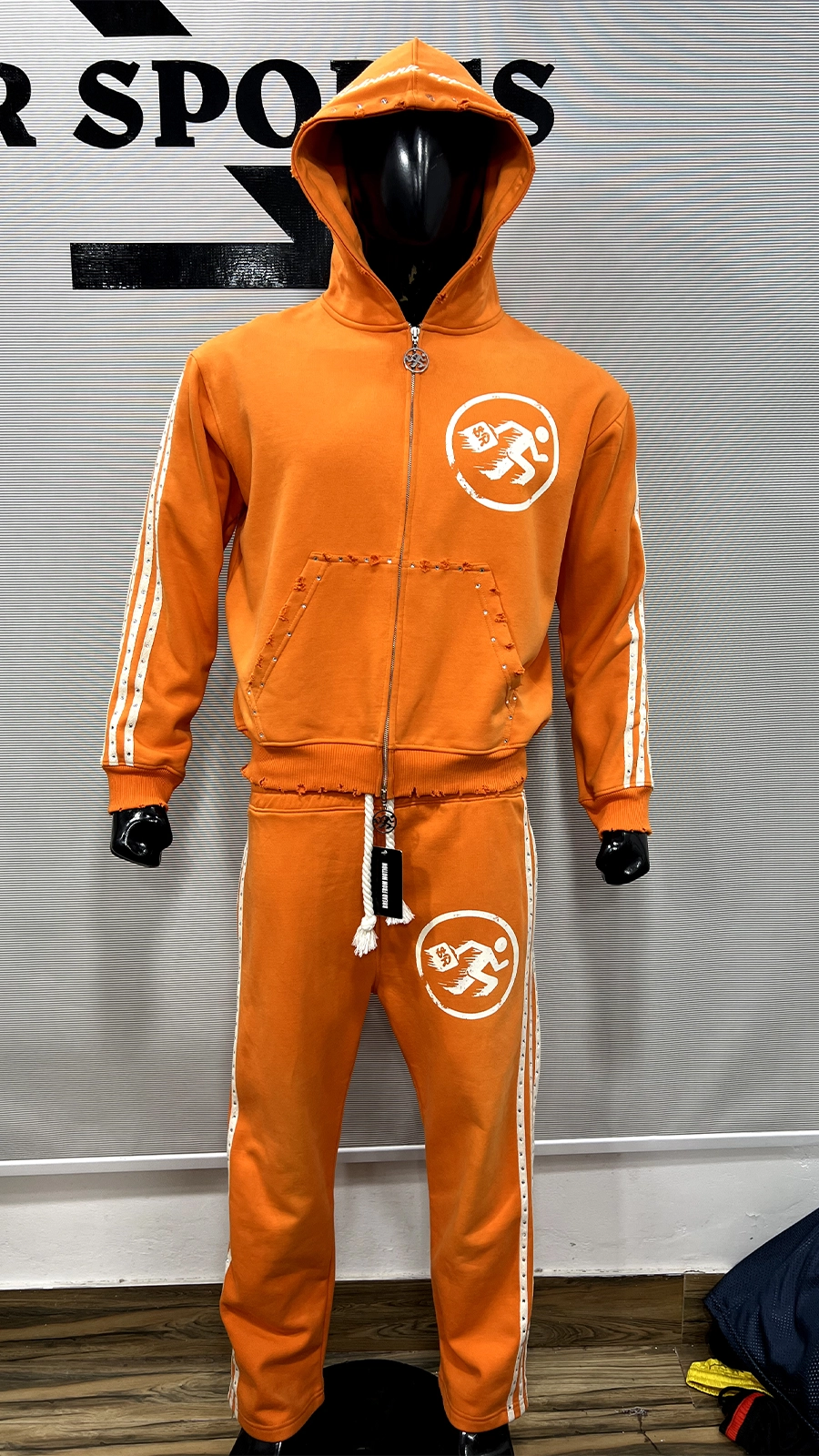
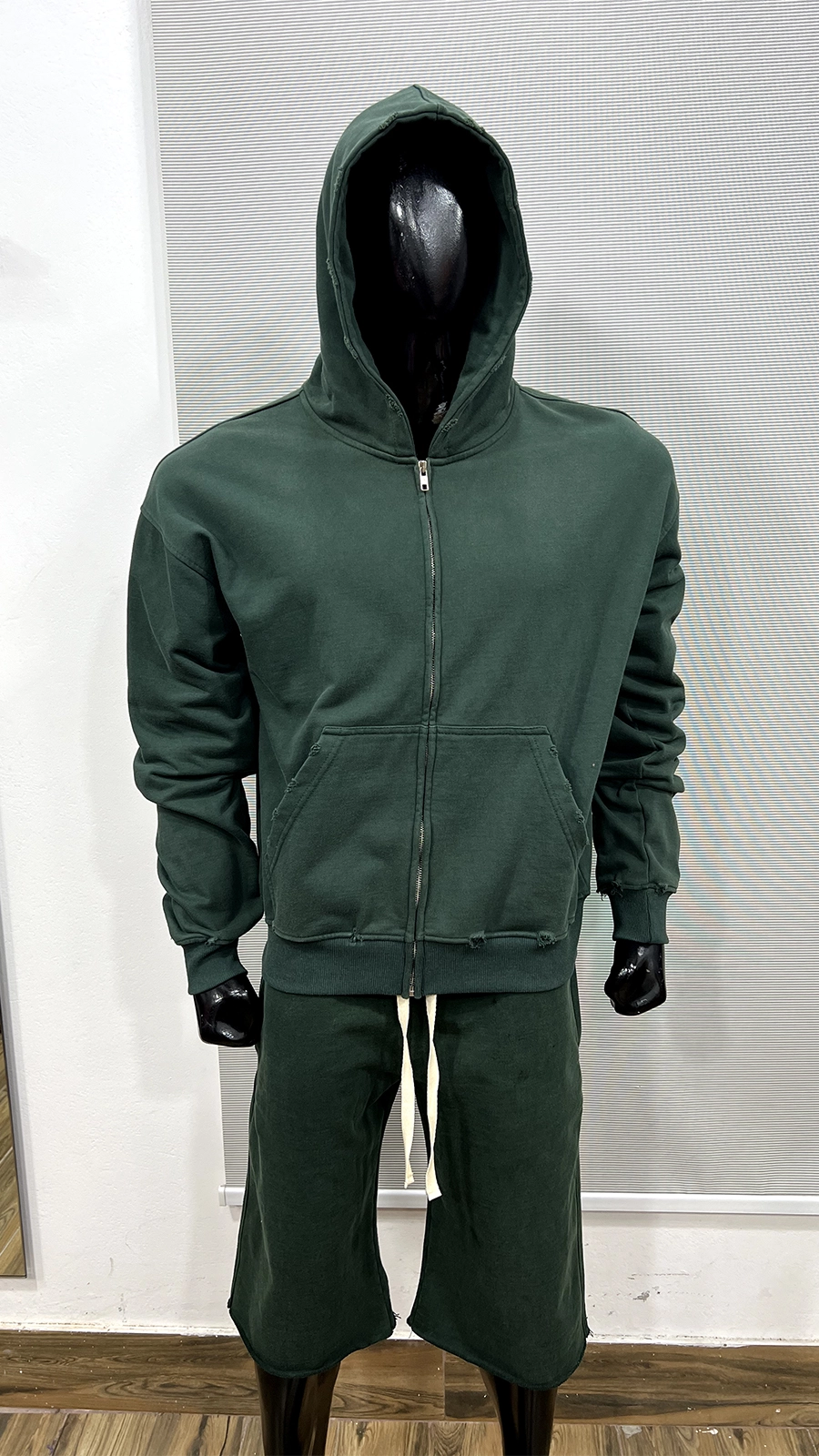
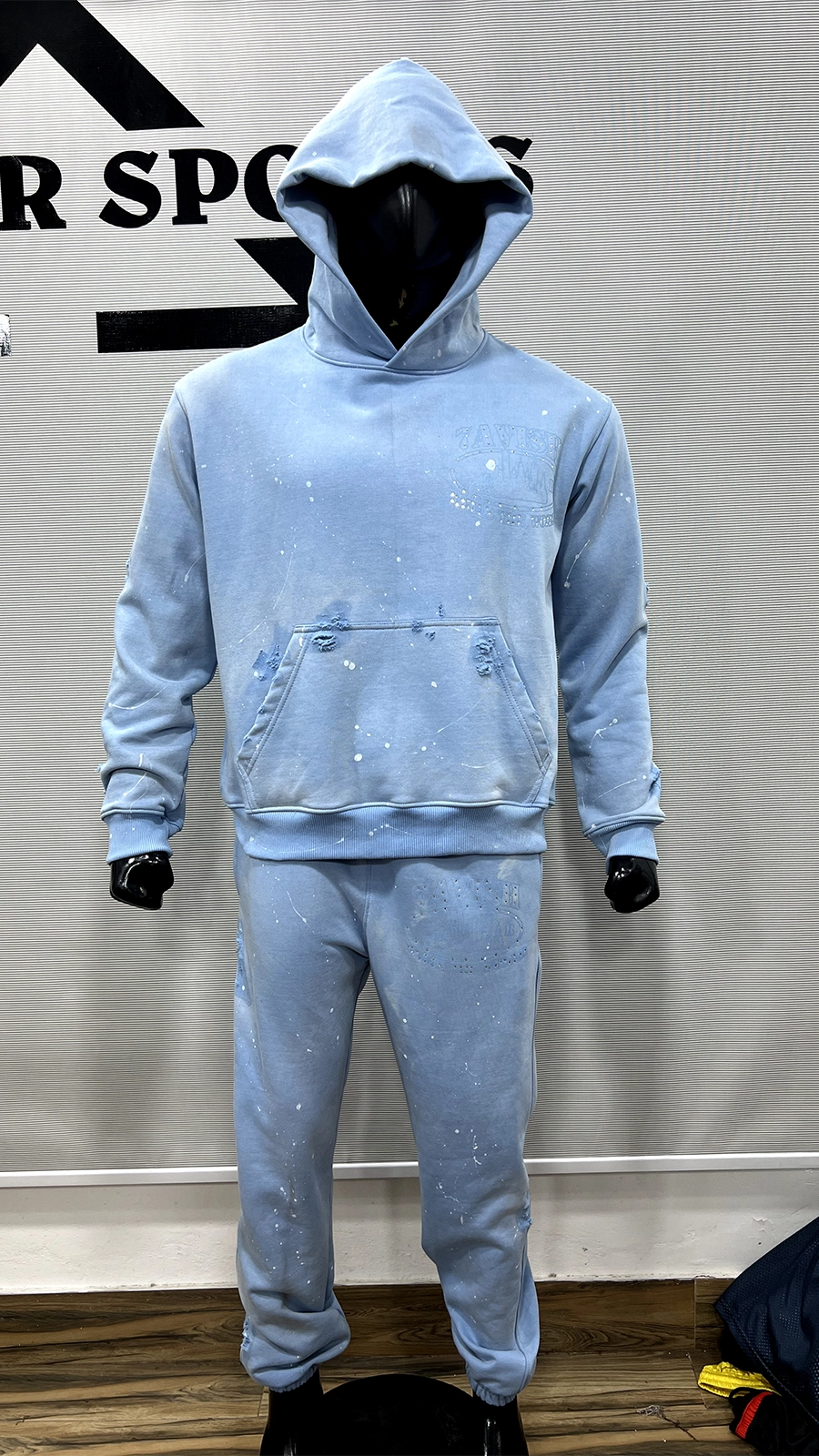
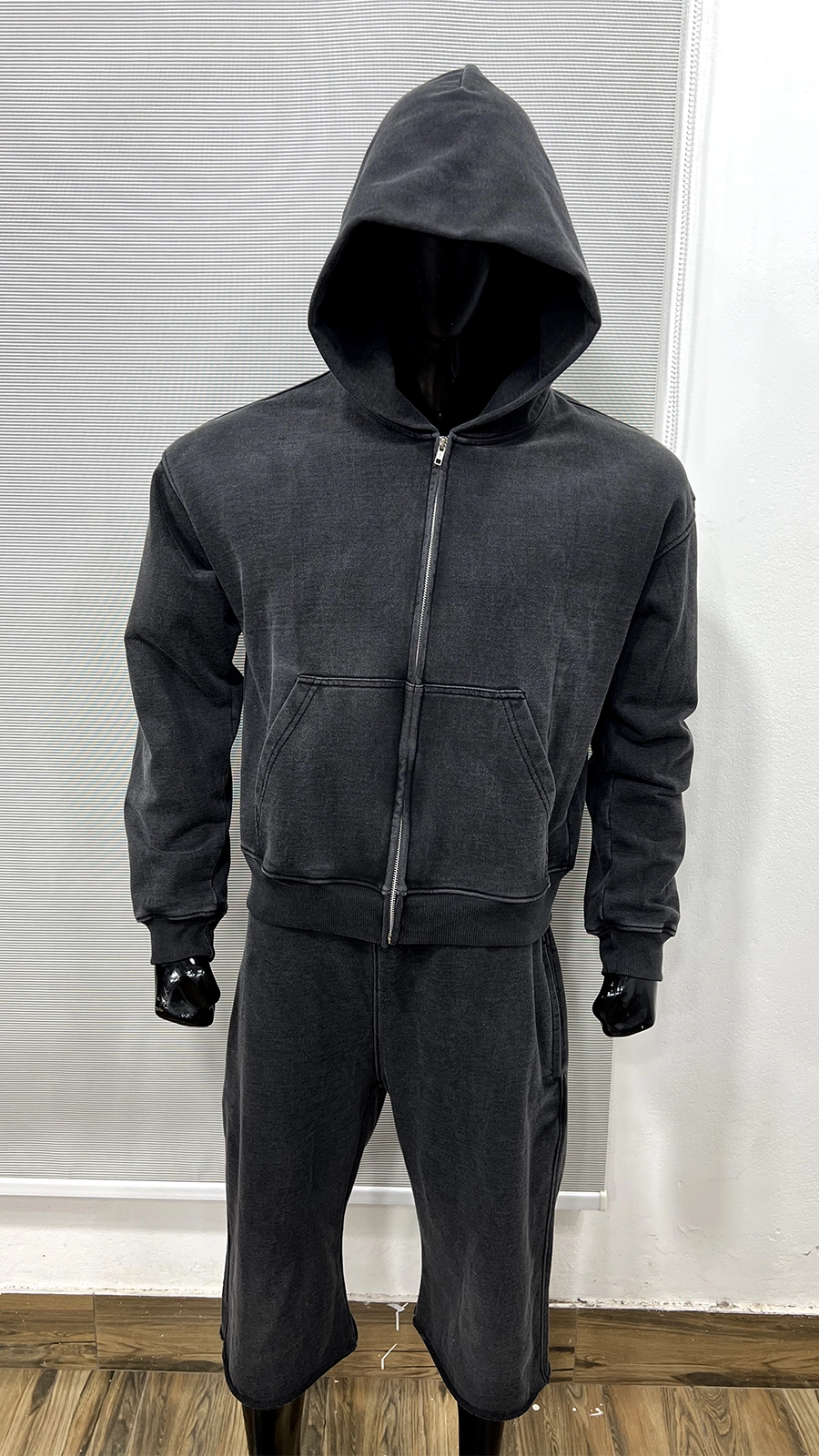
The pieces below are our own production samples, shot on the factory floor — not stock photos. Every order we run is fully custom to your spec, sizes, and branding.
01 — Why the Knee Comes Back Into Play Here, Even Though Shorts Skip It
What a Distress Sweat Suits Manufacturer Doesn’t Get to Skip
Our distress sweat pants page names the knee as the single highest-stakes distress placement we work with — it sees more repeated flexing and kneeling stress than anywhere else on that garment. Our distress sweat shorts page then covers a genuine positive: a short leg doesn’t reach the knee, so that specific risk simply isn’t part of the picture there.
A sweat suit’s bottom half is full-length sweatpants, not shorts — so the knee risk our shorts pages get to skip is fully back in play here. It’s worth being direct about that rather than letting the phrase "sweat suit" imply the same simplified wear-zone map our shorts page describes. The top piece has its own comparable zone worth naming — the elbow, which sees repeated flexing the way the knee does, though generally at a somewhat lower stakes level than the knee’s combination of flexing and kneeling contact. Between the two pieces, the bottom carries the more demanding wear-zone consideration.
If you’ve read our distress sweat shorts page and assumed a sweat suit inherits that same simplified risk profile, this is the correction worth making before you spec a design. The garment that pairs with the top in a suit is sweatpants specifically, not shorts, and that single distinction brings the knee’s full stakes back into the picture regardless of how the rest of the set is designed.
02 — Fabric and Construction: Consistent GSM, Different Wear-Zone Stakes
Fabric and Construction: Consistent GSM, Different Wear-Zone Stakes
| Weight | GSM | Distress Result Across the Set |
|---|---|---|
| Lightweight fleece | 240–280 GSM | Higher risk of unintended holes or laddering on either piece |
| Midweight to heavyweight fleece | 300–400+ GSM | The most reliable support for both pieces |
The fabric-consistency advantage we cover on our other sweat suits pages applies here too — one heavier fleece weight range works for both pieces without a shorts-style calibration mismatch. But it’s worth separating two different things: shared GSM gives both garments the same starting resistance to unwanted laddering or tearing, while the wear-zone risk we cover above is about where on each garment that resistance actually gets tested during real use. Even with identical fabric, the knee sees harder use than the elbow does.
That distinction matters when you’re troubleshooting a quality issue too. If a distress placement fails on the top, the first thing to check is usually technique or fabric weight. If the same kind of failure shows up on the bottom’s knee specifically, it’s worth considering whether the reinforcement itself was sufficient for that zone’s higher stakes, not just whether the fabric or sanding technique was at fault.
03 — Wear Zones, the Gusset, and Consistency Across the Set
Wear Zones, the Gusset, and Consistency Across the Set
On the top, distress placement follows our distress hoodie conventions — elbow, cuff edges, general surface wear, sanded and torn with the same care as any flat-panel piece. On the bottom, plan around the knee as the priority zone the same way our distress sweat pants page describes, with the hem and waistband edge as secondary considerations.
The gusset avoidance principle still applies on the bottom — keep distressing a reasonable distance from that seam, the same guidance as any sweatpants order. Decide upfront whether you want the two pieces to show matched wear intensity or natural variation between them, and flag if you’re pairing the distressing with an acid wash or spray wash treatment across the whole set — we cover both of those wash-treatment versions of this same set on their own pages, and either pairs naturally with distressing for a fully coordinated worn-in look.
When you brief the wear pattern for a matched set, it’s worth specifying the knee and elbow zones separately rather than describing the wear level once for the whole set — since these two zones carry genuinely different real-world stakes, treating them identically in the brief can lead to either under-reinforcing the knee or over-reinforcing the elbow relative to what each piece actually needs.
04 — What Separates Controlled Wear From Fabric That’s Failing on Each Piece
What Separates Controlled Wear From Fabric That’s Failing on Each Piece
On the top, give any reinforced tear near the elbow a real test — a firm pull, not just a light tug — and check sanded areas for evenness across the flat panel. On the bottom, apply the same test with extra attention at the knee specifically, since that’s the zone most likely to see real stress in actual wear; confirm reinforcement holds under a firm pull and check that distressing hasn’t crept too close to the gusset seam.
Check wear intensity and color for consistency between the two pieces under the same light — if you asked for matched wear, confirm both correspond; if you asked for natural variation, confirm it still reads as authentically worn on both.
Check the hem and cuff edges on both pieces too, since these are secondary wear zones present on either garment — a frayed cuff on the top or a frayed hem on the bottom should look intentionally worn rather than simply unfinished, the same distinction that matters on any distressed piece regardless of which half of the set it belongs to.
05 — MOQ and Sampling: What to Expect
MOQ and Sampling With Your Distress Sweat Suits Manufacturer
MOQ is 50 complete sets per style — 50 tops and 50 matching bottoms, split across whatever size run you need. Sampling takes 6–10 days, and the full cost is credited against your bulk order once you move forward. That same credit policy applies here as it does across every technique and category we offer.
Give the bottom’s knee placement extra scrutiny during sampling specifically, the same reinforcement-check priority we apply to any standalone distressed sweatpants order. The top’s elbow distressing still needs checking, but the knee is where a construction issue is most likely to show up under real wear.
Don’t rush the bottom piece’s sample review to keep pace with the top’s simpler check — the knee’s higher stakes justify a slower, more thorough look even if that means the sample stage takes a couple of extra days. That’s a much smaller cost than discovering a reinforcement issue across a full 50-set production run.
06 — What Actually Moves Your Price
What Actually Moves Your Price
The bottom piece carries a real cost the top doesn’t: knee reinforcement work, given how much more stress that specific zone sees compared to anywhere on the top piece. It’s worth knowing this asymmetry exists rather than assuming a "matching set" implies equal per-piece cost. Number of distress points, fabric GSM, whether the set is paired with a wash treatment, and total order volume (in complete sets) round out the rest.
This asymmetry is smaller and more predictable than the one we cover on our distressed embroidery sweat suits page, since it’s driven by a single well-understood wear zone rather than a compounded technical challenge — but it’s still worth budgeting for rather than assuming the top and bottom cost the same simply because they’re one style.
We don’t publish flat pricing because those variables interact too much to be useful as a single number. Run your spec through our Instant Quote tool instead — it gives you a price estimate in 5 seconds, a downloadable PDF quote, and a direct line to WhatsApp with your quote pre-filled. Final pricing is confirmed by our team within 24 hours.
07 — Shipping to the UK and EU Duty-Free
Shipping to the UK and EU Duty-Free
Manufacturing in Pakistan carries a trade advantage worth factoring into your landed cost. Apparel made here enters the UK at 0% duty under the Developing Countries Trading Scheme, and the EU at 0% duty under GSP+, versus roughly 12% on equivalent goods sourced from China.
Details on eligibility and the current tariff schedule are on the UK government’s own guidance page: Developing Countries Trading Scheme (DCTS) — GOV.UK. This matters on a matched set order too, since landed cost applies across both pieces of the set rather than a single garment.
08 — When Distress Isn’t the Right Call
When Distress Isn’t the Right Call
Distress isn’t the right call on a genuinely lightweight fabric on either piece, where the laddering risk narrows the safe timing and intensity window considerably. It’s also the wrong fit for an activewear or performance-focused set, where deliberate thin spots — especially at the knee — work against durability expectations, and for budget-conscious high-volume basics, since knee reinforcement adds real cost on the bottom piece specifically. If you want a worn-in look across the set without the structural considerations, our Acid Washed Sweat Suits page delivers that faded vintage color without any tear-and-reinforcement tradeoffs.
If you’re weighing distress against a wash treatment for a full set, the same guidance applies here as on our shorts and sweatpants comparisons — distress delivers a more dramatic, textural worn look at the cost of real structural considerations; a wash treatment gets you toward a similar vintage aesthetic with less to manage on either piece. Between our acid washed and spray washed set options, coverage extent and how much leg-to-leg or piece-to-piece variation you want are usually the deciding factors.
Table of Contents
Simple Process
From Spec to Shipped, in Four Steps
01
Quote & Spec
Run your GSM, distress zones, and intensity for both pieces through the Instant Quote tool; get a price estimate and a downloadable PDF in 5 seconds.
02
Sample
We sand, tear, and reinforce both pieces as a matched sample in 6–10 days, with extra care at the bottom’s knee; you can join a live video call from the floor before it ships.
03
Approve & Bulk
Approve the sample (its cost is credited to your order) and we run your full size and quantity — production takes 12–15 days.
04
Ship
Finished sets go out via DHL/FedEx air (3–7 days) or sea freight for larger volumes, landing duty-free in the UK and EU.
Our Advantage
Why Brands Choose Malinor
Floor Video Call Before You Pay Anything
See your actual distress production run in progress, not a stock photo, before you commit to bulk. Both pieces are shown together on the call, not just one garment in isolation.
Sample Cost Credited in Full
Nothing at all you spend on sampling is wasted once you move to bulk.
In-House Sanding, Distressing, and Reinforcement for Both Pieces
No subcontracting any decoration step to a third shop, so your timeline doesn’t depend on someone else’s queue.
Fast, Direct Replies
Most quote and spec questions get answered within 2 hours during business hours.
Common Questions
Frequently Asked Questions
Does the knee risk apply to this set the way it does to standalone sweatpants?+
Yes, fully. The bottom piece of a sweat suit is full-length sweatpants, not shorts, so the knee stays the single highest-stakes distress placement, the same as it is on our standalone distress sweat pants page. Being part of a set doesn’t change the underlying garment geometry.
Why did the shorts version of this technique get to skip the knee but this doesn’t?+
Because a short leg simply doesn’t reach the knee — that’s a real, physical simplification specific to shorts. A sweat suit’s bottom is a full sweatpant leg, which does reach the knee, so the risk that shorts sidestep is fully present here.
Should distressing be reinforced more on the bottom than the top?+
Yes, generally. The knee sees more repeated flexing and kneeling stress than anywhere on the top piece, so we apply extra reinforcement scrutiny there specifically. The top still needs proper reinforcement at its own wear zones, but the bottom carries the higher-stakes consideration.
Can this be combined with an acid wash or spray wash across the set?+
Yes, and it’s a common combination for a fully coordinated worn-in look. We cover the acid washed and spray washed versions of this same set on their own pages — either pairs naturally with distressing if you sequence both treatments on the same production run.
What’s the minimum order quantity?+
50 complete sets per style, with sizes split however your size run needs. A distressed sweat suit and an acid-washed sweat suit in the same order each need their own 50-set minimum, since they’re different styles.
How long does shipping take?+
DHL or FedEx air freight takes 3–7 days worldwide once your order is finished. For larger volumes, sea freight is available at a lower cost per unit but a longer transit time — we’ll walk you through both options once your bulk order is confirmed and ready to move.
Run Your Spec Through the Instant Quote Tool
Get a price estimate in 5 seconds, a downloadable PDF, and a straight line to WhatsApp with your quote pre-filled. Before you pay anything, we’ll get you on a live video call from the production floor.