Embroidery Sweat Shorts Manufacturer
Embroidery Sweat Shorts Manufacturer Where Less Leg Doesn’t Mean Less Difficulty
As an embroidery sweat shorts manufacturer based in Sialkot, Pakistan, we’ll tell you plainly that a shorter leg isn’t automatically an easier one to hoop — less fabric length inside the hoop attachment means less margin to position the garment correctly, not more. MOQ starts at 50 pieces per style with sizes split however you need, your sample takes 6–10 days and its full cost is credited against the bulk order, and production runs 12–15 days once you approve it.
The pieces below are our own production samples, shot on the factory floor — not stock photos. Every order we run is fully custom to your spec, sizes, and branding.
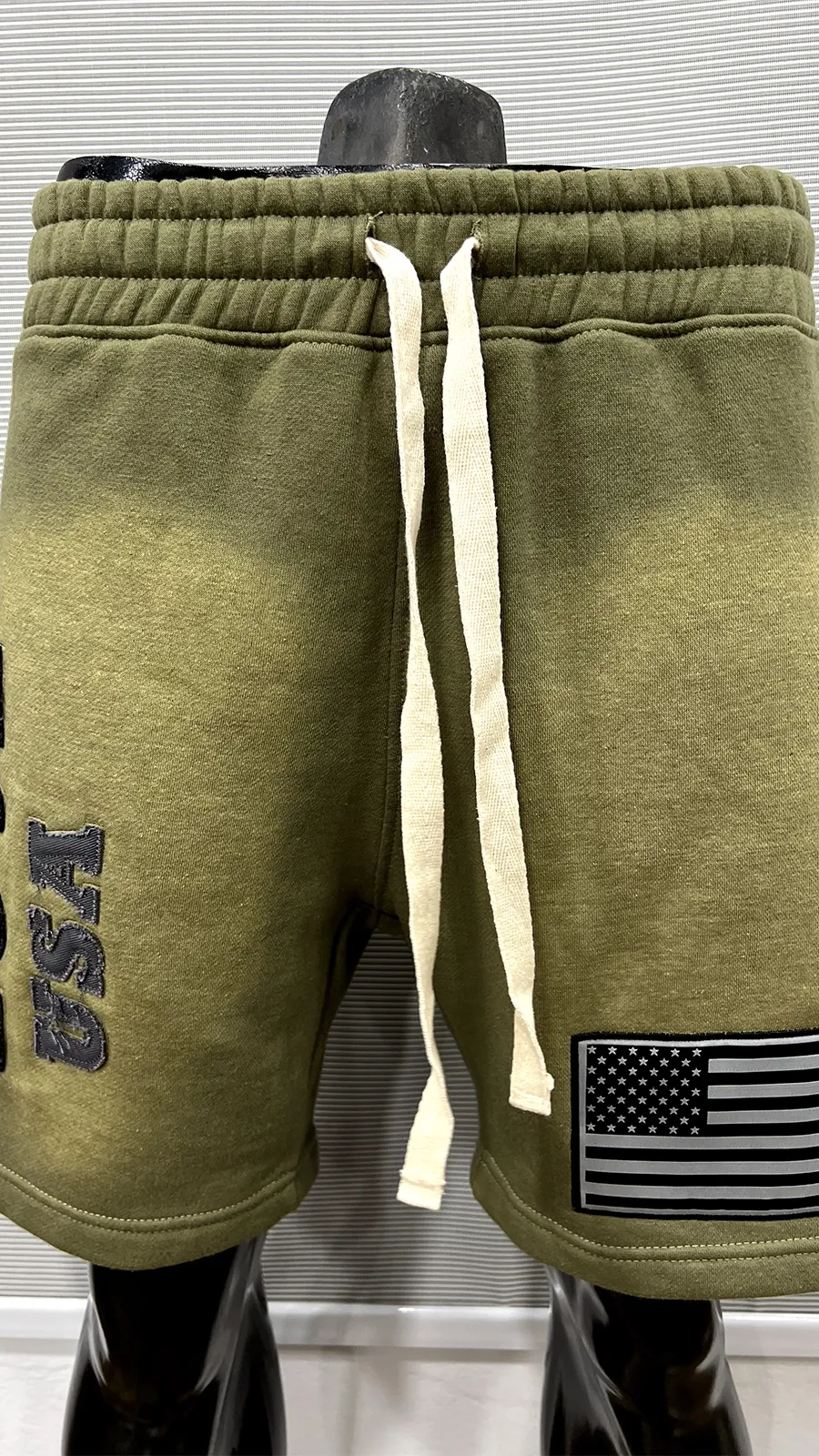
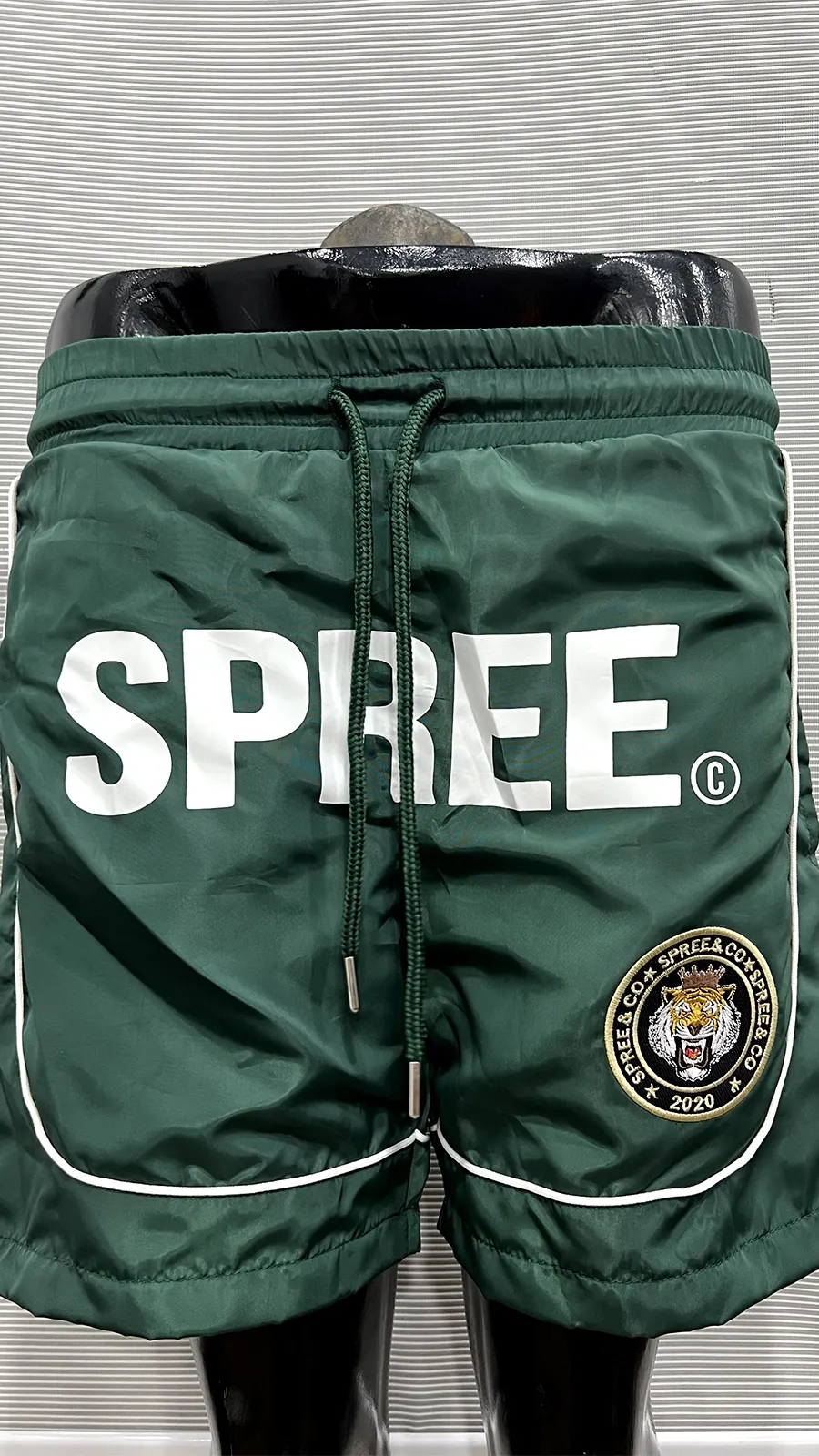
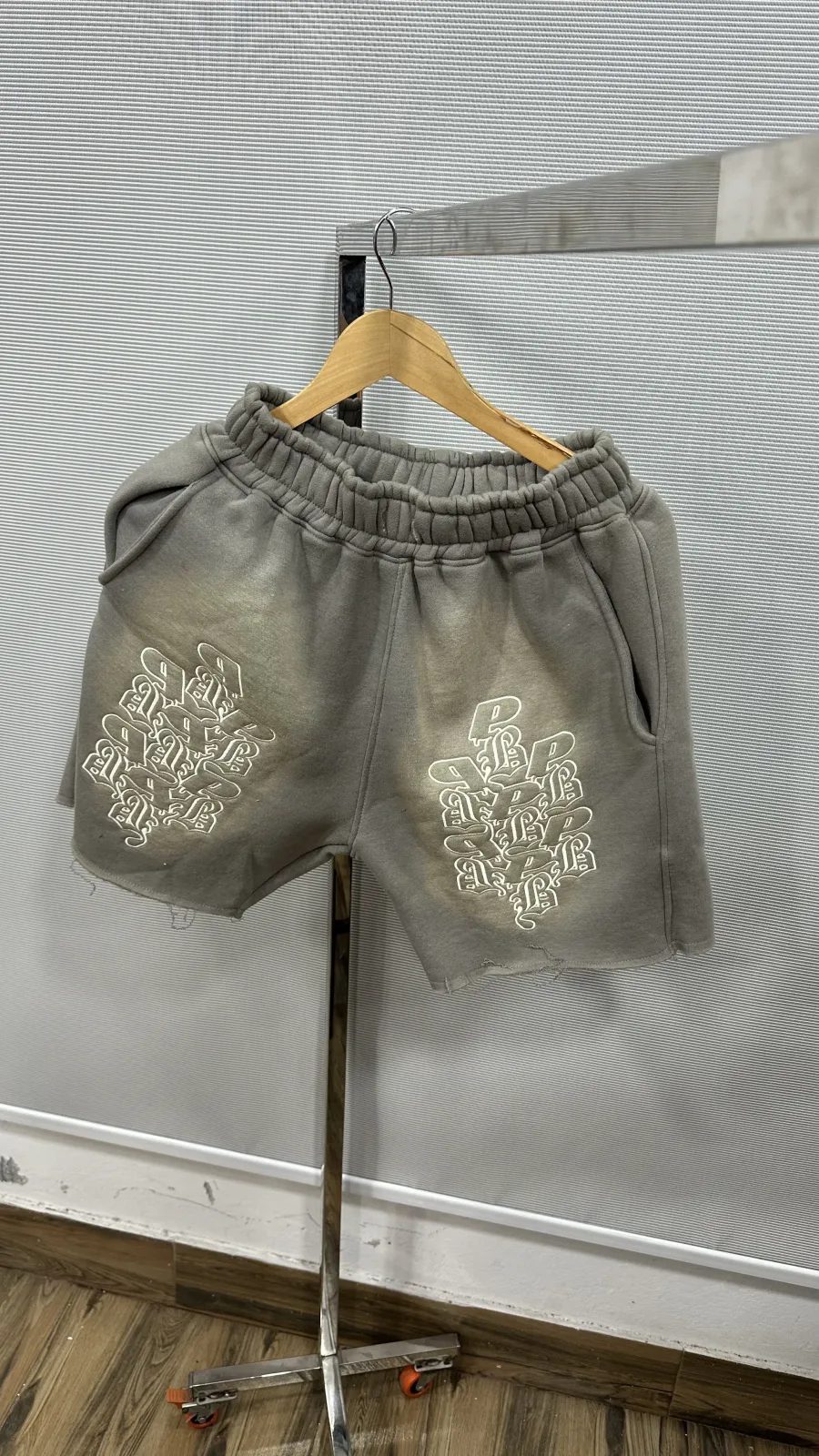
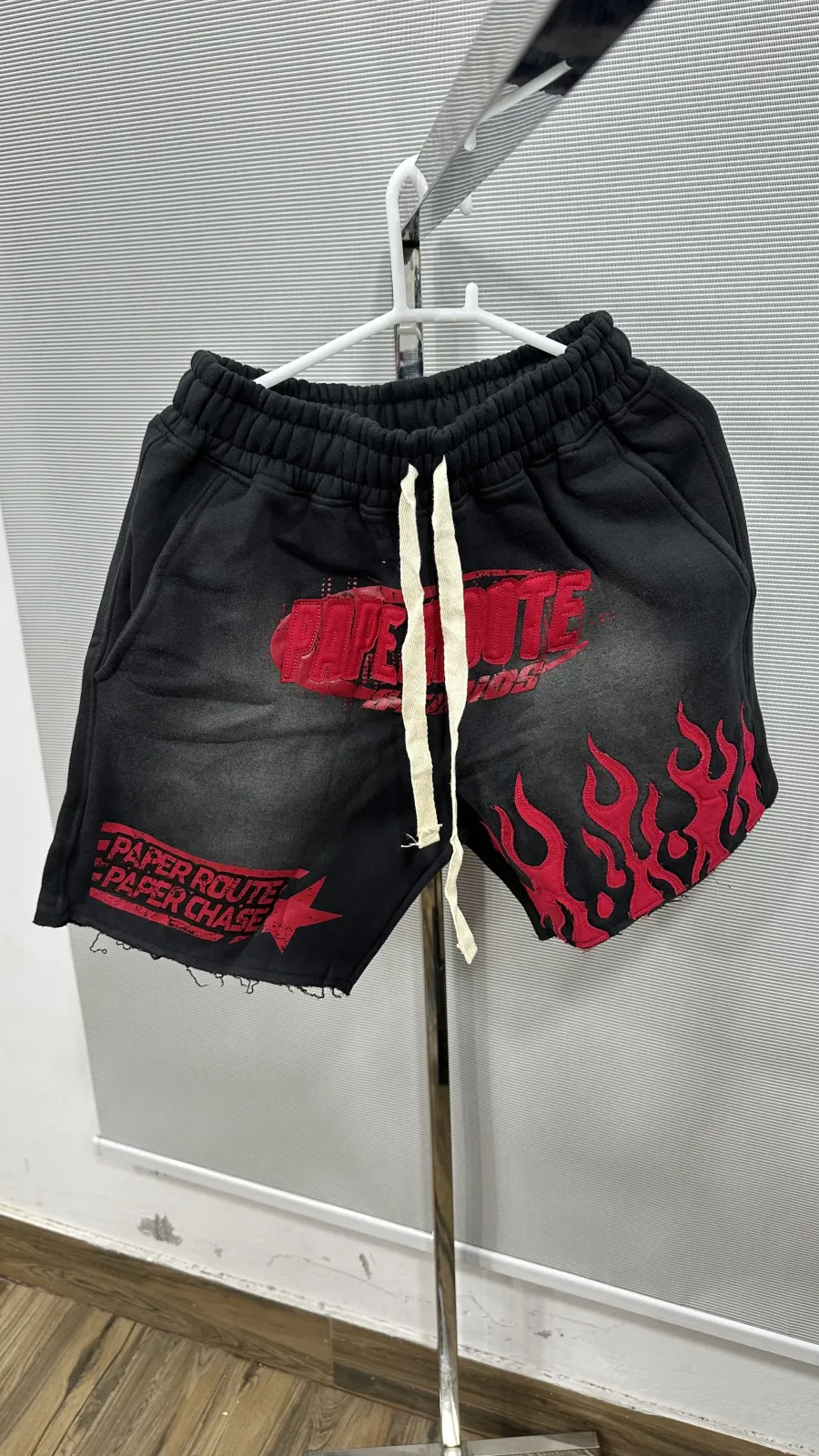
01 — Why a Shorter Leg Doesn't Make Hooping Easier
What an Embroidery Sweat Shorts Manufacturer Sets Up Differently
Our embroidery sweat pants page covers the real technical challenge of hooping a tubular garment leg for stitching, rather than a flat panel. A sweat short’s leg is still that same tube — just shorter. It’s worth stating plainly that shorter isn’t automatically easier here, and it’s actually the opposite in one specific way: less fabric length inside the hoop attachment means less margin to position and grip the garment correctly, not more room to work with.
That matters practically. A hooping setup calibrated for a full sweatpant leg doesn’t just scale down cleanly to a 5-inch inseam short — the shorter segment needs its own careful positioning, since there’s simply less fabric available to anchor the garment securely in the hoop before the needle starts. It’s genuinely a different setup, not a smaller version of the same one.
Stabilizer choice stays the same principle as sweatpants — cut-away stabilizer for a curved, sometimes stretchy surface — but the smaller working area on a short leg means there’s less margin to correct if the stabilizer shifts slightly during hooping. We check placement more closely on shorts specifically for this reason, since a small positioning error has proportionally more impact on a compact panel than the same error would on a longer sweatpant leg.
02 — Fabric and Construction: A Slightly Lighter GSM Range Than Sweatpants
Fabric and Construction: A Slightly Lighter GSM Range Than Sweatpants
| Weight | GSM | Embroidery Result on Shorts |
|---|---|---|
| Lightweight fleece | 240–280 GSM | Small logos only, check stitch density carefully |
| Midweight to heavyweight fleece | 300–400+ GSM | The most reliable support |
Sweat shorts commonly run a bit lighter than full-length sweatpants, since they’re often built for warmer-weather or athletic use where the extra fabric of a full leg isn’t wanted. That means the safe embroidery range shifts slightly compared to what we recommend on our sweatpants page — still heavier than tee jersey, and generally still embroidery-friendly, but worth confirming specifically if you’re at the lighter end of that range rather than assuming sweatpants-level GSM applies automatically.
Athletic and gym shorts specifically tend to sit toward the lighter end of this range, since breathability matters more for that use case than the substantial hand-feel a heavier lounge short might aim for. If your shorts lean athletic, it’s worth flagging that upfront so we can recommend a fabric weight that balances embroidery-friendliness against the breathability your product actually needs.
If you’re not certain where your fabric falls within this range, send us a swatch or the fabric’s spec sheet before finalizing your order. A quick composition and weight check on our end is a much smaller ask than discovering a puckering issue after the sample’s already been stitched.
03 — Placement, Side Slits, and the Liner Interaction
Placement, Side Slits, and the Liner Interaction
Hip and outer thigh placement follows the same convention as sweatpants, but the usable panel is smaller here — a design proportioned comfortably for a sweatpant thigh may not fit at all on a short inseam’s much more limited leg. Scale designs specifically for the shorts panel rather than shrinking a sweatpants-proportioned file.
Two considerations are genuinely new to this garment. If a design sits near a side slit, the stitching and backing need to stay clear of that finished edge so they don’t interfere with how it lies or catch on the opening. And if your shorts include a mesh liner, embroidery placed near the waistband needs to avoid accidentally catching the liner in the stitching — a real risk when two fabric layers meet at that seam, and something that would restrict the liner’s independent movement if it isn’t planned around carefully.
When you brief a design, mark the placement relative to the waistband, side seam, side slit (if present), and hem — the more of these reference points you give us, the less guesswork involved in translating your artwork onto the actual shorts panel. A sketch showing where the slit sits relative to your intended logo placement is worth more than a written description of “near the bottom.”
04 — What Separates Clean Shorts Embroidery From a Puckered or Caught Stitch
What Separates Clean Shorts Embroidery From a Puckered or Caught Stitch
Check for puckering the same way you would on any embroidery job, paying attention to how the shorter, more curved surface handled the stitch tension. If the design sits near a side slit, check that the slit still lies flat and opens cleanly — stitching that’s crept too close can distort how the finished edge sits.
If a liner is present, check that it moves independently of the outer fabric near the waistband — give it a gentle tug separate from the shell fabric and confirm the embroidery hasn’t caught it. And run the same waistband elastic recovery check as any sweat garment if the design sits near that zone, plus a two-leg symmetry check if you’ve ordered a mirrored design.
Check thread tension on the sample too, particularly given how compact the working area is on a shorts panel — loose threads or visible looping on the underside are worth catching here just as much as on a larger placement, even though the design itself is smaller and might seem like it carries less risk. A smaller design isn’t automatically a lower-stakes one for construction quality.
05 — MOQ and Sampling: What to Expect
MOQ and Sampling With Your Embroidery Sweat Shorts Manufacturer
MOQ is 50 pieces per style, split across whatever size run you need. Sampling takes 6–10 days, and the full cost is credited against your bulk order once you move forward. That same credit policy applies here as it does across every technique and category we offer.
Tell us upfront whether your shorts include a mesh liner or side slits, since both affect how we plan hooping and placement before the first sample is even cut — these aren’t details we can easily accommodate after a design has already been finalized without them in mind.
Handle the sample directly rather than just reviewing photos, particularly checking the liner and slit interactions if either applies to your design. A photo can show you the finished stitching looks clean, but it can’t show you whether the liner still moves freely or whether the slit still opens the way it should — those are physical checks that need the actual garment in hand.
06 — What Actually Moves Your Price
What Actually Moves Your Price
Tubular hooping setup takes real time regardless of how short the leg is — the shorter tube doesn’t reduce this cost proportionally the way you might expect, since the setup and care involved stay largely the same whether the leg is 9 inches or 5. Stitch count and density, thread colors, and total order volume move the price the same way they would on sweatpants. A mirrored two-leg design still costs more than a single placement.
If you’re comparing quotes across our sweatpants and shorts pages for a similar-sized logo, don’t expect the shorts version to come in meaningfully cheaper just because there’s less overall fabric in the garment — the decoration cost is driven by the placement work itself, which doesn’t scale down proportionally with the size of the garment it’s on.
We don’t publish flat pricing because those variables interact too much to be useful as a single number. Run your spec through our Instant Quote tool instead — it gives you a price estimate in 5 seconds, a downloadable PDF quote, and a direct line to WhatsApp with your quote pre-filled. Final pricing is confirmed by our team within 24 hours.
07 — Shipping to the UK and EU Duty-Free
Shipping to the UK and EU Duty-Free
Manufacturing in Pakistan carries a trade advantage worth factoring into your landed cost. Apparel made here enters the UK at 0% duty under the Developing Countries Trading Scheme, and the EU at 0% duty under GSP+, versus roughly 12% on equivalent goods sourced from China.
Details on eligibility and the current tariff schedule are on the UK government’s own guidance page: Developing Countries Trading Scheme (DCTS) — GOV.UK. It’s worth checking directly if landed cost is a factor in comparing us against a supplier based somewhere without the same preferential access.
08 — When Embroidery Isn't the Right Call
When Embroidery Isn’t the Right Call
Embroidery isn’t the right call for a large, all-over leg design — dense coverage across that much curved, limited surface gets impractical to stitch cleanly and doesn’t leave enough room to work with. For bigger coverage or a photographic design, our Screen Printing Sweat Shorts or DTG Printing Sweat Shorts pages are better starting points, depending on how much detail your design needs.
It’s also worth reconsidering embroidery for a very compact panel, like a short paired with a slim inseam and a wide waistband — at that point there may simply not be enough clean thigh surface left to place even a modest logo without it crowding the waistband or a side slit. If your inseam and rise combination leaves limited working room, we’ll flag that honestly during the quoting stage rather than trying to force a placement that doesn’t have space for it.
If you’re deciding between embroidery and a print technique for a shorts logo, coverage size and the presence of a liner or slit near your intended placement are usually the two factors that matter most. A small, isolated logo works well with embroidery on almost any short; a placement that has to work around a liner attachment or sits close to a slit edge is where the extra planning we’ve covered here really earns its keep.
Table of Contents
Simple Process
From Spec to Shipped, in Four Steps
01
Quote & Spec
Run your GSM, placement, and thread colors through the Instant Quote tool; get a price estimate and a downloadable PDF in 5 seconds.
02
Sample
We hoop and stitch a physical sample in 6–10 days, checking placement clear of any liner or slit; you can join a live video call from the floor before it ships.
03
Approve & Bulk
Approve the sample (its cost is credited to your order) and we run your full size and quantity — production takes 12–15 days.
04
Ship
Finished shorts go out via DHL/FedEx air (3–7 days) or sea freight for larger volumes, landing duty-free in the UK and EU.
Our Advantage
Why Brands Choose Malinor
Floor Video Call Before You Pay Anything
See your actual embroidery production run in progress, not a stock photo, before you commit to bulk.
Sample Cost Credited in Full
Nothing at all you spend on sampling is wasted once you move to bulk.
In-House Digitizing and Stitching
No subcontracting any decoration step to a third shop, so your timeline doesn’t depend on someone else’s queue.
Fast, Direct Replies
Most quote and spec questions get answered within 2 hours during business hours.
Common Questions
Frequently Asked Questions
Is embroidery easier on shorts than sweatpants since the leg is shorter?+
Not really, and it can actually be the opposite in one specific way. A shorter leg means less fabric length available inside the hoop attachment to position and grip the garment securely, so the setup needs its own careful handling rather than being a simpler version of a sweatpants hooping job.
Can embroidery be placed near a side slit?+
It can, but the stitching and backing need to stay clear of the slit’s finished edge so they don’t interfere with how it lies or catch on the opening. We plan placement specifically around this detail rather than treating a side slit as just another part of the leg panel.
Does a mesh liner affect where embroidery can go?+
Yes, if the placement sits near the waistband where the liner attaches. Embroidery there needs to avoid catching the liner fabric in the stitching, which would restrict how it moves independently of the outer shell. Tell us upfront if your shorts have a liner so we can plan around it.
What GSM works best for embroidered sweat shorts?+
Most orders do well between 300–400 GSM. Shorts commonly run lighter than full-length sweatpants since they’re built for warmer-weather or athletic use, so it’s worth confirming your specific fabric weight rather than assuming the same GSM recommendation that applies to sweatpants carries over automatically.
What’s the minimum order quantity?+
50 pieces per style, with sizes split however your size run needs — you’re not locked into 50 of one size. An embroidered short and a screen-printed short in the same order each need their own 50-piece minimum, since they’re different styles.
How long does shipping take?+
DHL or FedEx air freight takes 3–7 days worldwide once your order is finished. For larger volumes, sea freight is available at a lower cost per unit but a longer transit time — we’ll walk you through both options once your bulk order is confirmed and ready to move.
Run Your Spec Through the Instant Quote Tool
Get a price estimate in 5 seconds, a downloadable PDF, and a straight line to WhatsApp with your quote pre-filled. Before you pay anything, we’ll get you on a live video call from the production floor.