Distressed Embroidery Sweat Suits Manufacturer
Distressed Embroidery Sweat Suits Manufacturer Where the Bottom Piece Carries More Risk
As a distressed embroidery sweat suits manufacturer based in Sialkot, Pakistan, we’re upfront that the top and bottom aren’t equally demanding here — the flat chest panel carries one layer of technical risk, the curved sweatpants leg carries two. MOQ starts at 50 complete sets with sizes split however you need, your sample takes 6–10 days and its full cost is credited against the bulk order, and production runs 12–15 days once you approve it.
The pieces below are our own production samples, shot on the factory floor — not stock photos. Every order we run is fully custom to your spec, sizes, and branding.
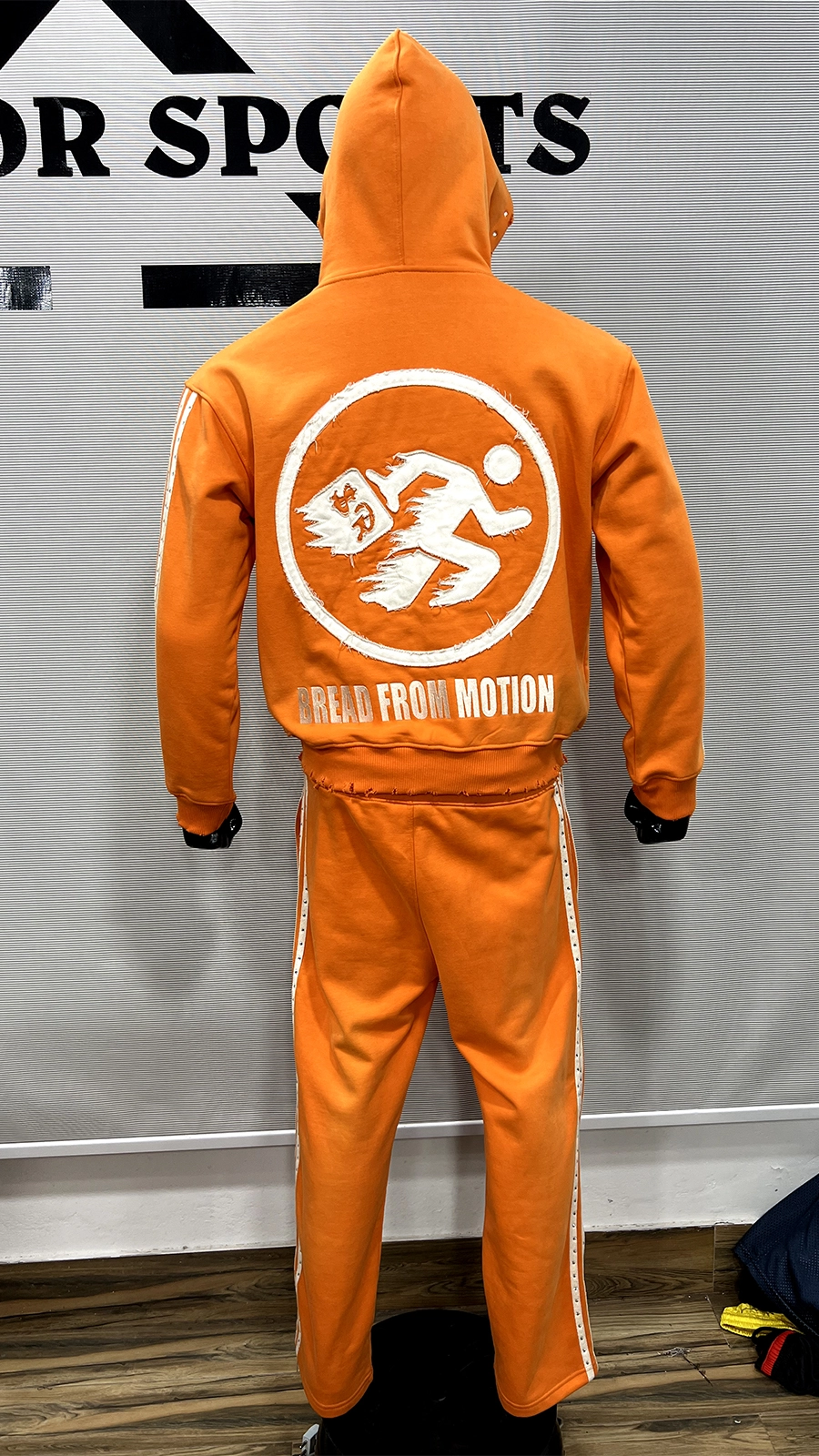
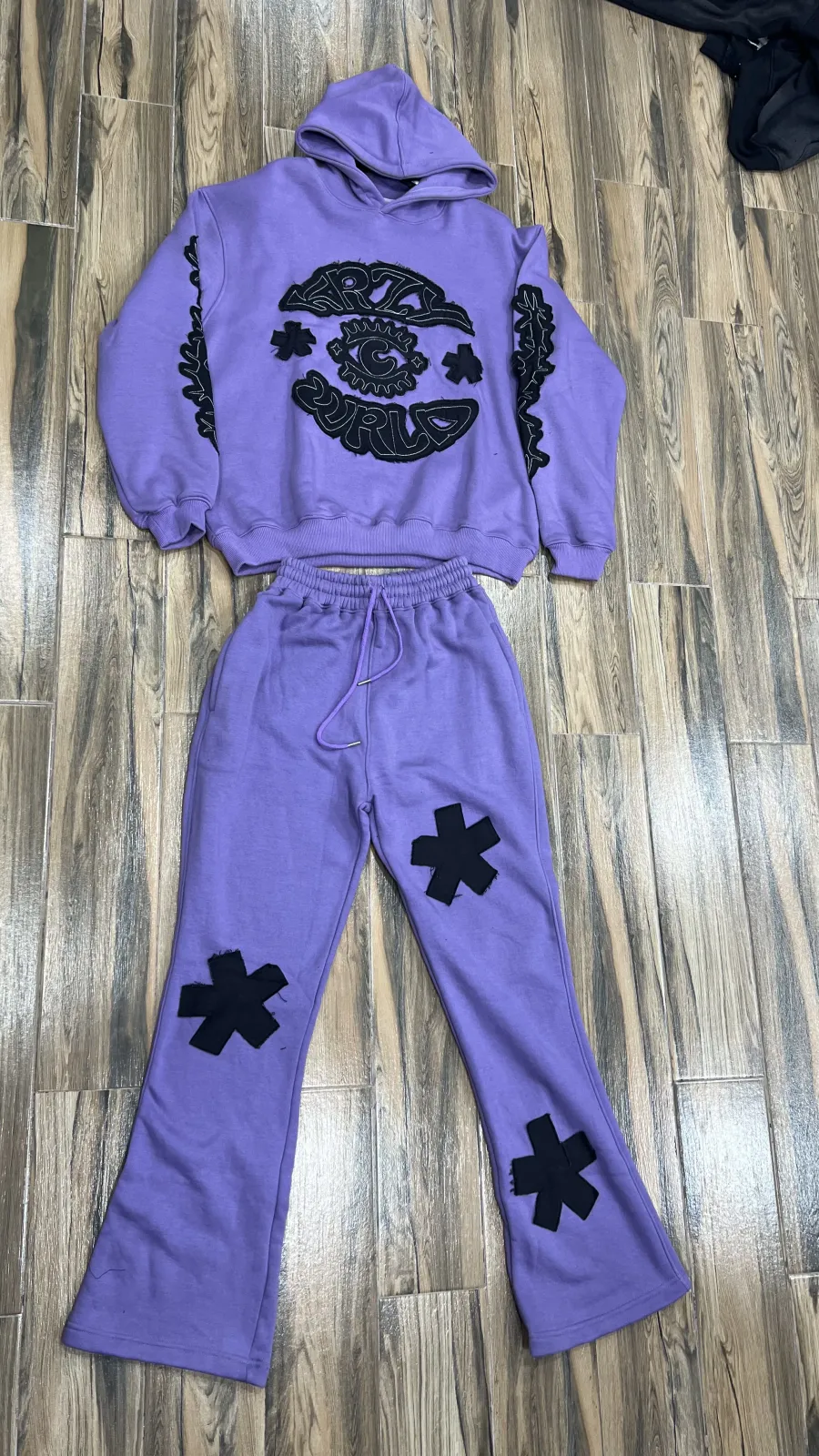
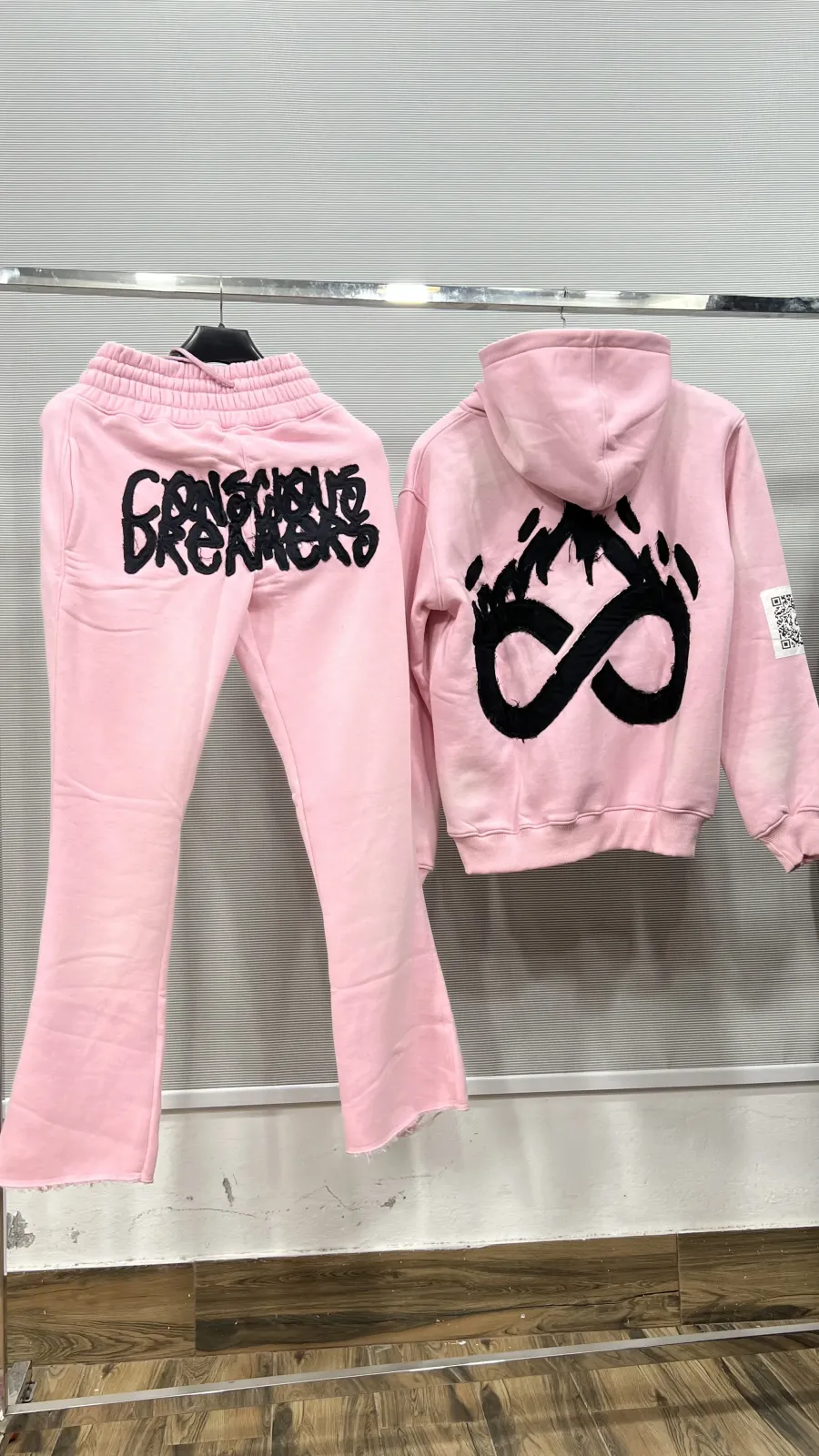
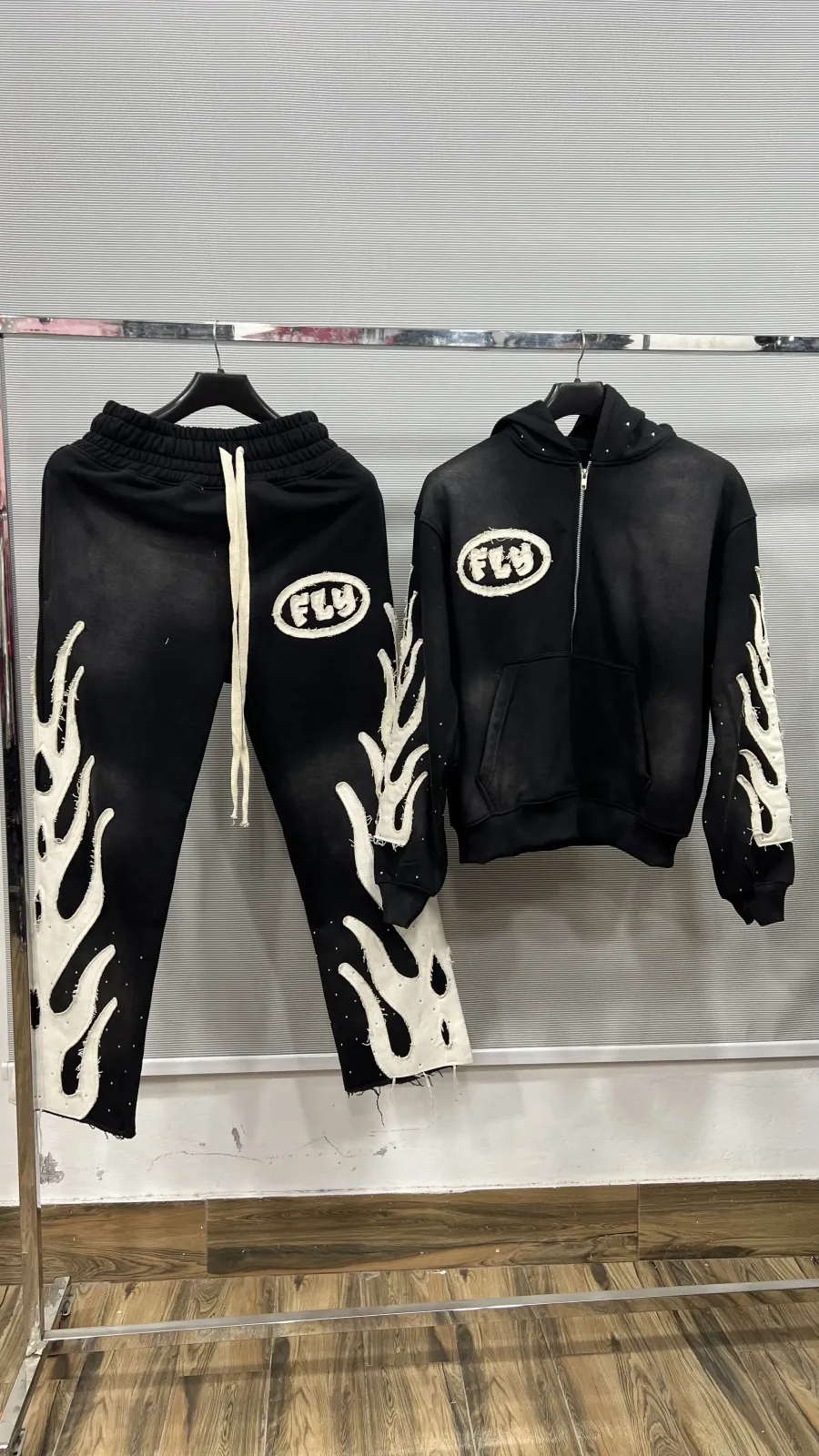
01 — Why the Bottom Piece Carries More Technical Risk Than the Top
What a Distressed Embroidery Sweat Suits Manufacturer Actually Manages
Each of our other sweat suits pages covers a different coordination story between the top and bottom — two hooping jobs for embroidery, two screens for screen printing, a genuine capability ceiling for DTG, a shared process for rhinestone, one method solving two different problems for chenille. Distressed embroidery has its own version, and it’s genuinely the most lopsided of them all.
The top is a flat panel with reduced structural support from the distressing itself — one layer of risk, the same single challenge we cover on our distressed embroidery hoodie page. The bottom is a curved sweatpants leg that also has that same reduced structural support layered on top of the curve-hooping difficulty we cover on our embroidery sweat pants page — two compounding factors stacked together, not one. We’ve been upfront elsewhere that this exact combination gets even more demanding on a shorts leg specifically, where the shorter working margin adds a third layer; a full sweatpant leg here sits one degree less extreme than that, but it’s still genuinely the higher-risk half of this particular set.
This asymmetry is worth naming plainly because it shapes how we approach the whole order, not just the bottom piece in isolation. Production timing, hooping setup, and the level of scrutiny we apply during quality checks all differ meaningfully between the two garments, even though the finished pieces are meant to look and feel like they belong to the same coordinated design.
02 — Fabric and Construction: One GSM Standard, Two Different Risk Profiles
Fabric and Construction: One GSM Standard, Two Different Risk Profiles
| Weight | GSM | Distressed Embroidery Result Across the Set |
|---|---|---|
| Lightweight fleece | 240–280 GSM | Not recommended for either piece — insufficient structure for the combined risk |
| Heavyweight fleece | 320–400+ GSM | The most reliable support for this combined risk on both pieces |
The fabric-consistency advantage we cover on our other sweat suits pages still applies here — one heavier fleece weight range works for both pieces without a shorts-style calibration mismatch. But it’s worth being clear that shared GSM doesn’t equalize the actual risk between the two garments. The fabric gives both pieces the same structural baseline to work from; the garment’s shape is what determines how much of that structure gets tested during construction, and the curved leg tests it more than the flat panel does regardless of how heavy the fleece is.
Stabilizer choice follows the same logic. We use the same robust cut-away backing on both pieces given how much structure this technique already sacrifices, but the bottom piece’s curved surface gives that backing less margin to compensate if anything shifts slightly during hooping — a real difference in outcome even when the input materials are identical across both garments.
03 — Placement, Wash Pairing, and Consistency Across the Set
Placement, Wash Pairing, and Consistency Across the Set
Placement on the top follows the conventions we cover on our distressed embroidery hoodie page — a chest logo or graphic, sanded and distressed with the lighter, more controlled pass a flat surface allows. Placement on the bottom follows our embroidery sweat pants conventions — hip or thigh, sanded with the same careful, lighter touch we use on any curved surface, since the working area there is harder to keep even.
Pairing the whole set with a distressed or acid-washed fabric base is a natural extension if you want a fully coordinated worn-in look — we’ll cover the acid washed and distress fabric versions of this set on their own pages, and either pairs naturally with distressed embroidery for a consistently aged aesthetic across both pieces. Decide upfront whether you want the wear pattern to match closely between the top and bottom or vary naturally, and lean toward muted or heathered thread if you’re pairing with a washed base — the same guidance we give on our standalone distressed embroidery pages, now applied across a coordinated set.
When you brief a matched design, send us reference photos for how you want each piece’s wear pattern to relate to the other — some brands want the top and bottom to look like they aged together as one garment set over time; others prefer each piece to carry its own distinct wear story that still reads as part of the same collection. Both are legitimate directions, and it’s worth being specific about which one you’re after rather than leaving us to guess.
04 — What Separates Intentional Wear From a Genuine Problem on Each Piece
What Separates Intentional Wear From a Genuine Problem on Each Piece
On the top, check sanded areas for evenness across the flat panel — a more forgiving surface than the bottom, but still worth a careful look. On the bottom, apply extra scrutiny specifically because of the compounded risk — check sanding evenness across the curve, give any frayed thread a firm tug to confirm it holds, and check hooping-related puckering more closely than you would on the top.
Check thread color and wear intensity for consistency between the two pieces under the same light — if you asked for matched wear, confirm both pieces correspond; if you asked for natural variation, confirm it still reads as authentically worn on both rather than randomly inconsistent between them.
Check overall garment weight and drape on the bottom piece specifically after distressing and embroidery are both applied — a leg that’s carried this compounded process should still move and hang the way sweatpants are meant to, not feel noticeably stiffer or thinner than the fabric’s base weight would suggest. This is one check that matters far more on the bottom than the top, given how much more that piece has been through.
05 — MOQ and Sampling: What to Expect
MOQ and Sampling With Your Distressed Embroidery Sweat Suits Manufacturer
MOQ is 50 complete sets per style — 50 tops and 50 matching bottoms, split across whatever size run you need. Sampling takes 6–10 days, and the full cost is credited against your bulk order once you move forward. That same credit policy applies here as it does across every technique and category we offer.
Give the bottom piece extra scrutiny during sampling specifically, since it’s carrying more compounded technical risk than the top. Check structural integrity and sanding evenness there with real care, and if you can, ask to see more than one bottom-piece sample before approving the full set for a 50-set run.
This isn’t about mistrusting the top piece — it’s simply a more forgiving, lower-stakes construction to begin with, so the sampling attention naturally weights toward wherever the real risk sits. Spending a little extra time confirming the bottom piece holds up is a much smaller cost than discovering a structural issue across a full production run of 50 sets.
06 — What Actually Moves Your Price
What Actually Moves Your Price
Be upfront with yourself about this before you budget: the bottom piece genuinely costs more to produce than the top for the same nominal style, given the compounded technical difficulty of distressed embroidery on a curved leg versus a flat panel. It’s not a symmetric split just because both pieces belong to one "matching" design — thread color count, placement size, fabric GSM, and total order volume (in complete sets) all factor in on top of that base asymmetry.
If you’re comparing this set’s price against a single distressed embroidery hoodie or sweat pants order, expect the set’s total cost to reflect both pieces’ individual complexity added together rather than some averaged middle price — the bottom piece doesn’t become cheaper just because it’s paired with a simpler top, and the top doesn’t inherit the bottom’s higher cost either.
We don’t publish flat pricing because those variables interact too much to be useful as a single number. Run your spec through our Instant Quote tool instead — it gives you a price estimate in 5 seconds, a downloadable PDF quote, and a direct line to WhatsApp with your quote pre-filled. Final pricing is confirmed by our team within 24 hours.
07 — Shipping to the UK and EU Duty-Free
Shipping to the UK and EU Duty-Free
Manufacturing in Pakistan carries a trade advantage worth factoring into your landed cost. Apparel made here enters the UK at 0% duty under the Developing Countries Trading Scheme, and the EU at 0% duty under GSP+, versus roughly 12% on equivalent goods sourced from China.
Details on eligibility and the current tariff schedule are on the UK government’s own guidance page: Developing Countries Trading Scheme (DCTS) — GOV.UK. This matters on a matched set order too, since landed cost applies across both pieces of the set rather than a single garment.
08 — When Distressed Embroidery Isn’t the Right Call
When Distressed Embroidery Isn’t the Right Call
Distressed embroidery isn’t the right call on a genuinely lightweight fabric on either piece — under about 240 GSM, there simply isn’t enough structure to safely support this combined challenge, especially on the bottom’s already-compounded risk profile. It’s also the wrong choice for a clean, minimalist, or premium-polished brand identity across the set. If a sharp, precise finish on both pieces is what your brand needs instead, our Embroidery Sweat Suits page is the better starting point.
If you’re weighing this technique against a clean alternative purely for cost reasons, it’s worth being honest with yourself about how much the worn-in aesthetic actually matters to your brand versus being a secondary preference.
Table of Contents
Simple Process
From Spec to Shipped, in Four Steps
01
Quote & Spec
Run your GSM, placement, and distress reference for both pieces through the Instant Quote tool; get a price estimate and a downloadable PDF in 5 seconds.
02
Sample
We digitize, stitch, and carefully distress both pieces as a matched sample in 6–10 days; you can join a live video call from the floor before it ships.
03
Approve & Bulk
Approve the sample (its cost is credited to your order) and we run your full size and quantity — production takes 12–15 days.
04
Ship
Finished sets go out via DHL/FedEx air (3–7 days) or sea freight for larger volumes, landing duty-free in the UK and EU.
Our Advantage
Why Brands Choose Malinor
Floor Video Call Before You Pay Anything
See your actual distressed production run in progress, not a stock photo, before you commit to bulk. Both pieces are shown together on the call, not just one garment in isolation.
Sample Cost Credited in Full
Nothing at all you spend on sampling is wasted once you move to bulk.
In-House Digitizing, Stitching, and Distressing for Both Pieces
No subcontracting any decoration step to a third shop, so your timeline doesn’t depend on someone else’s queue.
Fast, Direct Replies
Most quote and spec questions get answered within 2 hours during business hours.
Common Questions
Frequently Asked Questions
Does the bottom piece carry more risk than the top for this technique?+
Yes, genuinely. The top is a flat panel with one layer of risk from the distressing itself. The bottom is a curved sweatpants leg with that same risk layered on top of the curve-hooping difficulty any sweatpants leg presents — two compounding factors instead of one, making it the more demanding half of this particular set.
Will the two pieces cost the same even though they’re one style?+
Not necessarily. The bottom piece genuinely costs more to produce than the top given its compounded technical difficulty, even for a matching design. It’s worth budgeting for that asymmetry rather than assuming a "matching set" implies equal per-piece cost.
Can this be paired with a wash treatment across the set?+
Yes — distressed embroidery pairs naturally with an acid-washed or distressed fabric base for a fully coordinated worn-in look across both pieces. Tell us upfront if you’re planning this combination so we can sequence the embroidery and the wash treatment together.
Should both pieces show matching wear, or can they vary naturally?+
Either is a legitimate choice — tell us which you want. We can build a repeatable spec so both pieces show wear in matched places and intensity, or distress with intentional natural variation between them instead.
What’s the minimum order quantity?+
50 complete sets per style, with sizes split however your size run needs. A distressed embroidery sweat suit and a standard embroidered sweat suit in the same order each need their own 50-set minimum, since they’re different styles.
How long does shipping take?+
DHL or FedEx air freight takes 3–7 days worldwide once your order is finished. For larger volumes, sea freight is available at a lower cost per unit but a longer transit time — we’ll walk you through both options once your bulk order is confirmed and ready to move.
Run Your Spec Through the Instant Quote Tool
Get a price estimate in 5 seconds, a downloadable PDF, and a straight line to WhatsApp with your quote pre-filled. Before you pay anything, we’ll get you on a live video call from the production floor.