Standard Size Sweat Suits Manufacturer
Standard Size Sweat Suits Manufacturer for Matched Fleece Sets
As a standard size sweat suits manufacturer, we build matching hoodie-and-jogger sets cut from the same fabric lot, so the top and bottom actually match once they’re on a body — not just on a color chart. MOQ starts at 50 sets per style, sizes split across the run. Samples ship in 6–10 days and the full cost is credited against your bulk order, which lands in 12–15 days once approved.
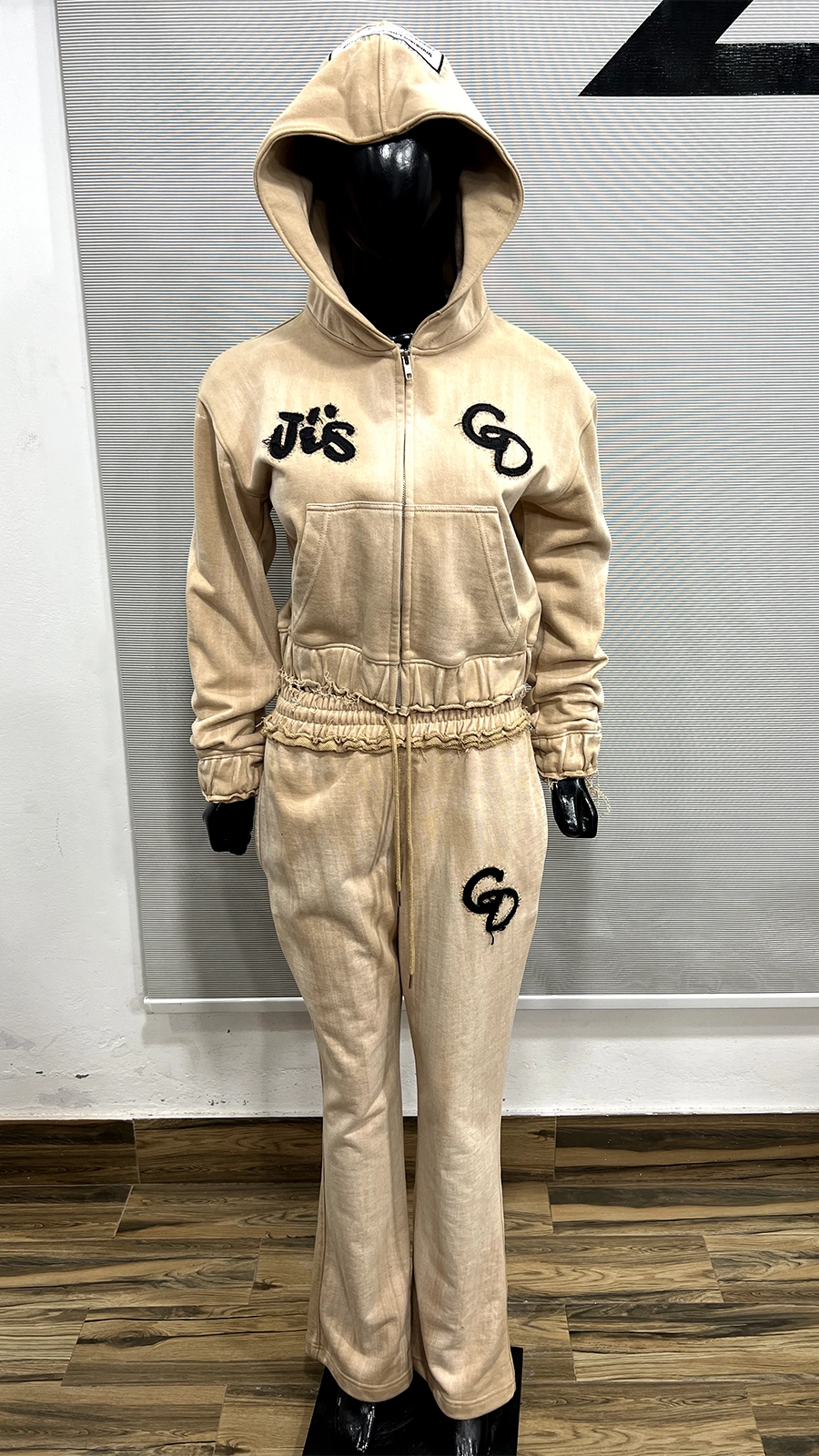
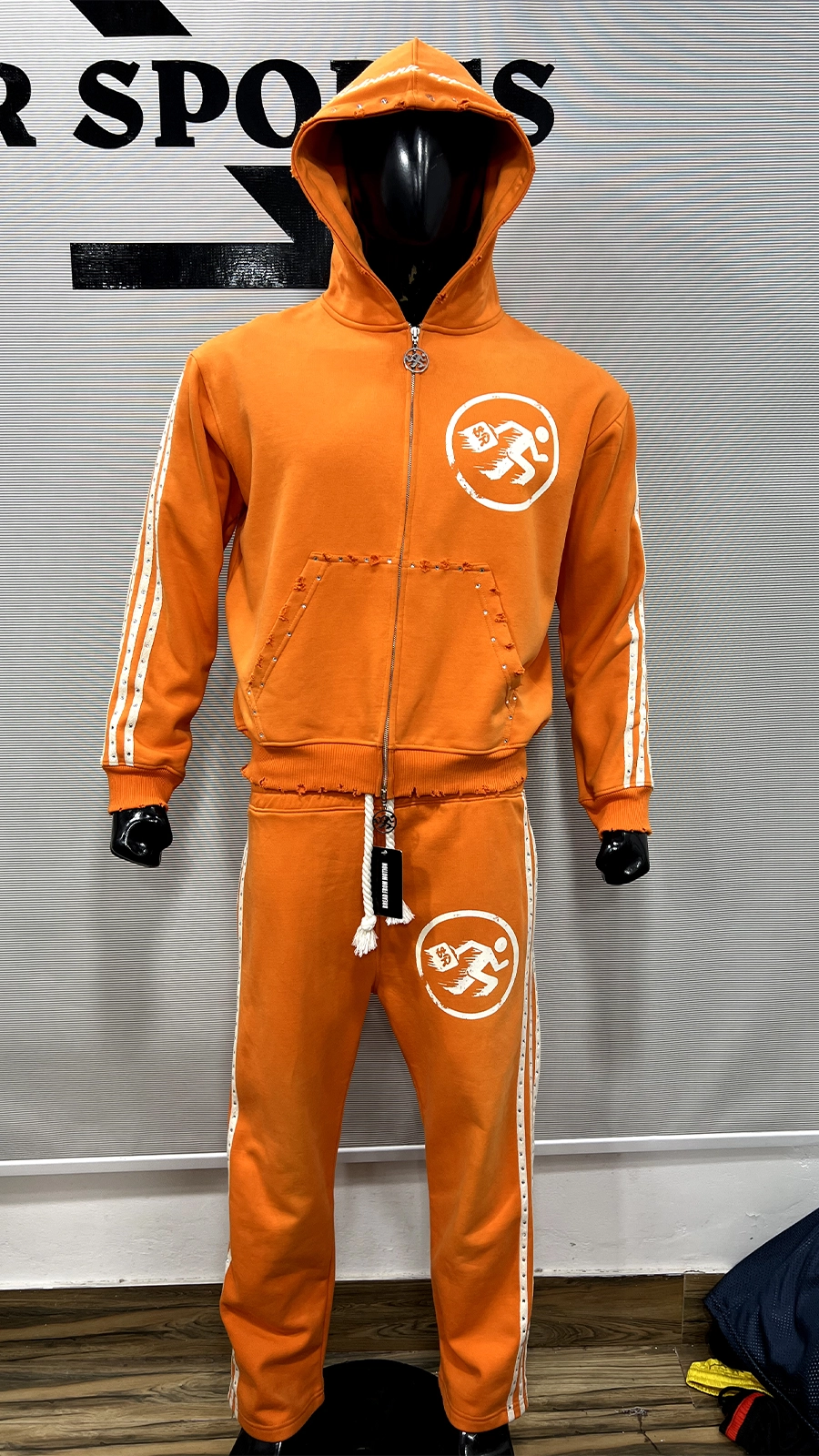
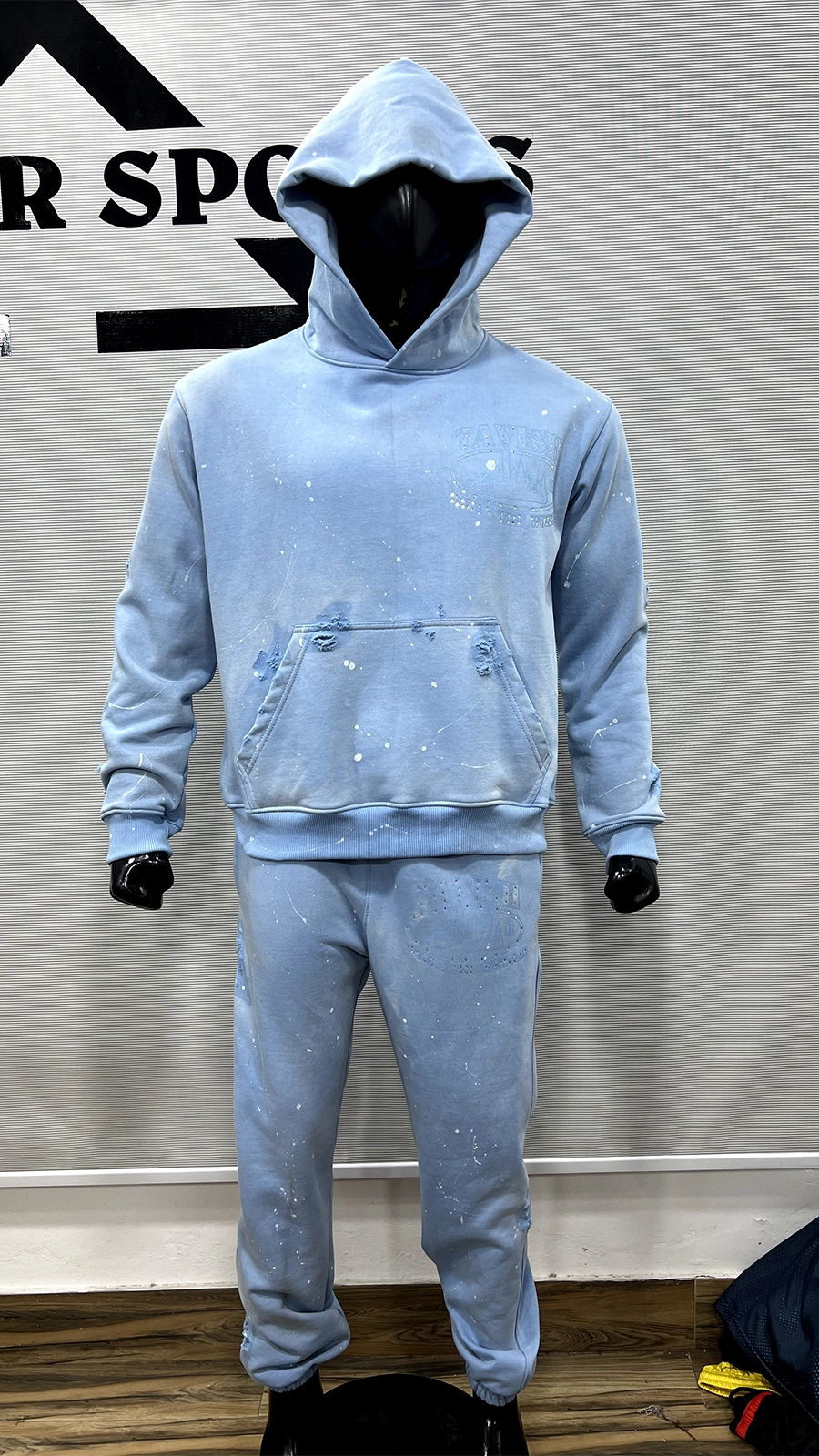
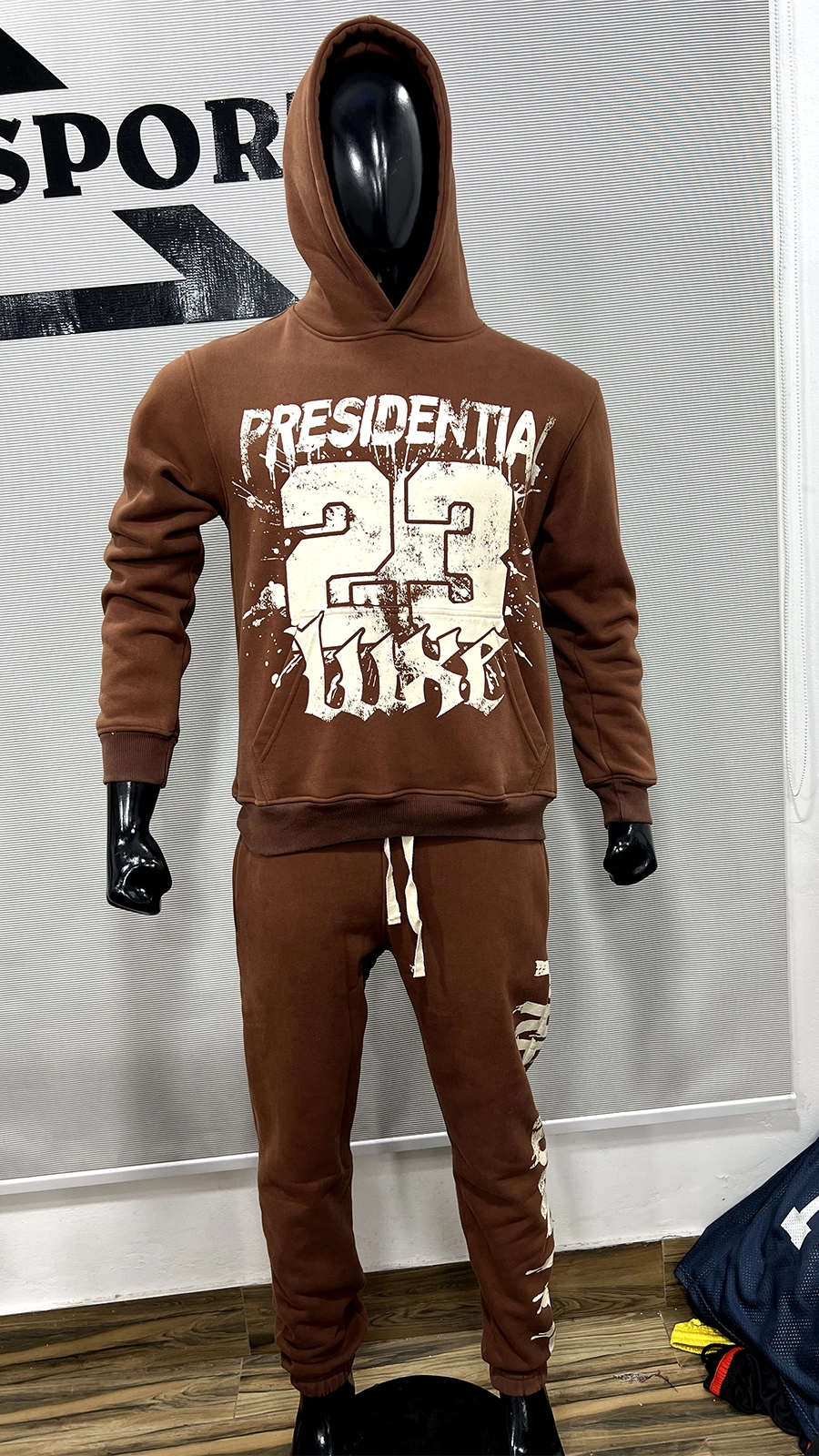
The sets below are production examples from our floor — every order is fully custom to your fabric, colorway, and decoration, not a reprint of what’s shown here.
01 — What We Actually Build: The Matched-Set Concept
What a Standard Size Sweat Suits Manufacturer Actually Builds
Building a proper set isn’t running a hoodie order and a jogger order side by side and hoping the colors land close enough. The two pieces get cut from the same fabric lot, dyed together, and tracked as one build, so the grey on the hood matches the grey on the drawstring waistband — not a shade lighter or warmer.
That matters more than it sounds. Fleece dye lots vary batch to batch, even within the same supplier and the same Pantone reference. Order a hoodie from one production run and joggers from another, and you’ll often get a visible mismatch once they’re side by side in daylight — something a single swatch card never catches on its own. For a matched set, we pull fabric for both pieces from one roll, or one confirmed-matching dye lot, before cutting starts.
Standard size, in this context, means true-to-size fit on both pieces: regular-cut pullover hoodie or crewneck, regular-rise jogger, no added room in the shoulders or extra taper in the leg. That’s the fit most private-label brands launch with, because it’s the easiest for a customer to size against a normal chart without guesswork.
MOQ works a little differently for a set than for a single garment. Fifty pieces per style still applies, but for a set that reads as fifty complete pairs — fifty tops, fifty bottoms, sizes split across both. You’re not ordering fifty random garments; you’re ordering fifty matched pairs, which is why fabric-lot tracking has to happen before the first roll gets cut, not after the fact.
02 — Fabric & Construction: Matching Top and Bottom
Fabric & Construction: Matching Top and Bottom
The hoodie or crewneck top typically runs heavier than the jogger bottom, and that’s intentional, not a mismatch. A slightly heavier top holds its shape through the hood, kangaroo pocket, and drawstring channel, while a lighter bottom keeps the joggers from feeling stiff at the knee and seat.
| Component | Typical GSM | Fabric | Why it’s built this way |
|---|---|---|---|
| Hoodie/crewneck top | 340–400 GSM | Brushed-back cotton/poly fleece | Structure for hood and pocket, warmth without excess bulk |
| Jogger bottom | 320–380 GSM | Same fleece base, often 20–40 GSM lighter | Freer movement, less stiffness at the knee and seat |
| Cuffs, waistband, hem rib | N/A | 95/5 or 97/3 cotton-spandex rib | Stretch recovery has to match at wrist, ankle, and waist or the set reads unfinished |
| Drawcord | N/A | Flat cotton cord, dyed to lot | Ties hood and waistband together visually |
The GSM gap between top and bottom isn’t a corner cut — it’s how most fleece sets are actually built, including ones from brands charging far more than a 50-piece private-label run. What we control for is the color and hand-feel of the fabric base, not forcing an identical weight onto two garments that do different jobs.
Where buyers get this wrong is asking for the exact same GSM on both pieces "to be safe." That usually produces an over-built jogger — heavy, hot, doesn’t move well — or an under-built hoodie with a thin hood and poor shape retention. We’ll flag it at the sample stage if the spec you send doesn’t match how the fabric actually performs on that garment type.
03 — Design, Placement, and File Requirements for a Set
Design, Placement, and File Requirements for a Set
Two garments in one order means two decoration decisions that need to agree with each other, not repeat each other. The most common approach: a primary logo on the hoodie’s left chest, 8–10cm wide, with a smaller secondary mark on the jogger — left thigh or rear hip, rarely both.
Printing or embroidering the same large graphic on both pieces usually reads as busy rather than coordinated. What works better is treating the set as one visual with two touchpoints: a bold mark on top, a quiet confirmation on the bottom.
File requirements are the same as any other decorated garment: vector artwork (AI, EPS, or a high-res PDF) for print and embroidery digitizing, Pantone references for ink, and separate thread-color callouts for embroidery, because thread color and printed ink color from the same Pantone number don’t always look identical on fleece.
One detail specific to sets: if you’re using embroidery on the top and screen print on the bottom — a common combination, since embroidery holds up better on a structured hoodie chest and print is more practical on a jogger leg — specify that the two colors need to match visually, not just by Pantone number. Thread has a sheen print ink doesn’t, so a side-by-side check during sampling matters more here than it would on a single garment.
04 — Quality Checks: What Separates a Matched Set From a Mismatched One
Quality Checks: What Separates a Matched Set From a Mismatched One
Hold the hoodie and jogger up together in daylight, not under factory fluorescents and not one at a time. Shade mismatch between top and bottom is the single most common defect on a cheaply run sweat suit, and it’s invisible under warm indoor lighting but obvious the moment a customer opens the bag at home.
Check the rib trim next. Cuffs, waistband, and hem ribbing should share the same gauge and stretch recovery across both pieces. A stretched-out cuff on the jogger next to a tight, springy cuff on the hoodie is a sign the two pieces weren’t sourced or knitted together.
Stitching should match too: the same top-stitch width, the same thread tension, the same seam type — typically flatlock or coverstitch on fleece — on both garments. A set stitched by two different lines on two different days can drift slightly even with identical machines.
One last check: if there’s a drawcord or metal aglet, confirm the hardware finish matches across hood and waistband when both have one. Cheap runs sometimes source drawcord hardware from two different suppliers under time pressure — a small detail, but exactly the kind a buyer notices in a flat-lay photo before anyone tries the set on.
05 — MOQ and Sampling: What to Expect
MOQ and Sampling for a Standard Size Sweat Suits Manufacturer Order
Fifty sets is the minimum, sizes split however your run needs — more small/medium if that’s your customer base, more large/XL if that’s yours. Both pieces of the set count toward the same 50-unit style minimum; you’re not required to separately hit 50 on the hoodie and 50 on the joggers as if they were unrelated SKUs.
Sampling takes 6–10 days, and this matters specifically for sets: we produce and ship the hoodie and jogger sample together, not staggered. Reviewing them side by side is the only reliable way to catch a fabric-lot mismatch before it’s locked into a 50-unit bulk run. The full sample cost is credited against your bulk order once you approve and place it.
If the sample comes back with any shade difference between top and bottom, that’s on us to fix before bulk cutting, not something you should have to spot and request a redo on — though you’re welcome to hold both pieces up under your own lighting and tell us if anything looks off.
06 — What Moves the Price on a Sweat Suit Set
What Moves the Price on a Sweat Suit Set
Four things drive the cost of a matched set: fabric weight and composition (heavier GSM and cotton-rich blends cost more than poly-heavy fleece), decoration technique and placement count (embroidery plus print across two pieces costs more than a single screen print on one), trim upgrades (branded metal aglets, custom drawcord color, contrast rib all add up), and packaging (bagged as a matched set costs a bit more than bulk-folded cartons, since each set has to be paired and checked before bagging).
We don’t publish flat prices because a set built in 380 GSM French terry with embroidery on both pieces costs meaningfully more than the same set in 320 GSM fleece with a single chest print, and neither number tells you much without knowing which one you actually want. The Instant Quote tool on our site gives you a price estimate in 5 seconds based on your specs, generates a downloadable PDF you can share internally, and lets you continue straight to WhatsApp with that quote pre-filled. The team confirms the final number within 24 hours.
07 — Shipping to the UK and EU Duty-Free
Shipping to the UK and EU Duty-Free
Apparel manufactured in Pakistan enters the UK at 0% duty under the Developing Countries Trading Scheme and the EU at 0% duty under GSP+. That’s a real cost difference on a two-piece set, where duty gets charged on the landed value of both garments combined — from China, the same set typically carries around 12% duty on top of freight. You can read the UK government’s own guidance on the trading scheme for developing nations for the full list of covered categories.
Air freight via DHL or FedEx takes 3–7 days once bulk production wraps. For larger set orders, sea freight is usually the better cost trade-off if your timeline allows for it.
08 — When a Matched Set Isn’t the Right Call
When a Matched Set Isn’t the Right Call
If you actually want an oversized, boxy silhouette — drop shoulders, longer body, wider leg — a standard fit set won’t get you there no matter how much we adjust the pattern. That’s a genuinely different block on both pieces, not a sizing tweak, and it’s worth ordering as Over Size Sweat Suits from the start rather than asking us to loosen a standard-fit pattern after the fact.
It’s also not the right call if you want to sell the hoodie and jogger as separate, mixable SKUs in different colorways — a customer buying black joggers with a cream hoodie, say. That’s not really a "set" anymore, and ordering them as two independent styles gives you more colorway flexibility per piece, even though you lose the guaranteed fabric match.
Table of Contents
Simple Process
From Spec to Shipped, in Four Steps
01
Send Your Set Spec
Top and bottom design, target fabric weight, one coordinated colorway.
02
We Pull Matching Fabric
Top and bottom cut from the same confirmed dye lot before anything gets sewn.
03
Sample Set Ships in 6–10 Days
Hoodie and jogger together, so you can check the match yourself; cost credited to your bulk order.
04
Bulk Runs 12–15 Days
Cut, sewn, decorated, paired, and bagged as complete sets ready for air or sea freight.
Our Advantage
Why Brands Choose Malinor
Floor Video Call Before You Pay Anything
See the actual fabric roll your set will be cut from.
Sample Cost Credited 100% to Your Bulk Order
The sample isn’t a separate expense, it’s a deposit.
Embroidery, Print, and Washing All In-House
No subcontracting one piece of the set to a shop across town and hoping the color still matches when it comes back.
Fast Replies
Questions about a two-piece order don’t sit in a queue while you wait to hear back.
Common Questions
Frequently Asked Questions
Do the hoodie and joggers really come from the same fabric roll?+
Wherever possible, yes — we pull top and bottom from one confirmed dye lot before cutting. When a run is large enough to need two rolls, we hold swatches from both against each other first and only proceed if they match under daylight, not just under the same Pantone number.
Can I order the top in a different size run than the bottom?+
Yes. A size M hoodie doesn’t have to pair with a size M jogger in every unit — we can split the size curve differently across top and bottom within your 50-set minimum, based on your own sizing data.
Is the decoration the same on both pieces?+
Not usually, and we wouldn’t recommend it. A bold chest mark on the hoodie paired with a smaller, secondary placement on the jogger reads better than repeating the same graphic at full size on both pieces.
Are sets shipped bagged together or as separate cartons?+
Bagged together as standard — each poly bag holds one matched top and bottom. Bulk-folded cartons without individual bagging are available too, and cost slightly less if you’re repacking at your own facility anyway.
What’s the MOQ for a sweat suit set?+
Fifty sets per style — fifty tops and fifty bottoms, sizes split across the run. That’s the same 50-unit minimum as any other Malinor style, just applied to a two-piece build instead of one garment.
How long from approved sample to shipped bulk order?+
12–15 days for production once you approve the sample, then 3–7 days by air or longer by sea. Sampling itself takes 6–10 days before that, with the cost credited against your bulk order.
Run Your Spec Through the Instant Quote Tool
Get a price estimate in 5 seconds, a downloadable PDF, and a straight line to WhatsApp with your quote pre-filled. Before you pay anything, we’ll get you on a live video call from the production floor.