Distress T Shirt Manufacturer
Distress T Shirt Manufacturer: Reinforced So a Rip Doesn’t Run
As a distress t shirt manufacturer based in Sialkot, Pakistan, we reinforce every tear specifically to stop a knit fabric’s natural tendency to run or ladder past where you wanted it to stop — a real risk on jersey that fleece mostly doesn’t share. MOQ starts at 50 pieces per style with sizes split however you need, your sample takes 6–10 days and its full cost is credited against the bulk order, and production runs 12–15 days once you approve it.
The pieces below are our own production samples, shot on the factory floor — not stock photos. Every order we run is fully custom to your spec, sizes, and branding.
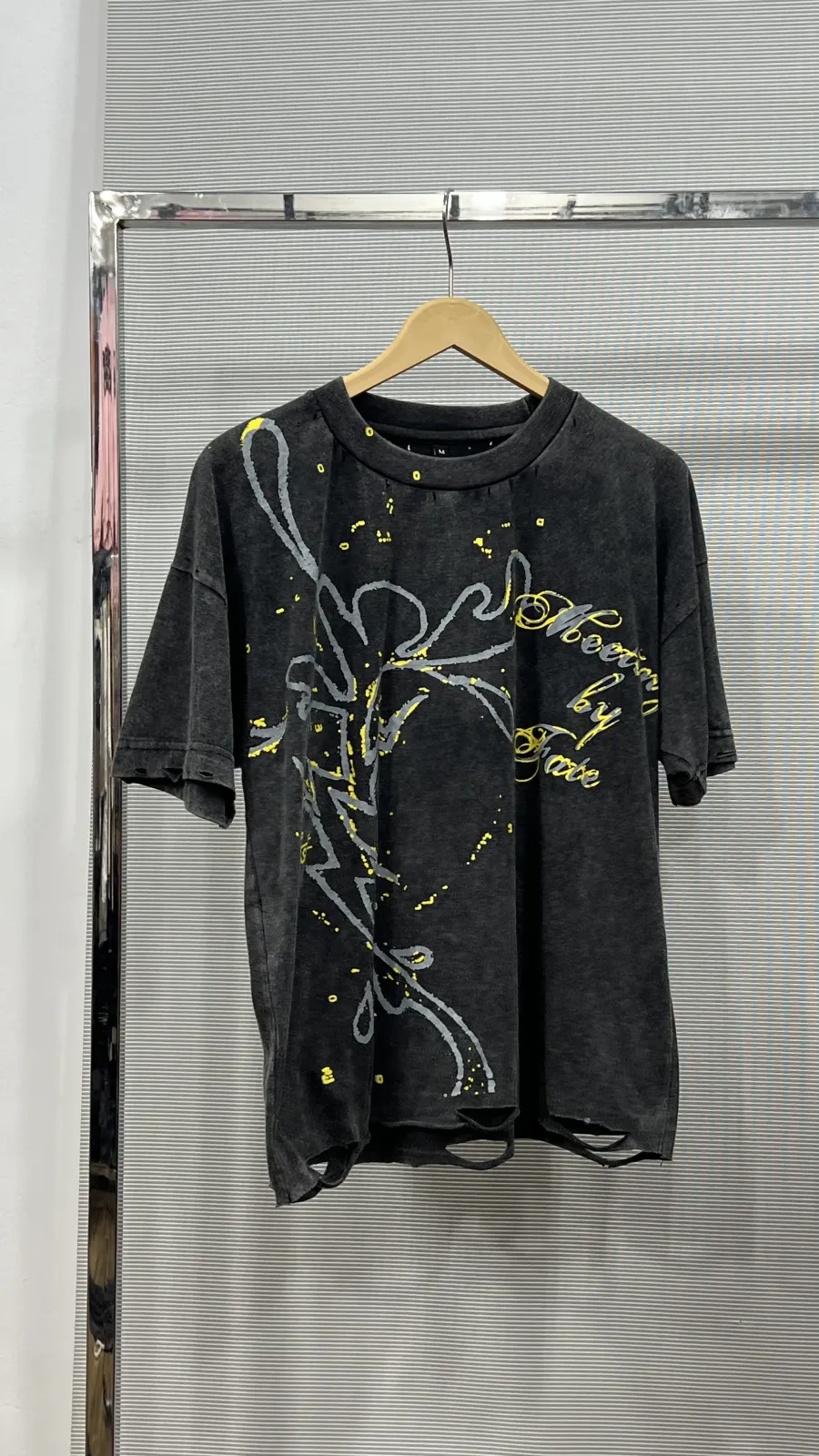
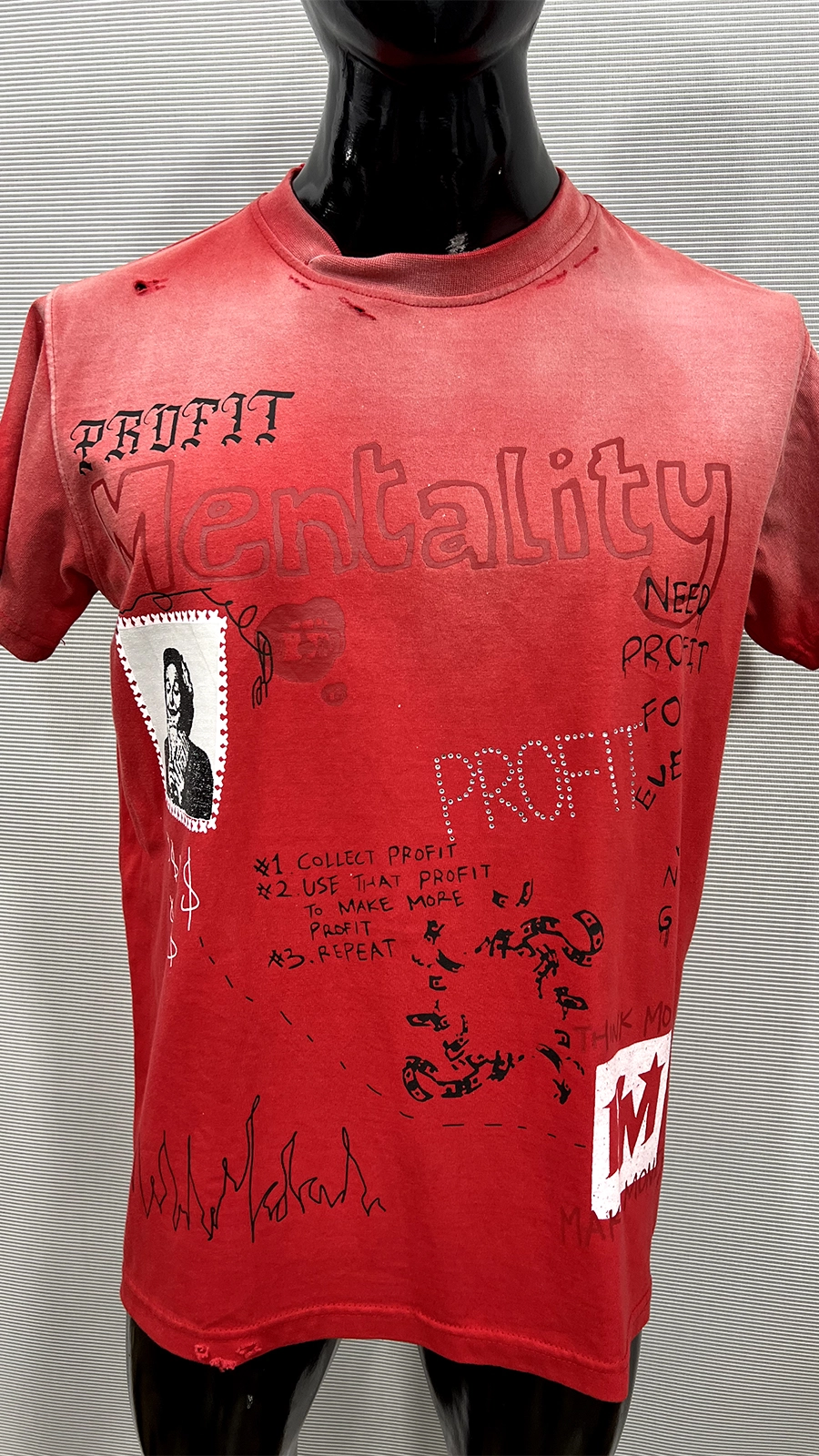
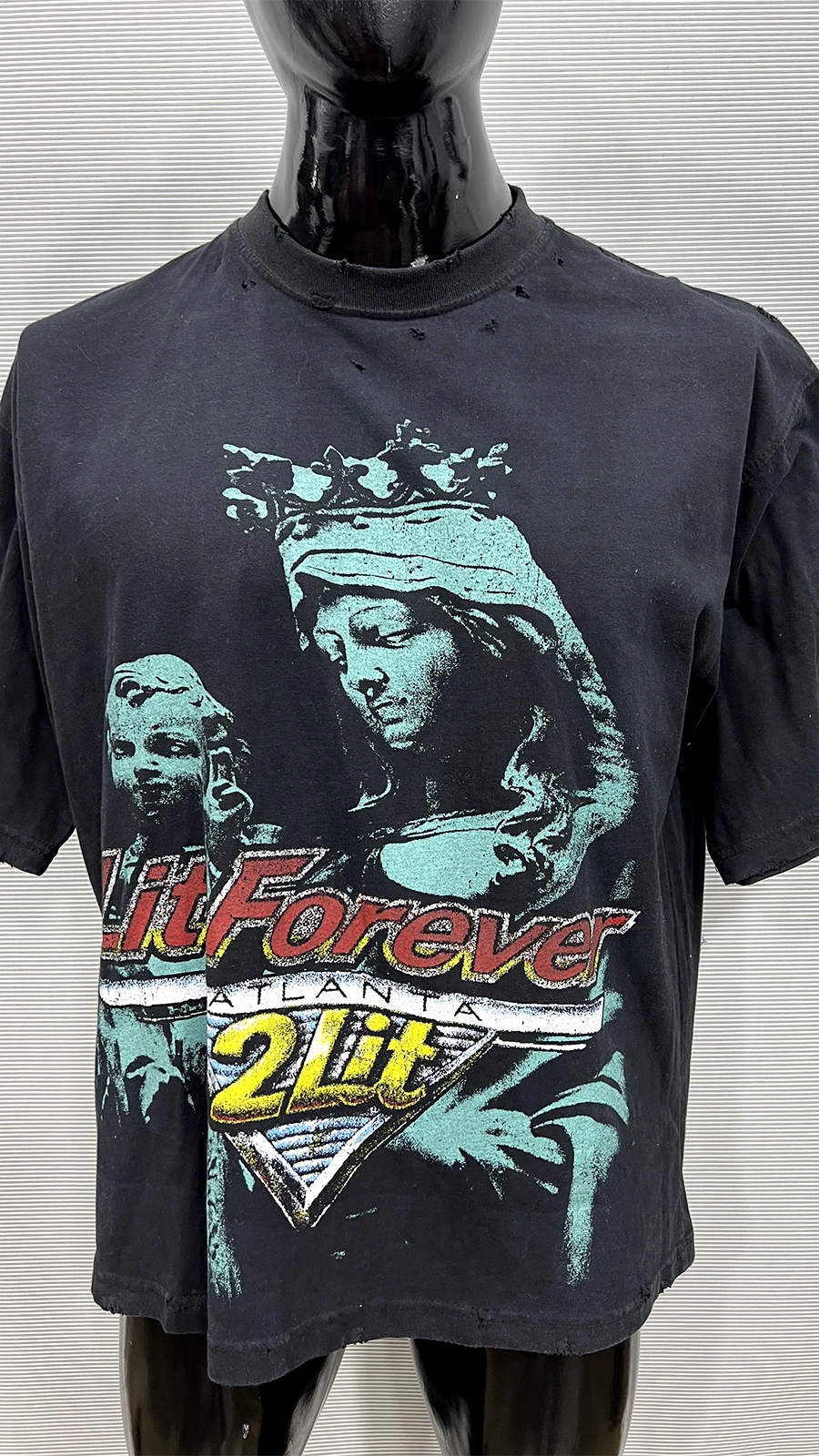
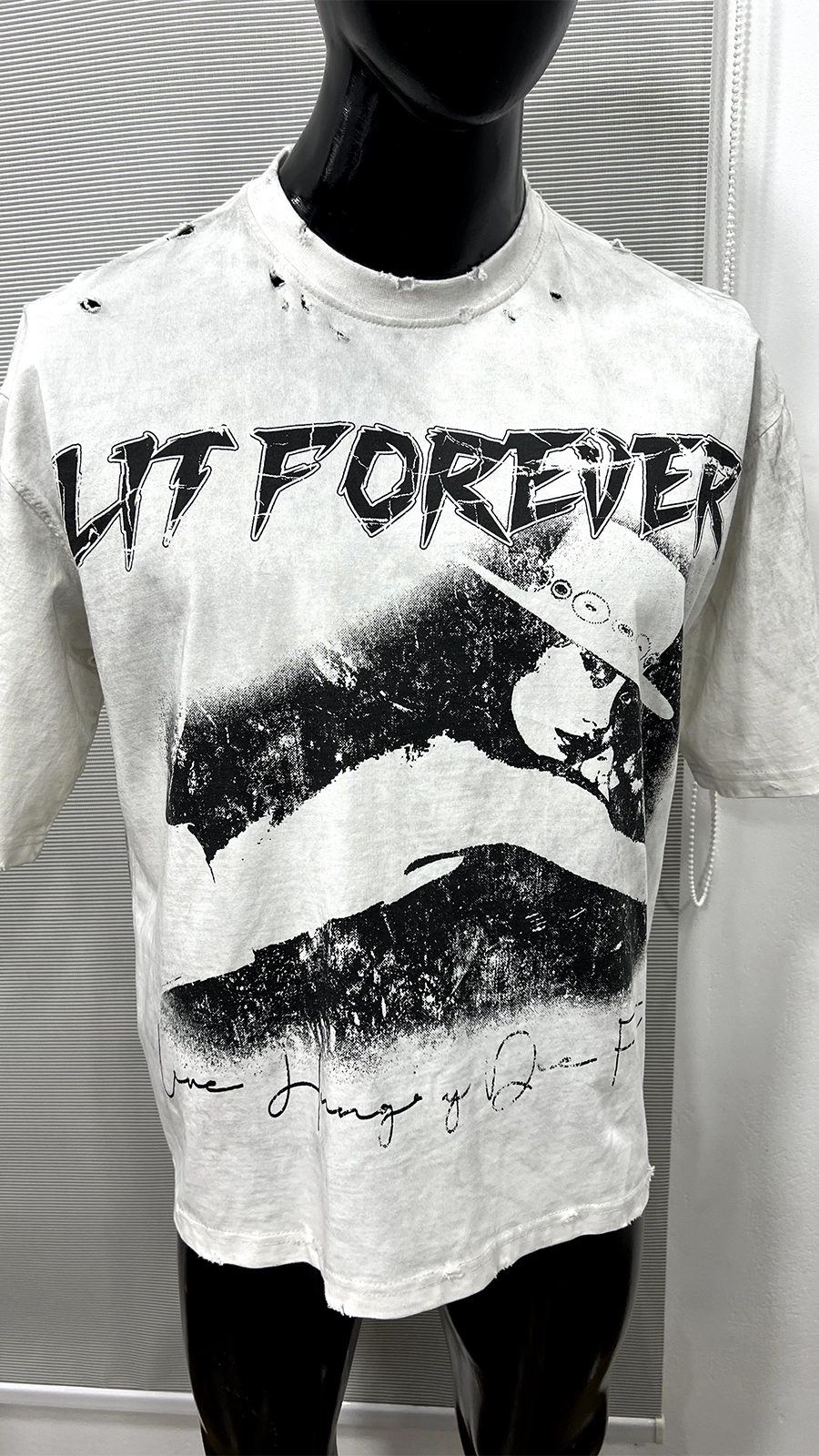
01 — Why Distressing a Tee Risks a Run, Not Just a Tear
What a Distress T Shirt Manufacturer Has to Prevent, Not Just Create
Jersey is a knit fabric, built from interlocking loops of yarn rather than the crossed threads of a woven fabric. That construction matters a lot once you start deliberately tearing it. Break a loop at the wrong point and the structure can unravel in a continuous line — a run, the same phenomenon that ruins a pair of stockings — rather than staying contained to where you wanted the tear to sit. Fleece doesn’t share this risk to the same degree, since its construction and brushed backing behave more like a stable, bonded fabric than an open knit.
That changes what "reinforcement" actually has to accomplish on a distressed tee. On a hoodie, a bar tack at each end of a tear mostly just stops the tear from lengthening. On a tee, that same reinforcement has to specifically arrest a knit’s tendency to run — a more precise, technically demanding job than it sounds like from the outside, and one reason distress work on tees takes more care than the same technique on fleece.
There’s an upside worth naming too. Vintage band tees and thrifted grunge styling are among the biggest established categories in casual fashion — arguably bigger than distressed hoodies as a cultural reference point. And knit fabric actually helps sell the illusion of authentic wear in a way woven fabric doesn’t always manage: a knit naturally shows thinning and minor unraveling at stressed edges the way a genuinely years-old tee would, where a distressed woven can sometimes look more obviously manufactured. Done carefully, a distressed tee can read as more convincingly "actually worn" than the same treatment on other fabric types — which is exactly why it’s worth getting the reinforcement right instead of cutting corners on it.
02 — Fabric and Construction: Heavier Jersey, Lighter Touch
Fabric and Construction: Heavier Jersey, Lighter Touch
| Weight | GSM | Distress Result on a Tee |
|---|---|---|
| Lightweight jersey | 160–180 GSM | High risk of unintended holes or laddering |
| Midweight jersey | 180–200 GSM | Workable for light, restrained distressing |
| Heavier jersey | 200–220+ GSM | The most reliable support for reinforced rips |
Sanding carries the same risk here as it does on our other tee-decoration pages that touch this fabric — thin jersey sands through to an unintended hole much faster than heavier fleece does, so the process needs a lighter, more closely watched touch. Combined with the running risk above, this is one of the more technically demanding combinations in our lineup, which is exactly why we default to recommending heavier tee weights for anything beyond a very light, restrained sanding pass.
03 — Placement and Spec Requirements for a Tee's Different Wear Zones
Placement and Spec Requirements for a Tee’s Different Wear Zones
A tee’s wear-zone map looks different from a hoodie’s, simply because the garment itself is a different shape. There’s no ribbed cuff or kangaroo pocket to distress — instead, the classic zones are the hem, the collar or neckline edge, and occasionally the shoulder seams. Frayed neckline distressing in particular is a signature move on vintage-style tees that doesn’t really have an equivalent on a hooded garment.
The same upfront decision applies as on any distress order: tight consistency across the run, or intentional natural variation piece to piece. On a tee specifically, leaving distress placement genuinely uncontrolled carries a bit more risk than it does on fleece, given the running tendency covered above — even "natural variation" needs some baseline control to keep a tear from spreading further than intended. Send us reference photos marking your target zones, tear length and direction, and sanding intensity, and we’ll build a spec around it.
Distress on tees is also very commonly paired with the fabric’s own wash or dye treatment — an acid wash or garment dye applied to the base tee before or alongside the distressing, so the whole piece reads as consistently worn rather than having a distressed logo area that looks out of place against an otherwise crisp garment. If you’re planning that combination, mention it upfront; the wash treatment and the distress work interact, and planning them together tends to give a more convincing result than layering one onto a garment already finished with the other.
04 — What Separates Controlled Wear From a Ladder That Won't Stop
What Separates Controlled Wear From a Ladder That Won’t Stop
Give any reinforced tear a gentle tug, the same check as on any distressed garment — but on a tee, also check a few centimeters beyond the reinforced point for any sign the knit structure is starting to run. That’s the failure mode specific to this fabric, and it’s not always obvious from a quick glance the way an unraveling woven edge would be.
Check sanded spots for the same thing as any distress job — thin without breaking through, unless a hole was specifically requested — and check any frayed neckline edge is finished enough to hold its shape rather than continuing to unravel with normal wear. These checks run on every sample before it’s approved for bulk.
We test reinforcement specifically for run resistance before any bulk order ships — pulling gently across the width of the fabric near each tear, not just lengthwise along it, since a knit’s tendency to run doesn’t always follow the direction you’d instinctively check first. It’s a small extra step compared to inspecting a woven fabric tear, but it’s the difference between a reinforced tear that stays exactly where you designed it and one that keeps spreading a little more with every wash.
05 — MOQ and Sampling With Your Distress T Shirt Manufacturer
MOQ and Sampling With Your Distress T Shirt Manufacturer
MOQ is 50 pieces per style, split across whatever size run you need. Sampling takes 6–10 days, and the full cost is credited against your bulk order once you move forward.
Review the sample for durability as much as look, the same principle as any distress order — but specifically stretch the fabric near any reinforced tear to confirm the knit isn’t starting to run beyond where it’s meant to stop. That’s a check worth doing yourself, not just trusting a photo, given how much this particular risk depends on how the fabric behaves under real tension.
If you’re new to ordering distressed tees, it’s worth asking us to explain what we’re checking on the sample rather than just approving or rejecting it on sight. A run risk that hasn’t manifested yet can still be present in how a reinforcement was executed, and it’s the kind of thing that’s easier to flag with a quick explanation from someone who’s checked hundreds of these than to catch cold on your own first order.
06 — What Actually Moves Your Price
What Actually Moves Your Price
Distressing is a manual or semi-manual process, so price scales with the number of distress points and how technically demanding each one is. Reinforcement against a potential knit run takes more precision than reinforcing a simple lengthwise tear on fleece, which is part of why distress work on tees can carry a slightly different cost profile than the same design would on a hoodie. Fabric GSM, whether the distressing is combined with a wash treatment, and total order volume round out the rest.
If you’re pairing distress with an acid wash or garment dye, factor both into your budget from the start rather than pricing them separately in your head — the two processes are usually sequenced together on the same production run, which is more efficient than treating them as fully independent line items, but it does mean the combined cost is worth discussing as a single package with our team.
We don’t publish flat pricing because those variables interact too much to be useful as a single number. Run your spec through our Instant Quote tool instead — it gives you a price estimate in 5 seconds, a downloadable PDF quote, and a direct line to WhatsApp with your quote pre-filled. Final pricing is confirmed by our team within 24 hours.
07 — Shipping to the UK and EU Duty-Free
Shipping to the UK and EU Duty-Free
Manufacturing in Pakistan carries a trade advantage worth factoring into your landed cost. Apparel made here enters the UK at 0% duty under the Developing Countries Trading Scheme, and the EU at 0% duty under GSP+, versus roughly 12% on equivalent goods sourced from China.
Details on eligibility and the current tariff schedule are on the UK government’s own guidance page: Developing Countries Trading Scheme (DCTS) — GOV.UK. It’s worth checking that page directly if landed cost is a factor in comparing us against a supplier based somewhere without the same preferential access.
08 — When Distress Isn't the Right Call on a Tee
When Distress Isn’t the Right Call on a Tee
Distress isn’t the right call on a genuinely lightweight tee — under about 160–180 GSM, the fabric is prone to unintended holes and knit-running that no amount of careful technique fully controls. It’s also the wrong fit for activewear, where deliberate thin spots and holes work against durability expectations, and for budget-conscious high-volume basics, since the manual reinforcement work adds real cost. If you want a worn-in look without the structural risk, our Acid Washed T Shirt page delivers that faded vintage color without any tear-and-run tradeoffs.
Table of Contents
Simple Process
From Spec to Shipped, in Four Steps
01
Quote & Spec
Run your GSM, distress zones, and intensity through the Instant Quote tool; get a price estimate and a downloadable PDF in 5 seconds.
02
Sample
We sand, tear, and reinforce a physical sample in 6–10 days; you can join a live video call from the floor before it ships.
03
Approve & Bulk
Approve the sample (its cost is credited to your order) and we run your full size and quantity — production takes 12–15 days.
04
Ship
Finished tees go out via DHL/FedEx air (3–7 days) or sea freight for larger volumes, landing duty-free in the UK and EU.
Our Advantage
Why Brands Choose Malinor
Floor Video Call Before You Pay Anything
See your actual distress run in production, not a stock photo, before you commit to bulk.
Sample Cost Credited in Full
Nothing you spend on sampling is wasted once you move to bulk.
In-House Sanding, Distressing, and Reinforcement
No subcontracting any decoration step to a third shop, so your timeline doesn’t depend on someone else’s queue.
Fast, Direct Replies
Most quote and spec questions get answered within 2 hours during business hours.
Common Questions
Frequently Asked Questions
Why does distressing a t-shirt risk a "run" the way distressing a hoodie doesn’t?+
Jersey is built from interlocking loops of yarn, the same basic structure as a knit stocking. Break a loop at the wrong point during a deliberate tear and the fabric can unravel in a continuous line rather than staying contained. Fleece’s more stable, bonded construction doesn’t share this tendency to the same degree, which is why reinforcement has to work harder on a tee.
Where are the natural wear zones on a distressed t-shirt?+
The hem, the neckline or collar edge, and occasionally the shoulder seams — a different map than a hoodie’s, since there’s no cuff or kangaroo pocket on a tee. Frayed neckline distressing specifically is a signature move on vintage-style tees that doesn’t really have an equivalent placement on a hooded garment.
Can the neckline be distressed on a t-shirt?+
Yes, and it’s one of the most recognizable distressed-tee moves — a frayed or worn-looking edge around the crew or v-neck. It needs to be finished carefully so it holds its shape rather than continuing to unravel with normal wear, the same reinforcement principle that applies to any deliberate tear on this fabric.
Will sanding go all the way through my t-shirt fabric?+
It can, if the pass is too aggressive for the fabric weight — thin jersey sands through to an unintended hole faster than heavier fleece does. We use a lighter, more closely monitored touch on tees for exactly this reason, and recommend a heavier GSM for anything beyond a very light, restrained sanding effect.
What’s the minimum order quantity?+
50 pieces per style, with sizes split however your size run needs — you’re not locked into 50 of one size. A distressed tee and an acid-washed tee in the same order each need their own 50-piece minimum, since they’re different styles.
How long does shipping take?+
DHL or FedEx air freight takes 3–7 days worldwide once your order is finished. For larger volumes, sea freight is available at a lower cost per unit but a longer transit time — we’ll walk you through both options once your bulk order is confirmed and ready to move.
Run Your Spec Through the Instant Quote Tool
Get a price estimate in 5 seconds, a downloadable PDF, and a straight line to WhatsApp with your quote pre-filled. Before you pay anything, we’ll get you on a live video call from the production floor.