Screen Printing Sweat Pants Manufacturer
Screen Printing Sweat Pants Manufacturer That Prints on a Leg-Shaped Platen
As a screen printing sweat pants manufacturer based in Sialkot, Pakistan, we load each leg onto a platen actually shaped to slide inside it and hold it flat and taut — not a flat chest board pressed into service for a job it wasn’t built for. MOQ starts at 50 pieces per style with sizes split however you need, your sample takes 6–10 days and its full cost is credited against the bulk order, and production runs 12–15 days once you approve it.
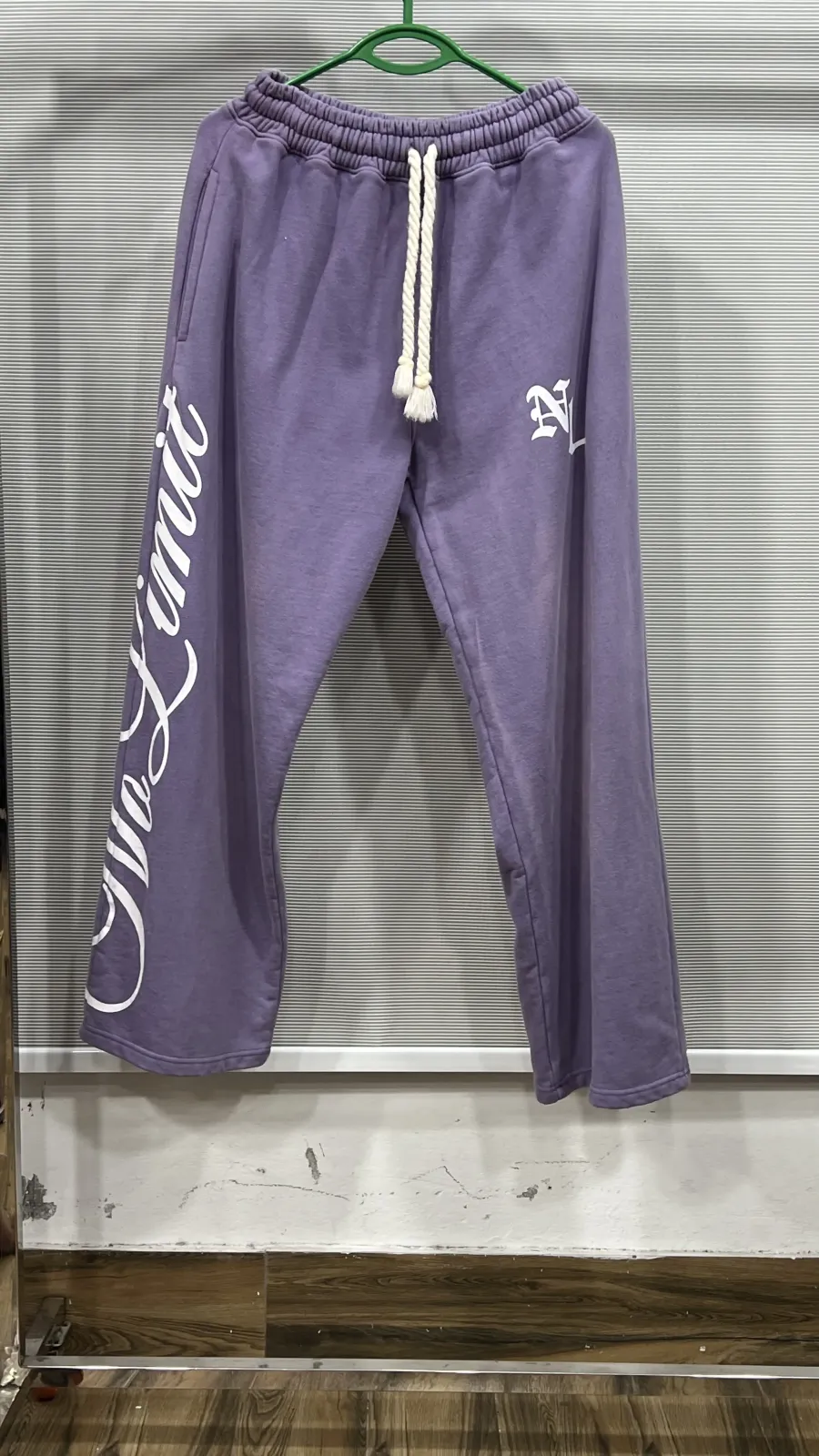
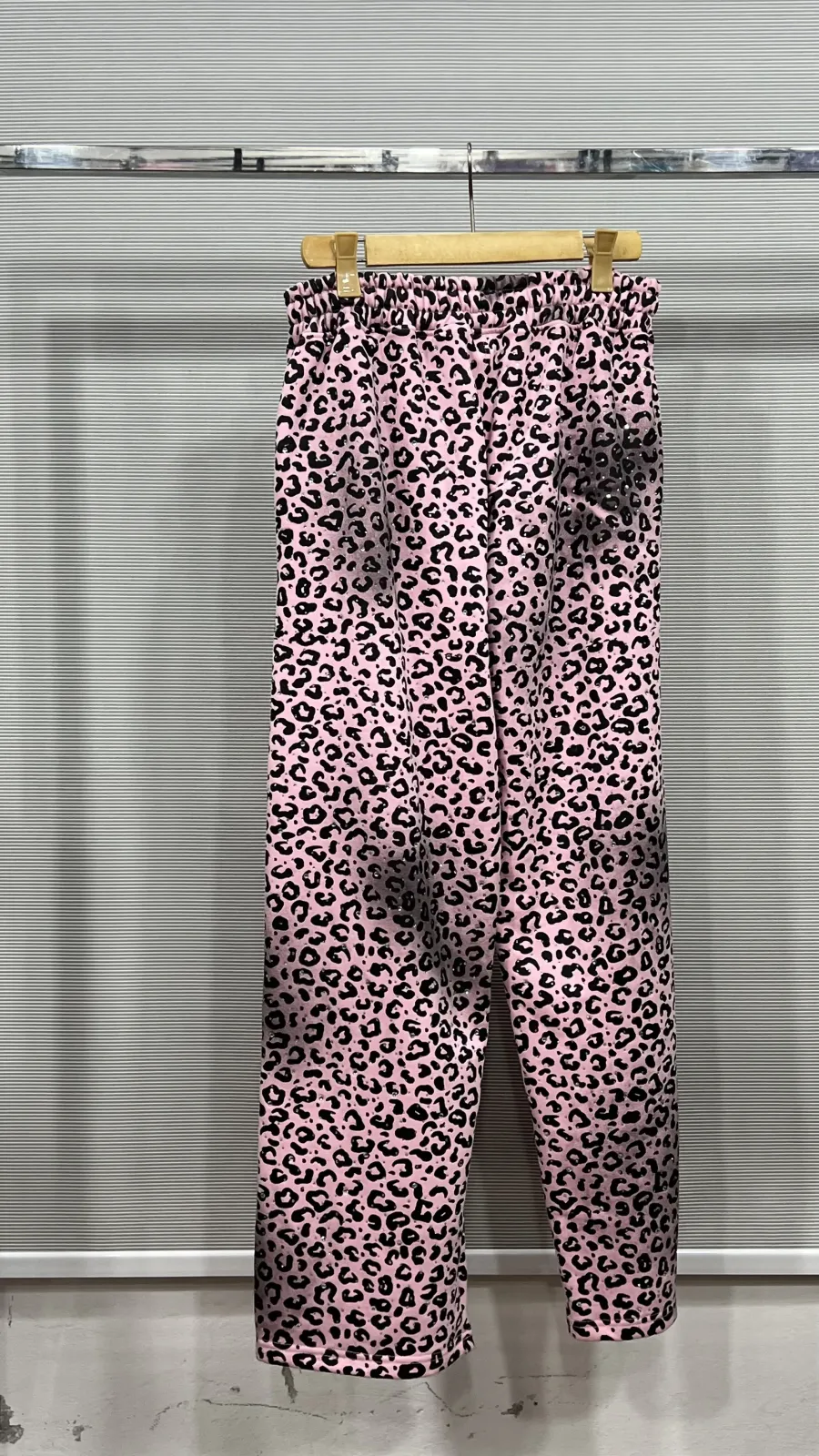
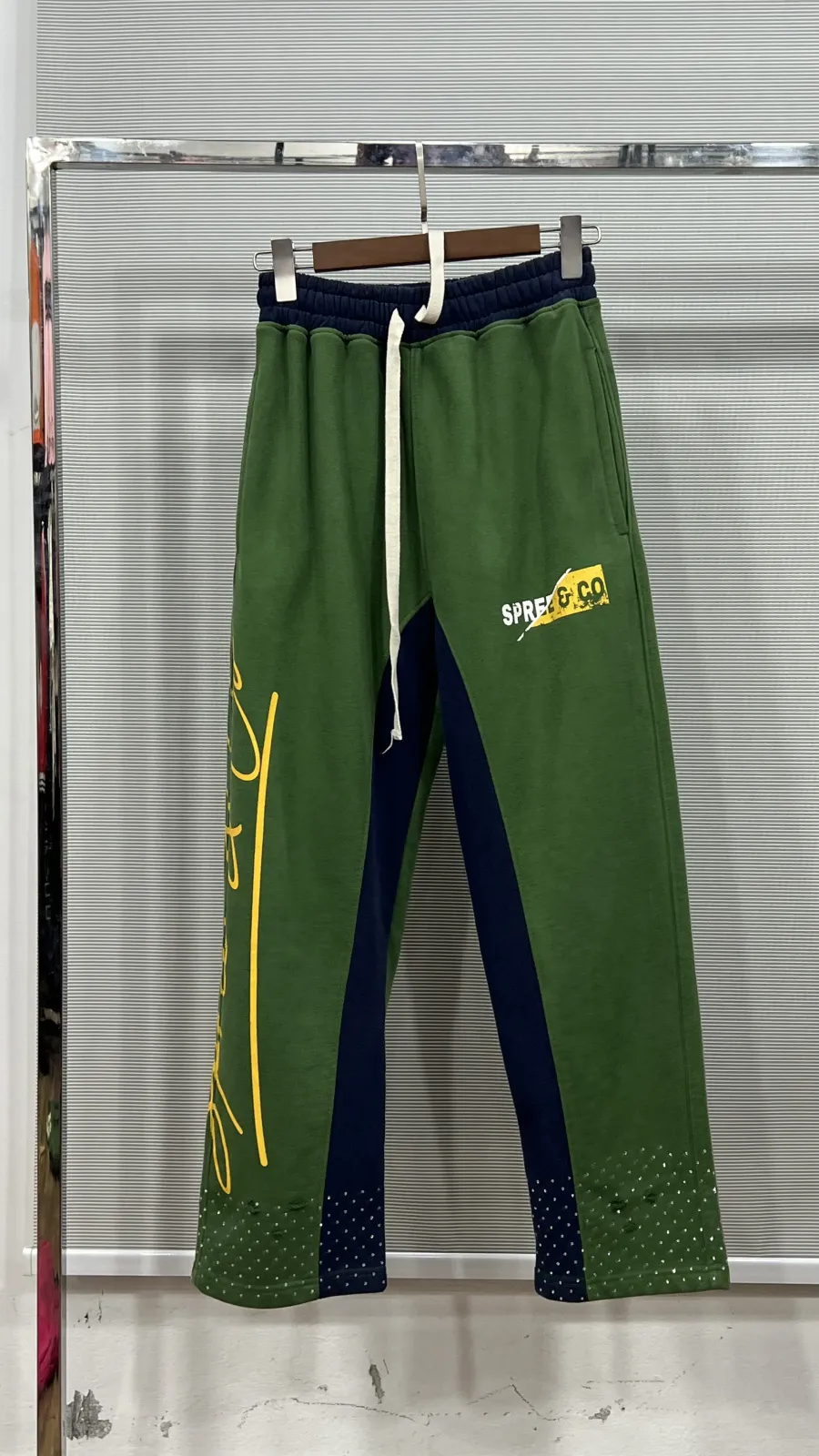
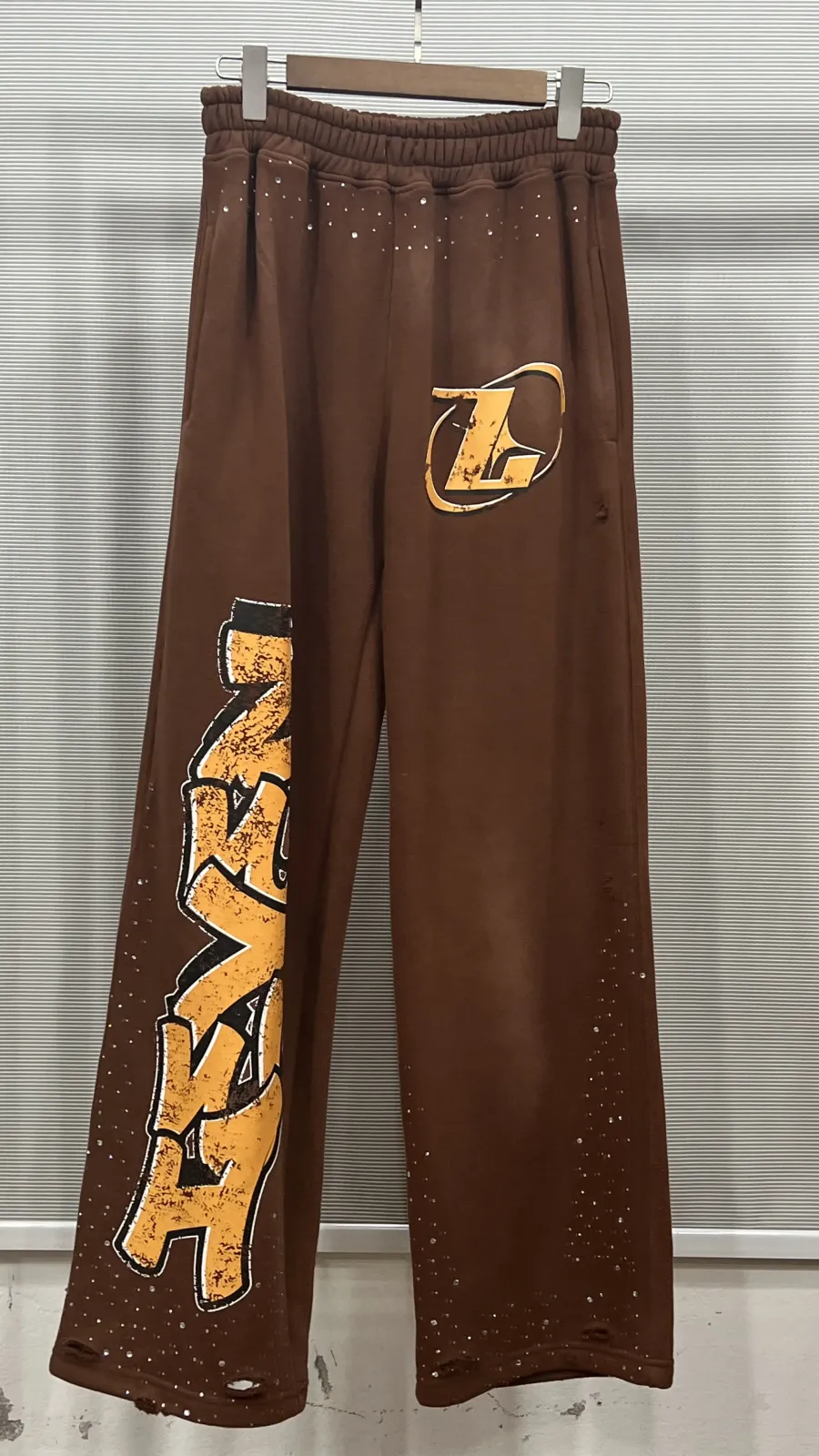
The pieces below are our own production samples, shot on the factory floor — not stock photos. Every order we run is fully custom to your spec, sizes, and branding.
01 — What Loading a Leg for Printing Actually Requires
What a Screen Printing Sweat Pants Manufacturer Loads Differently
A hoodie or tee prints on a flat board platen — the garment goes over it, the panel lies flat, done. A sweatpant leg is a tube, and screen printing needs a genuinely different piece of equipment to handle it: a leg-shaped platen, built to slide inside the leg opening and hold the fabric flat and taut from the inside, rather than a flat board pressed against an outer panel.
That’s not a minor variation on the same setup. A leg platen has to account for the taper of the leg — wider at the thigh, narrower toward the ankle — and loading the garment correctly onto it takes more care than dropping a flat panel over a standard board. Get the loading wrong and the fabric can bunch or shift slightly during the print pass, which shows up as a soft or doubled edge on the finished design.
We keep a dedicated set of leg-shaped platens sized across our standard range, rather than trying to make one flat board work across every garment type we print. That’s a real equipment investment specific to running sweatpants well, and it’s part of why leg placements take a bit more setup time per piece than the same design would on a hoodie’s flat front panel.
02 — Fabric and Construction: Ink Deposit on Heavy Fleece
Fabric and Construction: Ink Deposit on Heavy Fleece
Sweatpants fabric runs in the same heavy range as hoodie fleece — typically 350–500 GSM — which means the same core ink logic applies: a coarser mesh to push ink into the textured surface, plastisol as the durable default, and a white underbase when printing light colors on a dark base. None of that changes just because the garment is pants instead of a top.
What is different is what happens after the ink goes down. A tubular leg, still wet with ink, has to move through flash-drying and final cure without the fabric folding onto itself in a way that transfers ink to a spot it shouldn’t touch. A flat hoodie panel doesn’t have this risk in the same way — there’s no second layer of the same garment right behind it to smear against. We handle sweatpant legs through the curing process specifically with this in mind, keeping the printed surface open and unfolded until the ink has fully set.
Mesh count matters slightly differently here too. The curved surface at the hip and upper thigh takes ink a touch less predictably than the flatter section further down the leg, so a mesh count that reads perfectly even on a flat chest panel can show subtle unevenness across a curved hip placement if it isn’t adjusted. We check ink coverage specifically at any curved section of a design rather than assuming uniform results across the whole print.
03 — Placement, Registration on a Tapered Leg, and File Requirements
Placement, Registration on a Tapered Leg, and File Requirements
Placement geography matches what we cover on our embroidery sweatpants page — hip and outer thigh for a sponsor-style logo, a side-seam stripe or vertical text running the leg, or a waistband-adjacent mark. Where screen printing genuinely pulls ahead of embroidery on this garment is large coverage: a big thigh graphic or a full-leg design that would get heavy and expensive stitched in thread prints efficiently and economically here, since screen printing’s cost scales with color count and coverage area rather than stitch count.
Multi-color registration gets more complicated on a leg than on a flat chest panel specifically because of the taper — a design has to hold its alignment across a surface that changes width as it runs down the leg, not a consistent flat area. If you want the same design mirrored on both legs, both need to print with matched registration and placement, the same symmetry requirement that applies to embroidery. Send us artwork with placement marked relative to the waistband, side seam, or hem, and flag early if the design needs to account for the leg’s taper rather than assuming a flat surface.
For a design that runs the full length of the leg — a side stripe, for instance — the color separation needs to be planned with the taper in mind from the start, not adjusted after the fact. A stripe of constant width looks subtly different against a widening thigh than it does against a narrowing ankle, and getting that consistent visually (rather than just numerically) sometimes means the file itself needs slight width compensation built in along its length.
04 — What Separates a Clean Leg Print From a Smeared or Misregistered One
What Separates a Clean Leg Print From a Smeared or Misregistered One
Check registration first, the same way you would on any multi-color print — clean edges at every color transition, no fringing or halo. On a leg specifically, check that registration holds consistently from the wider thigh area down through the narrower ankle if your design spans that range; a design that lines up perfectly at the top but drifts slightly by the hem points to a platen-loading issue.
Check for any faint transfer marks or ghosting where the fabric might have folded against wet ink during handling — a subtle smudge that wasn’t part of the design is the tell-tale sign of a curing process that didn’t keep the leg properly open. And if you’ve ordered a mirrored two-leg design, lay both legs flat side by side and confirm the print matches in placement and size across both.
05 — MOQ and Sampling: What to Expect
MOQ and Sampling With Your Screen Printing Sweat Pants Manufacturer
MOQ is 50 pieces per style, split across whatever size run you need. Sampling takes 6–10 days, and the full cost is credited against your bulk order once you move forward.
Because leg printing involves genuinely different equipment and handling than a flat chest job, the sample stage is where you confirm registration holds across the taper and that curing hasn’t left any transfer marks — check both specifically rather than just approving on overall visual impression. If your design spans a large area of the leg, request to see it under a few different angles of light, since ink deposit issues sometimes show up more clearly that way than in a single flat photo.
If you’re ordering both a small placement (a hip logo, say) and a large-coverage design (a full-leg graphic) as part of the same collection, it’s worth sampling both separately even if they’ll ship in the same bulk order — the equipment and handling considerations genuinely differ between a small placement and a large one, and a sample that confirms one doesn’t automatically confirm the other.
06 — What Actually Moves Your Price
What Actually Moves Your Price
Number of colors, placement size and coverage, and total order volume move the price the same way they would on any screen-printed garment. The leg-shaped platen setup adds a modest amount to placement cost compared to a flat chest job, but screen printing’s fixed per-color setup cost still amortizes across your run the same way it always does — which is exactly why large leg graphics are genuinely economical here in a way they wouldn’t be with embroidery’s per-stitch scaling.
If you’re deciding between embroidery and screen printing for a sweatpant design, coverage size is usually the deciding factor more than anything else. A small, precise chest-logo-scale placement often costs similarly either way; a large thigh or full-leg design tips the economics firmly toward screen printing, since the cost there doesn’t scale with density the way stitched thread does.
We don’t publish flat pricing because those variables interact too much to be useful as a single number. Run your spec through our Instant Quote tool instead — it gives you a price estimate in 5 seconds, a downloadable PDF quote, and a direct line to WhatsApp with your quote pre-filled. Final pricing is confirmed by our team within 24 hours.
07 — Shipping to the UK and EU Duty-Free
Shipping to the UK and EU Duty-Free
Manufacturing in Pakistan carries a trade advantage worth factoring into your landed cost. Apparel made here enters the UK at 0% duty under the Developing Countries Trading Scheme, and the EU at 0% duty under GSP+, versus roughly 12% on equivalent goods sourced from China.
Details on eligibility and the current tariff schedule are on the UK government’s own guidance page: Developing Countries Trading Scheme (DCTS) — GOV.UK. It’s worth checking directly if landed cost is a factor in your sourcing decision.
08 — When Screen Printing Isn't the Right Call
When Screen Printing Isn’t the Right Call
Screen printing isn’t the right call for a very small, highly detailed logo where the screen setup cost isn’t justified relative to the placement size — embroidery or a smaller digital print handles that more economically. It’s also not the choice for photorealistic detail or gradients, which spot-color screens can’t reproduce cleanly. For a small detailed logo, our Embroidery Sweat Pants page is a better starting point; for photographic detail, see our DTG Printing Sweat Pants page instead.
Table of Contents
Simple Process
From Spec to Shipped, in Four Steps
01
Quote & Spec
Run your GSM, color count, and placement through the Instant Quote tool; get a price estimate and a downloadable PDF in 5 seconds.
02
Sample
We load the leg onto a shaped platen and print a physical sample in 6–10 days; you can join a live video call from the floor before it ships.
03
Approve & Bulk
Approve the sample (its cost is credited to your order) and we run your full size and quantity — production takes 12–15 days.
04
Ship
Finished sweatpants go out via DHL/FedEx air (3–7 days) or sea freight for larger volumes, landing duty-free in the UK and EU.
Our Advantage
Why Brands Choose Malinor
Floor Video Call Before You Pay Anything
See your actual print run in production, not a stock photo, before you commit to bulk.
Sample Cost Credited in Full
Nothing you spend on sampling is wasted once you move to bulk.
In-House Ink Mixing and Curing
No subcontracting any decoration step to a third shop, so your timeline doesn’t depend on someone else’s queue.
Fast, Direct Replies
Most quote and spec questions get answered within 2 hours during business hours.
Common Questions
Frequently Asked Questions
How is screen printing sweatpants different from printing a t-shirt?+
The equipment changes. A tee prints on a flat board platen; a sweatpant leg needs a leg-shaped platen that slides inside the leg opening to hold it flat and taut from the inside. Loading and registration both need more care here than on a flat chest panel, and curing has to account for the tubular shape so wet ink doesn’t transfer if the fabric folds.
Can screen printing cover a large area of the leg economically?+
Yes — this is actually where screen printing pulls ahead of embroidery on sweatpants. Screen print cost scales with color count and coverage area rather than stitch count, so a big thigh graphic or full-leg design prints efficiently here in a way that would get heavy and expensive if stitched in thread instead.
Why is registration harder on a sweatpant leg than a flat chest panel?+
Because the leg tapers — wider at the thigh, narrower toward the ankle — a multi-color design has to hold its alignment across a surface that changes width as it runs down, not a consistent flat area. That’s a genuinely different registration challenge than lining up colors on a flat panel of uniform shape.
Can the same design be printed symmetrically on both legs?+
Yes, and it’s a common request for side-seam stripes or mirrored logos. Both legs need to print with matched registration and placement so the design lines up when the pants are worn — the same symmetry requirement that applies to mirrored embroidery designs on this garment.
What’s the minimum order quantity?+
50 pieces per style, with sizes split however your size run needs — you’re not locked into 50 of one size. A screen-printed sweatpant and an embroidered sweatpant in the same order each need their own 50-piece minimum, since they’re different styles.
How long does shipping take?+
DHL or FedEx air freight takes 3–7 days worldwide once your order is finished. For larger volumes, sea freight is available at a lower cost per unit but a longer transit time — we’ll walk you through both options once your bulk order is confirmed and ready to move.
Run Your Spec Through the Instant Quote Tool
Get a price estimate in 5 seconds, a downloadable PDF, and a straight line to WhatsApp with your quote pre-filled. Before you pay anything, we’ll get you on a live video call from the production floor.