Embroidery Sweat Pants Manufacturer
Embroidery Sweat Pants Manufacturer Where Hooping Gets More Complicated
As an embroidery sweat pants manufacturer based in Sialkot, Pakistan, we hoop a curved, tube-shaped leg the same carefully as a flat chest panel — a genuinely different technical challenge that a rushed shop skips past at the cost of stitching quality. MOQ starts at 50 pieces per style with sizes split however you need, your sample takes 6–10 days and its full cost is credited against the bulk order, and production runs 12–15 days once you approve it.
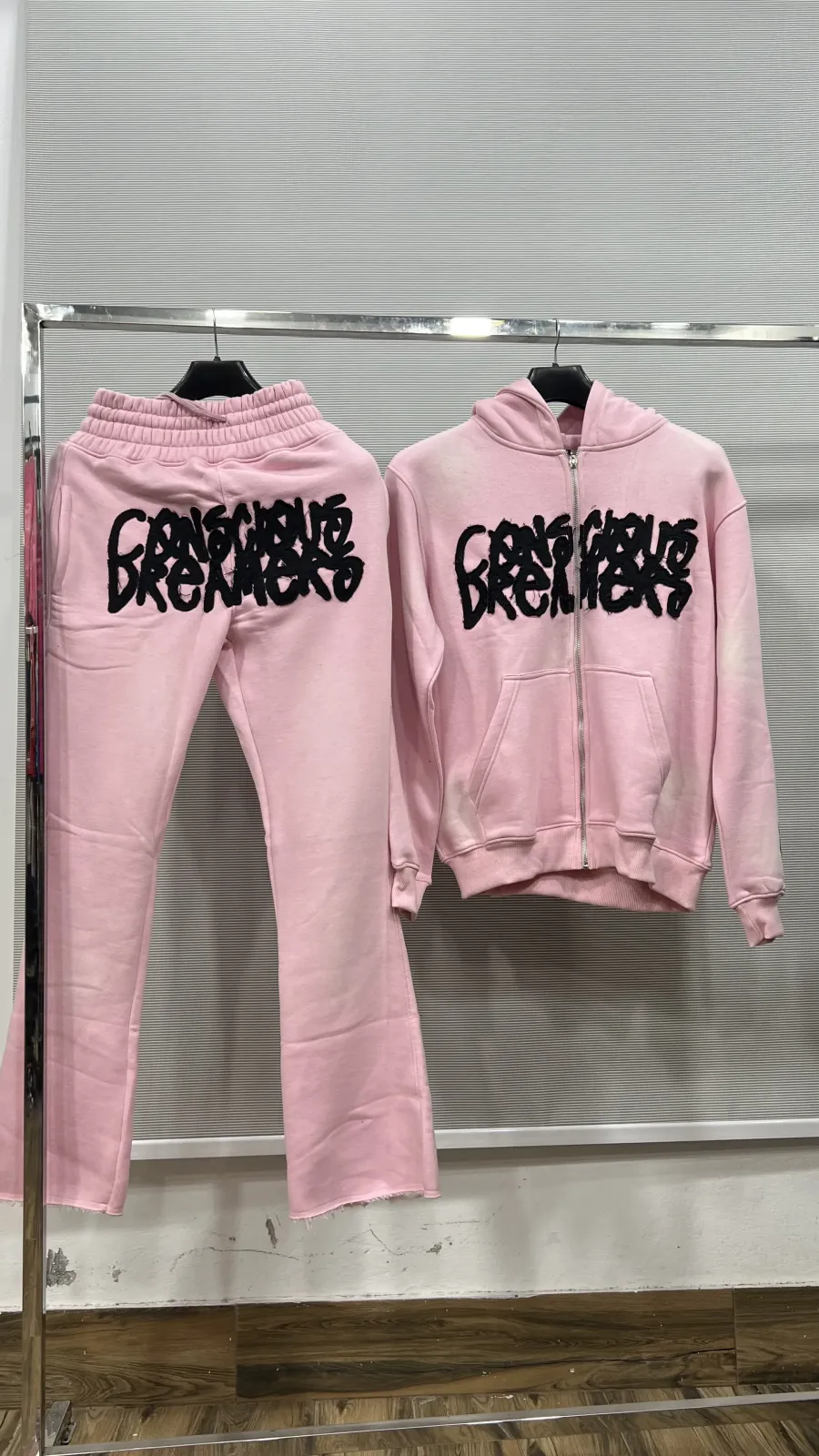
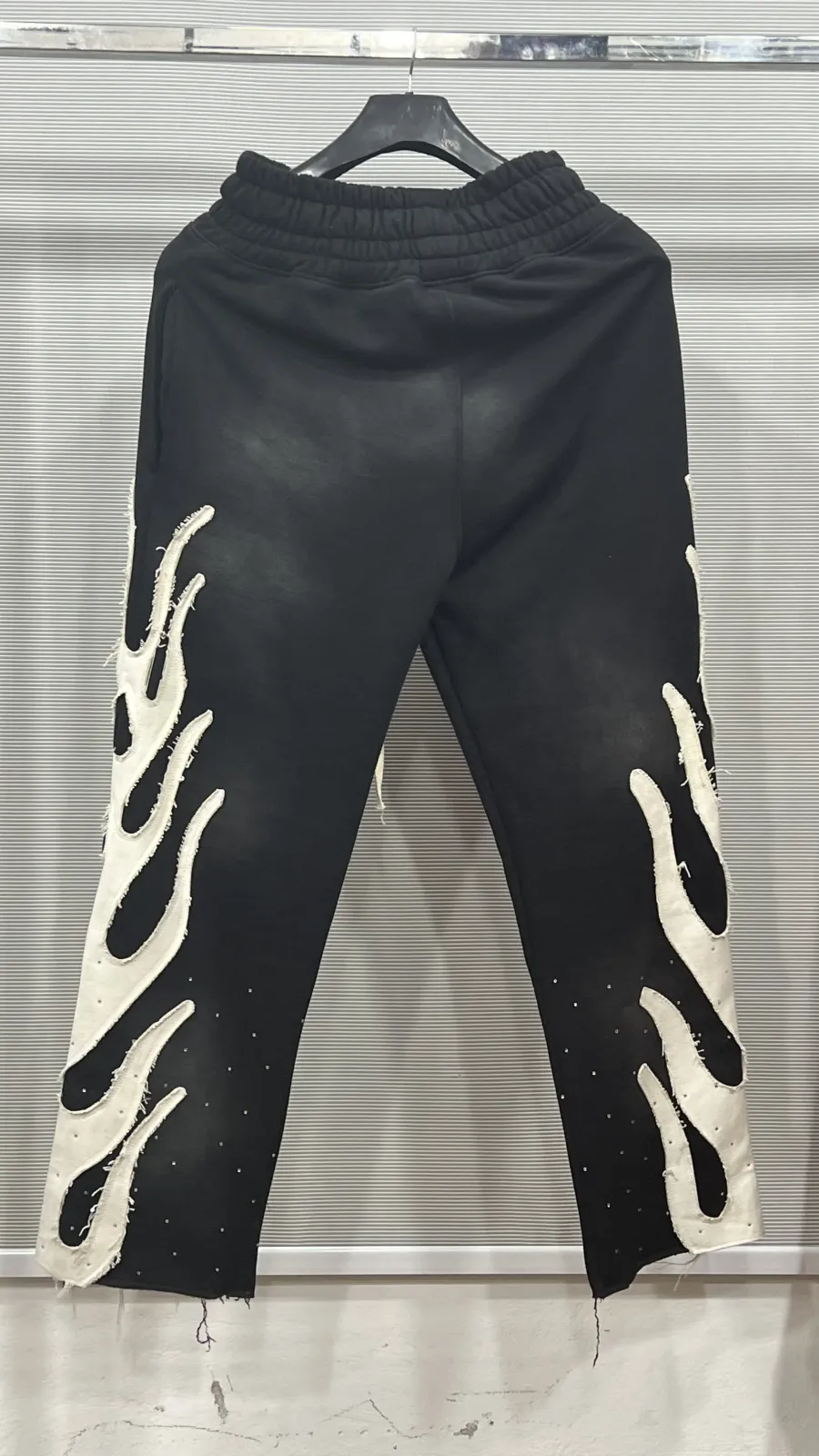
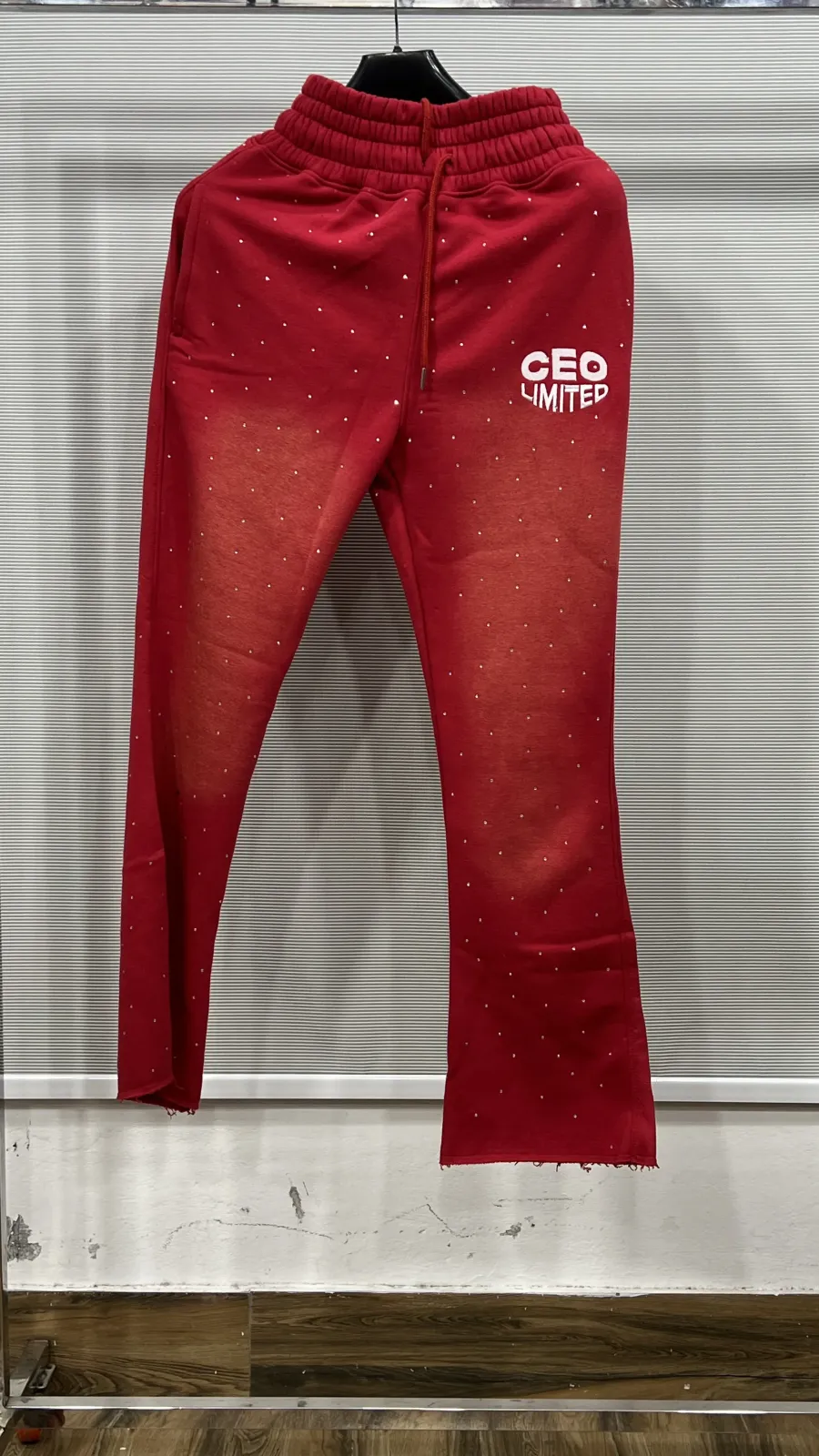
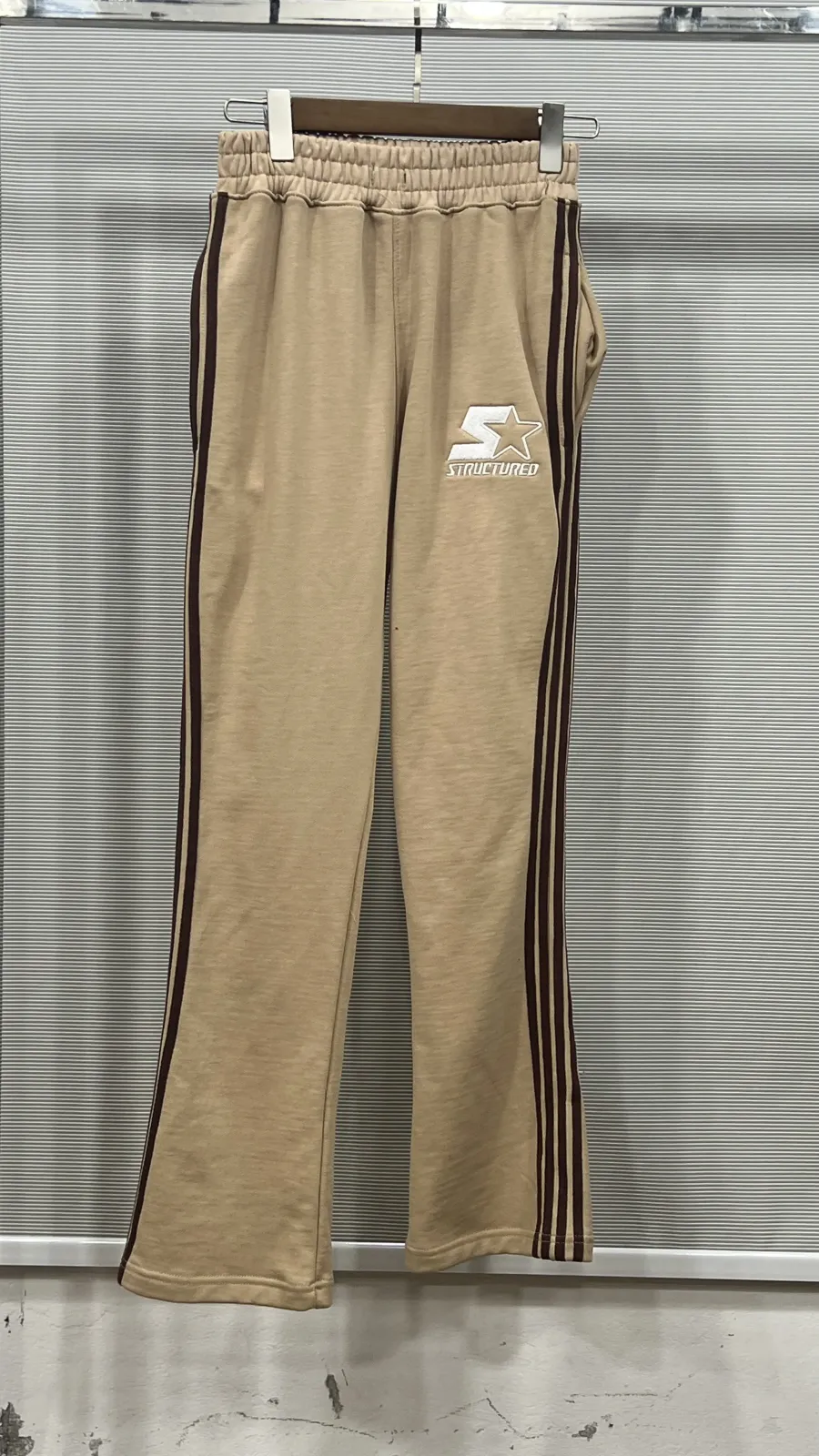
The pieces below are our own production samples, shot on the factory floor — not stock photos. Every order we run is fully custom to your spec, sizes, and branding.
01 — Why Sweatpants Are Harder to Hoop Than a Flat Panel
What an Embroidery Sweat Pants Manufacturer Has to Set Up Differently
A tee’s chest or a hoodie’s front panel is flat — you hoop it, stitch it, done. A sweatpant leg is a tube, not a flat panel, and that changes the whole hooping process. Lay it flat and hoop it the way you would a chest logo, and there’s a real risk of accidentally stitching through both layers of fabric if the garment isn’t positioned exactly right — the needle can catch the back of the leg along with the front if the hoop isn’t set up carefully.
The more reliable approach uses a specialized cylindrical or tubular hooping attachment, built specifically to hold a garment leg open in its natural tube shape rather than flattening it. That’s genuinely different equipment and technique from what a chest-logo job needs, and it’s one reason embroidery on sweatpants takes more careful setup than the same design would on a hoodie or tee, even before you get to the design itself.
None of that makes it a niche or unusual request — hip-logo sweatpants are a well-established athletic and streetwear convention, and the extra setup work is a normal part of running that category, not a red flag or a reason to avoid it. It just means the process looks different behind the scenes than it does for a flat chest logo, and it’s worth knowing that going in.
02 — Fabric and Construction: Why Heavier Fleece Actually Helps Here
Fabric and Construction: Why Heavier Fleece Actually Helps Here
| Weight | GSM | Embroidery Result |
|---|---|---|
| Midweight fleece | 320–360 GSM | Small logos, light stitch density |
| Heavyweight fleece | 380–450+ GSM | Most sweatpant orders — supports moderate density well |
Here’s a genuine advantage sweatpants carry into embroidery that a t-shirt doesn’t: sweatpants fabric already runs in the same heavy GSM range that supports embroidery well, unlike a tee’s lightweight jersey, which needs careful stitch-density limits to avoid puckering. You’re not fighting the fabric the way you sometimes are on a lighter garment.
What does need attention is the curve and give of the fabric right at the hip and thigh, where sweatpants often build in a bit more stretch for range of motion than a flat hoodie panel has. Stabilizer choice and hoop tension need to account for that curved, sometimes stretchy surface rather than treating it like a flat, stable panel — the same fabric weight that helps on a flat area can still pucker if the stabilizer doesn’t match the actual shape it’s being stitched onto.
We typically use a cut-away stabilizer on sweatpant embroidery, the same choice we make on stretchier jersey, precisely because a curved and mobile area needs backing that stays with the fabric rather than being torn away and potentially distorting the stitched shape. On a flatter, more stable part of the leg — away from the hip curve — a lighter stabilizer approach can sometimes work, but we’d rather default to the more robust option than risk a puckered result on a placement that’s harder to redo than a flat chest logo.
03 — Placement, Waistband Interaction, and File Requirements
Placement, Waistband Interaction, and File Requirements
Sweatpants placement geography is genuinely different from anything on a top. The hip or outer thigh is the classic "sponsor logo" spot, a convention borrowed straight from athletic and sports apparel. A vertical text or stripe design running down the side seam of one or both legs is a popular streetwear alternative. A small mark near the front of the waistband is a third, more understated option. Each of these reads as a distinct style choice to a customer, not just a variation on the same idea, so it’s worth being deliberate about which one fits your brand.
Waistband-adjacent embroidery needs real care — stitching too close to or through the elastic itself can restrict its stretch or cause it to pucker, undermining the exact recovery quality we build the waistband for in the first place. If a design sits near a pocket opening, the backing and stitch placement need to stay clear of the pocket bag fabric so they don’t interfere with how the pocket actually functions. And if you want the same design mirrored on both legs, both need to be hooped and stitched with matched precision — a symmetry requirement that simply doesn’t come up on a single chest-logo placement.
File requirements follow the same basics as any embroidery job — vector or high-resolution artwork, Pantone references for thread matching — but tell us the exact placement relative to the waistband, side seam, or pocket when you brief us. A design intended for the outer thigh reads very differently once it’s mapped onto a curved hip panel instead, so being specific about the reference points avoids a placement mismatch on the first sample.
04 — What Separates Clean Sweatpant Embroidery From a Puckered Leg
What Separates Clean Sweatpant Embroidery From a Puckered Leg
Lay the leg flat and check the area around the stitching for puckering, the same basic check as any embroidery job — but pay particular attention to whether the curved hip or thigh area shows any distortion that a flat chest panel wouldn’t reveal at the same stitch density. If the waistband sits near the design, stretch it and confirm it still recovers properly; embroidery that’s compromised the elastic is a real defect, not a stylistic quirk.
If a pocket is nearby, check that it still opens and closes smoothly without the stitching or backing catching on it. And if you’ve ordered a mirrored two-leg design, lay both legs side by side and confirm the placement, size, and alignment actually match — a design that’s a few millimeters off between legs is more noticeable on a symmetrical garment than the same discrepancy would be anywhere else.
It’s worth running a stretch test on any waistband-adjacent design specifically, beyond just checking it visually. Pull the waistband the way normal wear would, and confirm the recovery still feels the same as an unembroidered section of the same waistband. If the stitching has stiffened that area even slightly compared to the rest of the band, that’s worth catching on the sample rather than discovering it after fifty pairs have shipped.
05 — MOQ and Sampling: What to Expect
MOQ and Sampling With Your Embroidery Sweat Pants Manufacturer
MOQ is 50 pieces per style, split across whatever size run you need. Sampling takes 6–10 days, and the full cost is credited against your bulk order once you move forward. That credit applies the same way here as on any other category we run.
Given the hooping complexity specific to a tube-shaped leg, sampling matters more here than it would for a straightforward chest logo — it’s your chance to confirm placement, tension, and (if applicable) two-leg symmetry on the actual 3D garment rather than a flat mockup. If your design sits near the waistband or a pocket, specifically check those interaction points on the sample before approving bulk.
It’s also worth asking to see the actual hooping process, either over our video call or in photos, if this is your first time ordering leg embroidery from us or anyone else. Watching how the leg is positioned and held during stitching gives you a much better sense of what to expect from the finished piece than the finished sample alone, especially around the waistband and pocket areas where the process itself explains a lot about the result.
06 — What Actually Moves Your Price
What Actually Moves Your Price
Tubular hooping takes more setup time than a flat chest-panel job, which factors into placement cost alongside the usual levers: stitch count and density, thread color count, and total order volume. A mirrored two-leg design costs more than a single-leg placement, since it’s effectively two embroidery jobs rather than one, each needing to match the other precisely.
Placement choice itself can also nudge cost slightly — a waistband-adjacent design requires more careful, slower stitching to avoid the elastic than a straightforward hip or thigh placement does, and that added care shows up as a modest time difference in production even for designs of similar size and stitch count.
We don’t publish flat pricing because those variables interact too much to be useful as a single number. Run your spec through our Instant Quote tool instead — it gives you a price estimate in 5 seconds, a downloadable PDF quote, and a direct line to WhatsApp with your quote pre-filled. Final pricing is confirmed by our team within 24 hours.
07 — Shipping to the UK and EU Duty-Free
Shipping to the UK and EU Duty-Free
Manufacturing in Pakistan carries a trade advantage worth factoring into your landed cost. Apparel made here enters the UK at 0% duty under the Developing Countries Trading Scheme, and the EU at 0% duty under GSP+, versus roughly 12% on equivalent goods sourced from China.
Details on eligibility and the current tariff schedule are on the UK government’s own guidance page: Developing Countries Trading Scheme (DCTS) — GOV.UK. It’s worth checking directly if landed cost is a factor in your sourcing decision.
08 — When Embroidery Isn't the Right Call
When Embroidery Isn’t the Right Call
Embroidery isn’t the right call for a large, all-over leg design — dense coverage across that much curved surface gets heavy, stiff, and impractical to stitch cleanly. For big coverage or a photographic design, our Screen Printing Sweat Pants or DTG Printing Sweat Pants pages are better starting points, depending on how much detail your design needs.
Table of Contents
Simple Process
From Spec to Shipped, in Four Steps
01
Quote & Spec
Run your GSM, placement, and thread colors through the Instant Quote tool; get a price estimate and a downloadable PDF in 5 seconds.
02
Sample
We hoop and stitch a physical sample in 6–10 days, checking placement and tension on the actual garment; you can join a live video call from the floor before it ships.
03
Approve & Bulk
Approve the sample (its cost is credited to your order) and we run your full size and quantity — production takes 12–15 days.
04
Ship
Finished sweatpants go out via DHL/FedEx air (3–7 days) or sea freight for larger volumes, landing duty-free in the UK and EU.
Our Advantage
Why Brands Choose Malinor
Floor Video Call Before You Pay Anything
See your actual embroidery production run in progress, not a stock photo, before you commit to bulk.
Sample Cost Credited in Full
Nothing at all you spend on sampling is wasted once you move to bulk.
In-House Digitizing and Stitching
No subcontracting any decoration step to a third shop, so your timeline doesn’t depend on someone else’s queue.
Fast, Direct Replies
Most quote and spec questions get answered within roughly 2 hours during business hours.
Common Questions
Frequently Asked Questions
Why is embroidering sweatpants more complicated than embroidering a t-shirt?+
A t-shirt’s chest panel is flat; a sweatpant leg is a tube. Hooping a curved, tubular surface needs either very careful flat-laying to avoid accidentally stitching through both fabric layers, or a specialized cylindrical hooping attachment built for garment legs — genuinely different equipment and technique than what a flat chest logo requires.
Can embroidery be placed near the waistband without affecting the elastic?+
Yes, but it needs real care. Stitching too close to or through the elastic itself can restrict its stretch or cause puckering, which undermines the recovery the waistband is built for in the first place. We keep stitching and backing clear of the elastic zone specifically to avoid this.
Where do brands typically place embroidery on sweatpants?+
Most commonly the hip or outer thigh — the classic "sponsor logo" placement borrowed from athletic apparel. A vertical text or stripe design down the side seam is a popular streetwear alternative, and a small mark near the waistband is a third, more understated option.
Can the same design be embroidered symmetrically on both legs?+
Yes, and it’s a common request. Both legs need to be hooped and stitched with matched precision so the placement, size, and alignment line up when the pants are worn — a symmetry requirement specific to a two-legged garment that doesn’t come up on a single chest-logo placement.
What’s the minimum order quantity?+
50 pieces per style, with sizes split however your size run needs — you’re not locked into 50 of one size. An embroidered sweatpant and a screen-printed sweatpant in the same order each need their own 50-piece minimum, since they’re different styles.
How long does shipping take?+
DHL or FedEx air freight takes 3–7 days worldwide once your order is finished. For larger volumes, sea freight is available at a lower cost per unit but a longer transit time — we’ll walk you through both options once your bulk order is confirmed and ready to move.
Run Your Spec Through the Instant Quote Tool
Get a price estimate in 5 seconds, a downloadable PDF, and a straight line to WhatsApp with your quote pre-filled. Before you pay anything, we’ll get you on a live video call from the production floor.