Embroidery Hoodie Manufacturer
Embroidery Hoodie Manufacturer With In-House Digitizing and Stitching
As an embroidery hoodie manufacturer based in Sialkot, Pakistan, we digitize your logo in-house, match thread to your brand colors, and stitch onto a GSM fleece your design actually needs to sit flat without puckering. MOQ starts at 50 pieces per style with sizes split however you need, your sample takes 6–10 days and its full cost is credited against the bulk order, and production runs 12–15 days once you approve it.
The pieces below are our own production samples, shot on the factory floor — not stock photos. Every order we run is fully custom to your spec, sizes, and branding.
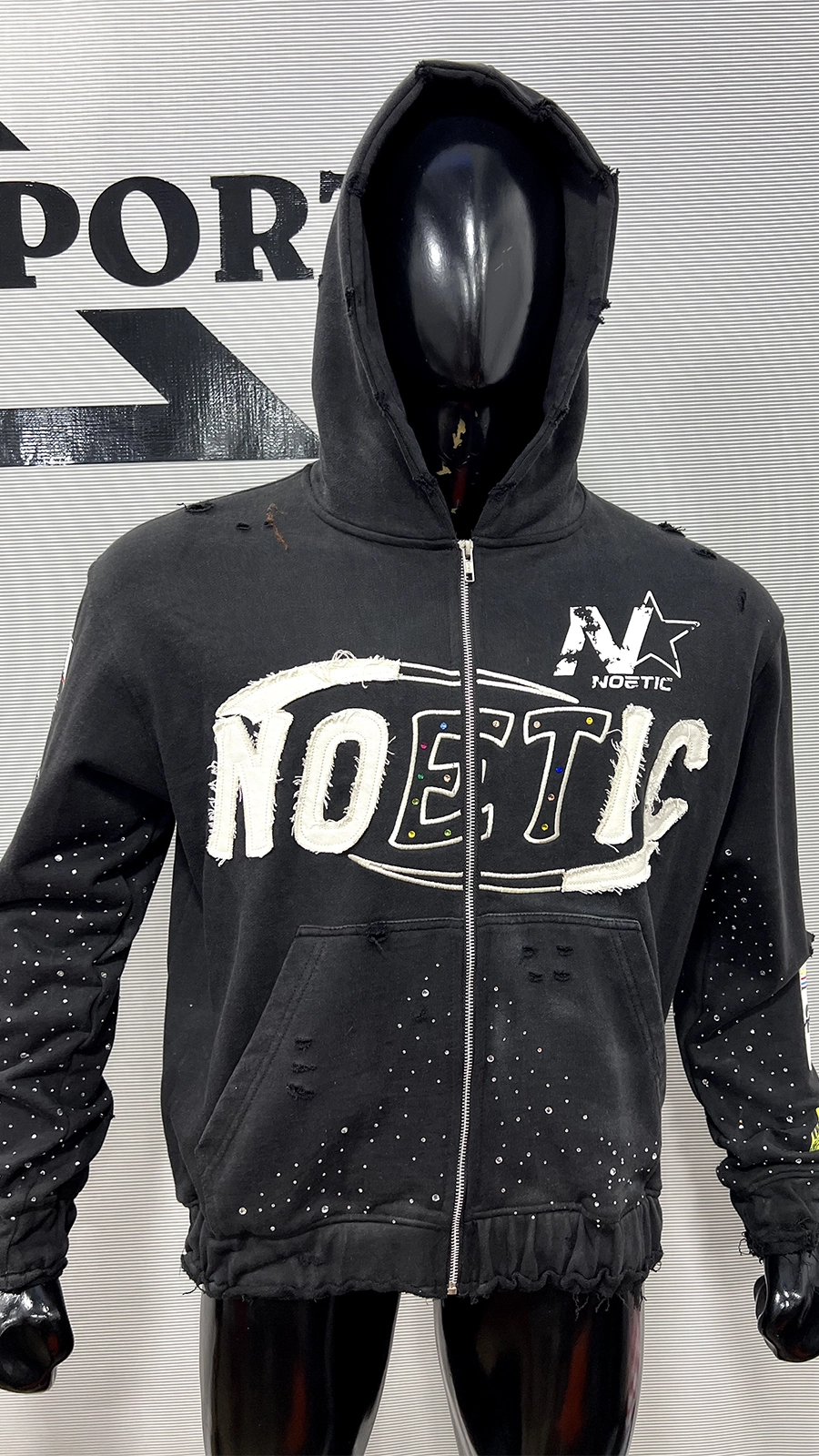
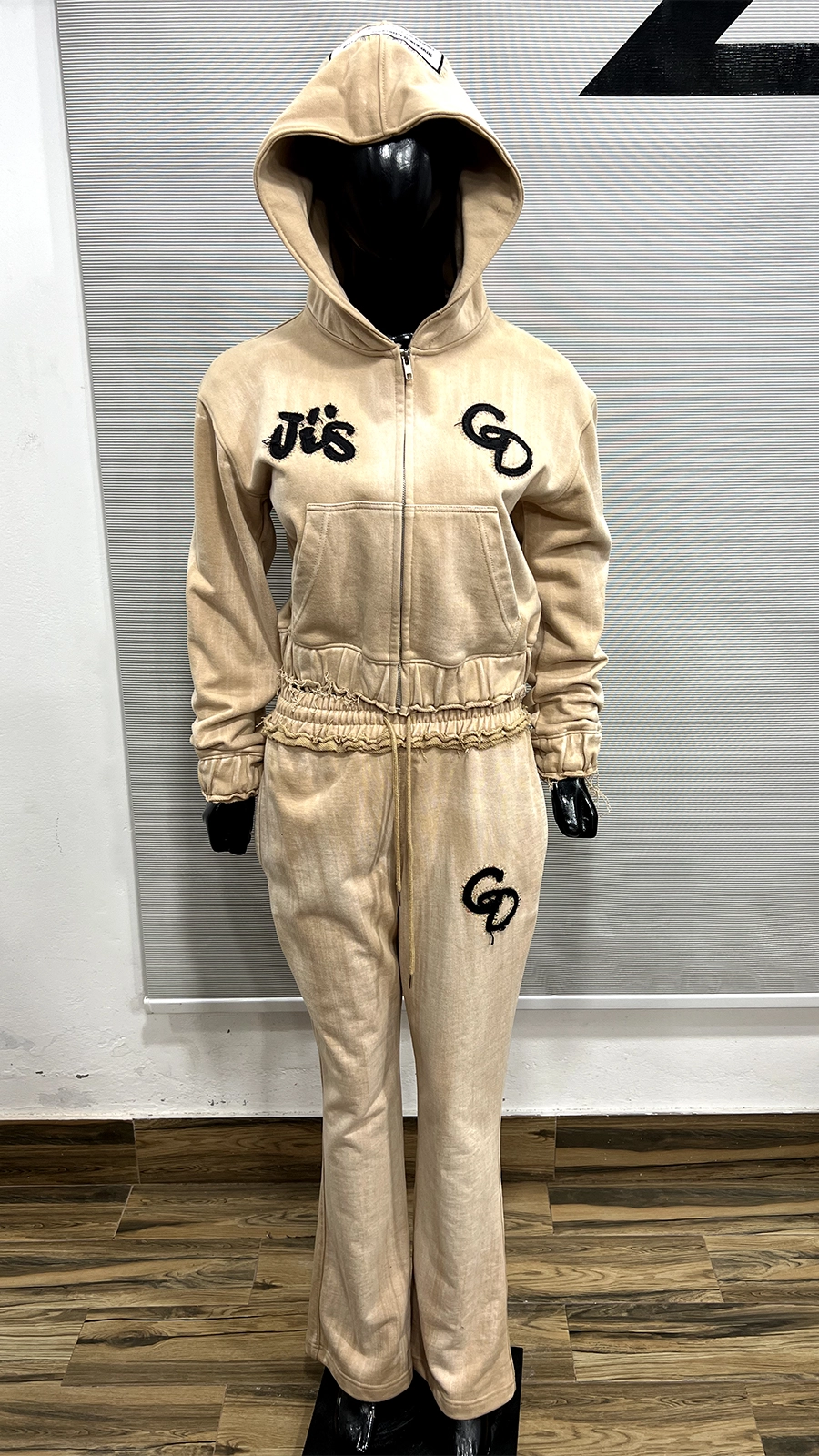
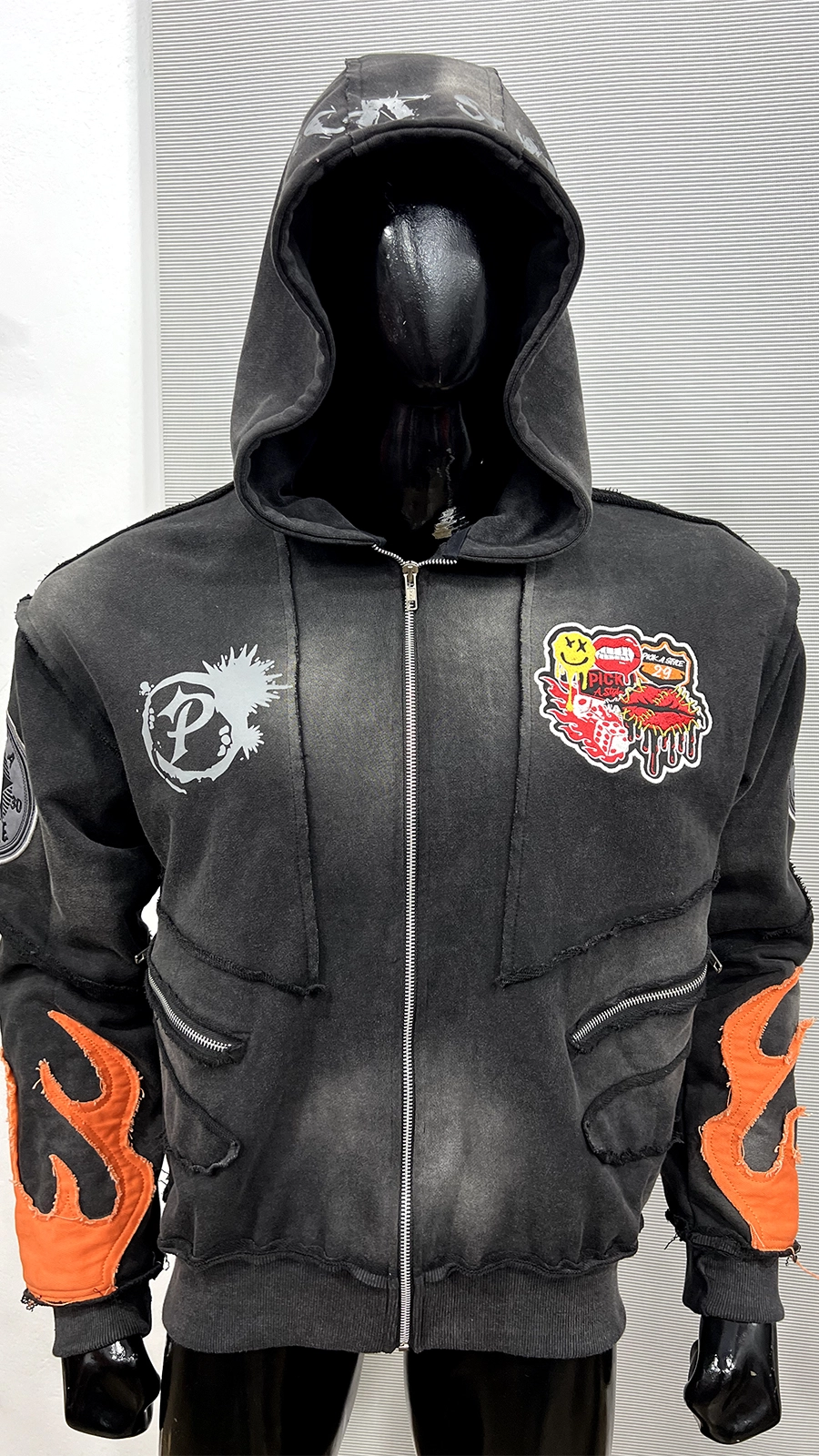
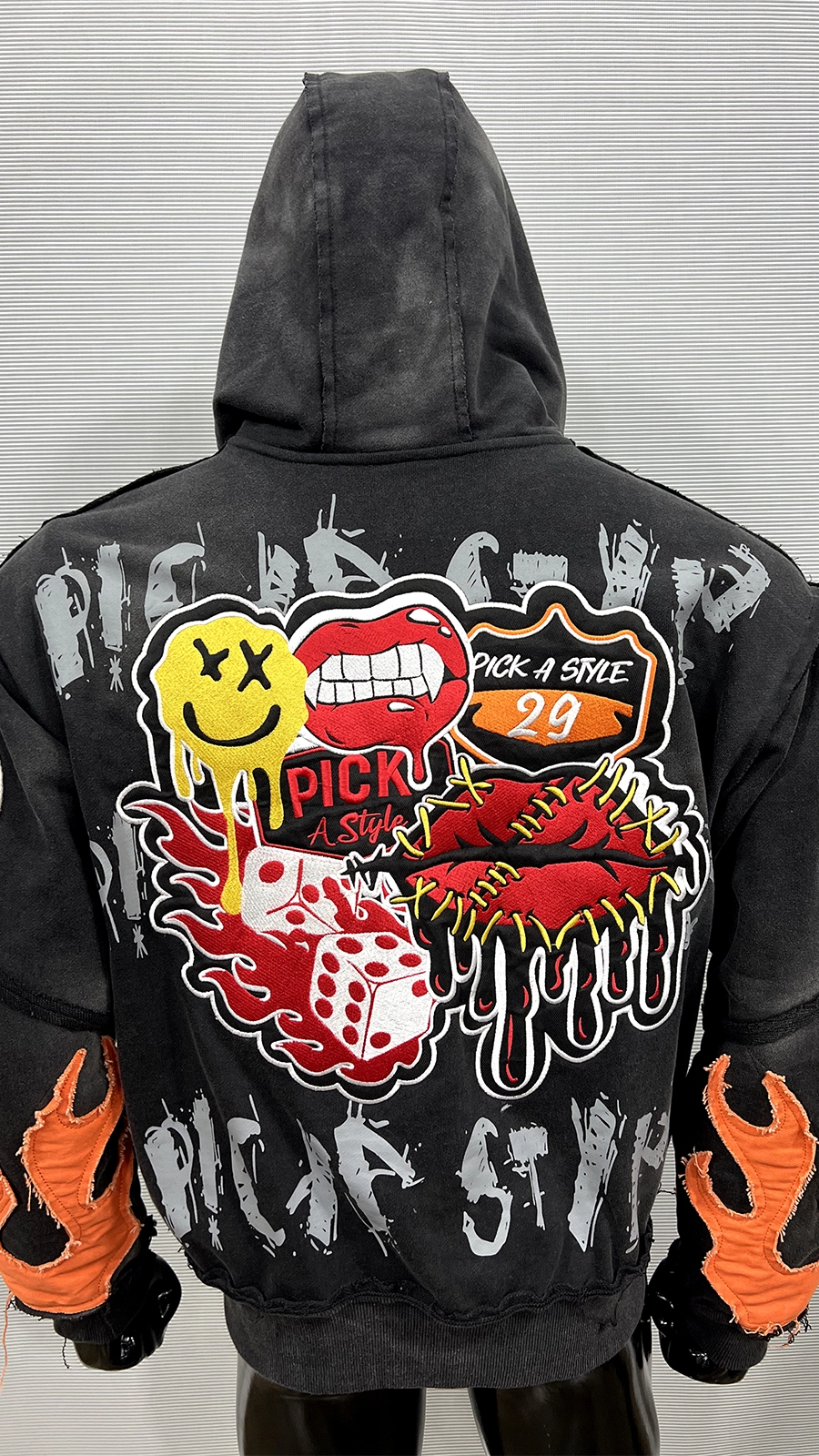
01 — What Embroidery Actually Involves on the Machine
What an Embroidery Hoodie Manufacturer Actually Does on the Machine
Embroidery isn’t a print — it’s thread physically stitched through the fabric by a needle, following a digitized stitch file rather than a direct image transfer. That file, usually a .DST, tells a multi-head machine exactly where every stitch lands, in what order, and with which thread color loaded.
Stitch density — how many stitches pack into a given area — is what controls how bold and solid a design looks. Low density gives a lighter, almost sketched fill; high density gives a thick, raised, fully-covered look, but it also pulls harder on the fabric underneath it. That pull is the reason embroidery behaves so differently from printing: the fabric has to be structurally ready to take that tension, or the design puckers the surrounding material instead of sitting flat.
Our multi-head machines run several garments at once per cycle, but stitch count still sets the pace — a 5,000-stitch chest logo runs through a cycle in a couple of minutes, while a dense 15,000-stitch back piece can take 15–20 minutes per piece. That difference is why a high-stitch-count design adds real production time on top of the usual 12–15 days, especially on larger orders — it’s worth knowing upfront if your timeline is tight.
02 — Fabric and Construction: Why GSM Determines Stitch Density
Fabric and Construction: Why GSM Determines Stitch Density
| Weight | GSM | Best For |
|---|---|---|
| Midweight fleece | 300–320 GSM | Small logos, light-to-medium stitch density |
| Heavier midweight | 320–380 GSM | Standard chest logos — most of our embroidery orders run here |
| Heavyweight fleece | 380–450+ GSM | Dense fills and large back placements |
Under 300 GSM, dense stitching tends to pucker or pull the knit out of shape — there’s not enough fabric structure to anchor against the stitch tension. We back every embroidery placement with cut-away stabilizer rather than tear-away, since tear-away distorts a stretchy knit like fleece when it’s removed. On lighter fabric, though, stabilizer can only do so much — if your design is dense, we’ll usually recommend stepping up in GSM rather than fighting the fabric.
03 — Design Placement, Digitizing, and File Requirements
Design Placement, Digitizing, and File Requirements
Left-chest placement runs 8–10cm, the industry standard for a reason — anything wider starts to crowd a standard block’s chest panel. Back placements run 30cm and up, and large back designs get hooped and stitched in sections, which means alignment between sections matters as much as the stitching itself. Sleeve embroidery is possible but needs cap-hooping equipment and a design that works within a narrower stitching field.
Digitizing converts your artwork into that stitch file, and it’s not a 1:1 translation. Fine text under about 5mm tends to fill in and become unreadable once stitched, and gradients get converted into flat blocks of color, since thread can’t blend the way ink does. Send us vector files or high-resolution artwork along with your Pantone references — thread comes in a standardized color range, so we’ll match to the nearest available thread rather than an exact custom mix, which is a real difference from screen printing.
04 — What Separates Good Embroidery From a Puckered Mess
What Separates Good Embroidery From a Puckered Mess
Puckering is the first thing to check — lay the garment flat and look at the fabric immediately around the stitched area. It should sit as flat as the rest of the panel, not bunch or ripple. Flip the garment inside out and check the backing: it should be trimmed cleanly, not left as a ragged patch that’ll scratch against skin.
Check thread tension too — loose threads or visible looping on the underside usually mean the tension wasn’t set correctly for that fabric weight. On multi-section back designs, check that the sections actually align; a half-millimeter of hoop shift is enough to throw off a border or an outline. These are the checks we run on every sample before it goes to bulk.
Care instructions are worth passing on to your customers, too. The stitched area is stiffer than the surrounding fleece, and it can shrink slightly differently through repeated hot washes and high-heat drying — over time that shows up as subtle puckering that wasn’t there on day one. Recommending an inside-out, cold wash with low or no tumble heat protects both the stitching and the print on the reverse side, and it’s a small line item that cuts down on "why does my logo look weird now" messages months after launch.
05 — MOQ and Sampling With Your Embroidery Hoodie Manufacturer
MOQ and Sampling With Your Embroidery Hoodie Manufacturer
MOQ is 50 pieces per style, split across whatever size run you need. Sampling takes 6–10 days, and the full cost is credited against your bulk order once you move forward.
Always approve a physically stitched sample, not just a digitized mockup on screen. A mockup can’t show you puckering, thread sheen under real light, or how a color match actually reads against your fabric — all things that only show up once the needle’s actually gone through the material.
06 — What Actually Moves Your Price
What Actually Moves Your Price
Price on embroidery moves on stitch count and density (more stitches means more machine time), the number of thread colors in your design (each color change adds setup time), placement size, fabric GSM, and your total order volume. A small single-color chest logo and a dense multi-color back piece are priced very differently even on the same hoodie.
We don’t publish flat pricing because those variables interact too much to be useful as a single number. Run your spec through our Instant Quote tool instead — it gives you a price estimate in 5 seconds, a downloadable PDF quote, and a direct line to WhatsApp with your quote pre-filled. Final pricing is confirmed by our team within 24 hours.
07 — Shipping to the UK and EU Duty-Free
Shipping to the UK and EU Duty-Free
Manufacturing in Pakistan carries a trade advantage worth factoring into your landed cost. Apparel made here enters the UK at 0% duty under the Developing Countries Trading Scheme, and the EU at 0% duty under GSP+, versus roughly 12% on equivalent goods sourced from China.
Details on eligibility and the current tariff schedule are on the UK government’s own guidance page: Developing Countries Trading Scheme (DCTS) — GOV.UK.
08 — When Embroidery Isn't the Right Call
When Embroidery Isn’t the Right Call
Embroidery isn’t the right call for photographic designs, color gradients, or fine detail smaller than a few millimeters — thread simply can’t reproduce what ink can there, and a digitizer will end up simplifying your design more than you probably want. It’s also not the most economical choice for a large full-coverage graphic, since dense stitching over a big area gets heavy, stiff, and expensive fast. For any of those, our DTG Printing Hoodie page is a better starting point.
Table of Contents
Simple Process
From Spec to Shipped, in Four Steps
01
Quote & Spec
Run your GSM, placement, stitch density, and thread colors through the Instant Quote tool; get a price estimate and a downloadable PDF in 5 seconds.
02
Sample
We digitize your artwork and stitch a physical sample in 6–10 days; you can join a live video call from the floor before it ships.
03
Approve & Bulk
Approve the sample (its cost is credited to your order) and we run your full size and quantity — production takes 12–15 days.
04
Ship
Finished hoodies go out via DHL/FedEx air (3–7 days) or sea freight for larger volumes, landing duty-free in the UK and EU.
Our Advantage
Why Brands Choose Malinor
Floor Video Call Before You Pay Anything
See your actual embroidery run in production, not a stock photo, before you commit to bulk.
Sample Cost Credited in Full
Nothing you spend on sampling is wasted once you move to bulk.
In-House Digitizing and Stitching
No subcontracting a decoration step to a third shop, so your timeline doesn’t depend on someone else’s queue.
Fast, Direct Replies
Most quote and spec questions get answered within 2 hours during business hours.
Common Questions
Frequently Asked Questions
Why does embroidery need heavier GSM fleece than print?+
Stitching pulls on the fabric underneath it, and denser designs pull harder. Below about 300 GSM, that tension can pucker or distort the knit, especially on fleece, which stretches more than a woven fabric. Heavier GSM gives the stitching something structurally solid to anchor into, so the design sits flat instead of warping the panel around it.
Can embroidery match my exact brand Pantone color?+
Not always exactly. Thread comes in a standardized color range (we work from a chart similar to Madeira or Isacord), so we match to the nearest available thread rather than custom-mixing like a screen print ink. It’s usually close enough that customers won’t notice, but if exact color match is critical to your brand, that’s a real difference worth planning around.
How do you prevent puckering on embroidered hoodies?+
Three things together: cut-away stabilizer behind the fabric (not tear-away, which distorts stretchy fleece), correct hoop tension for the specific GSM, and staying within a stitch density the fabric can actually support. We test-stitch new designs on scrap fabric from the same roll before running a full sample.
What’s the difference between embroidery and chenille?+
Embroidery uses fine stitched thread and works well for detailed logos and small text. Chenille builds up a bolder, raised, looped texture — the classic varsity-letter look — and reads much bigger and chunkier at the same size. They’re different machines and different price points; chenille tends to cost more per placement but makes a stronger visual statement for large lettering.
What’s the minimum order quantity?+
50 pieces per style, with sizes split however your size run needs — you’re not locked into 50 of one size. An embroidered hoodie and a screen-printed hoodie in the same order each need their own 50-piece minimum, since they’re different styles.
How long does shipping take?+
DHL or FedEx air freight takes 3–7 days worldwide once your order is finished. For larger volumes, sea freight is available at a lower cost per unit but a longer transit time — we’ll walk you through both options once your bulk order is confirmed.
Run Your Spec Through the Instant Quote Tool
Get a price estimate in 5 seconds, a downloadable PDF, and a straight line to WhatsApp with your quote pre-filled. Before you pay anything, we’ll get you on a live video call from the production floor.