DTG Printing Hoodie Manufacturer
DTG Printing Hoodie Manufacturer With Pretreatment Done Right
As a DTG printing hoodie manufacturer based in Sialkot, Pakistan, we pretreat every garment before printing so photographic detail and full-color gradients actually hold their color wash after wash, not just on day one. MOQ starts at 50 pieces per style with sizes split however you need, your sample takes 6–10 days and its full cost is credited against the bulk order, and production runs 12–15 days once you approve it.
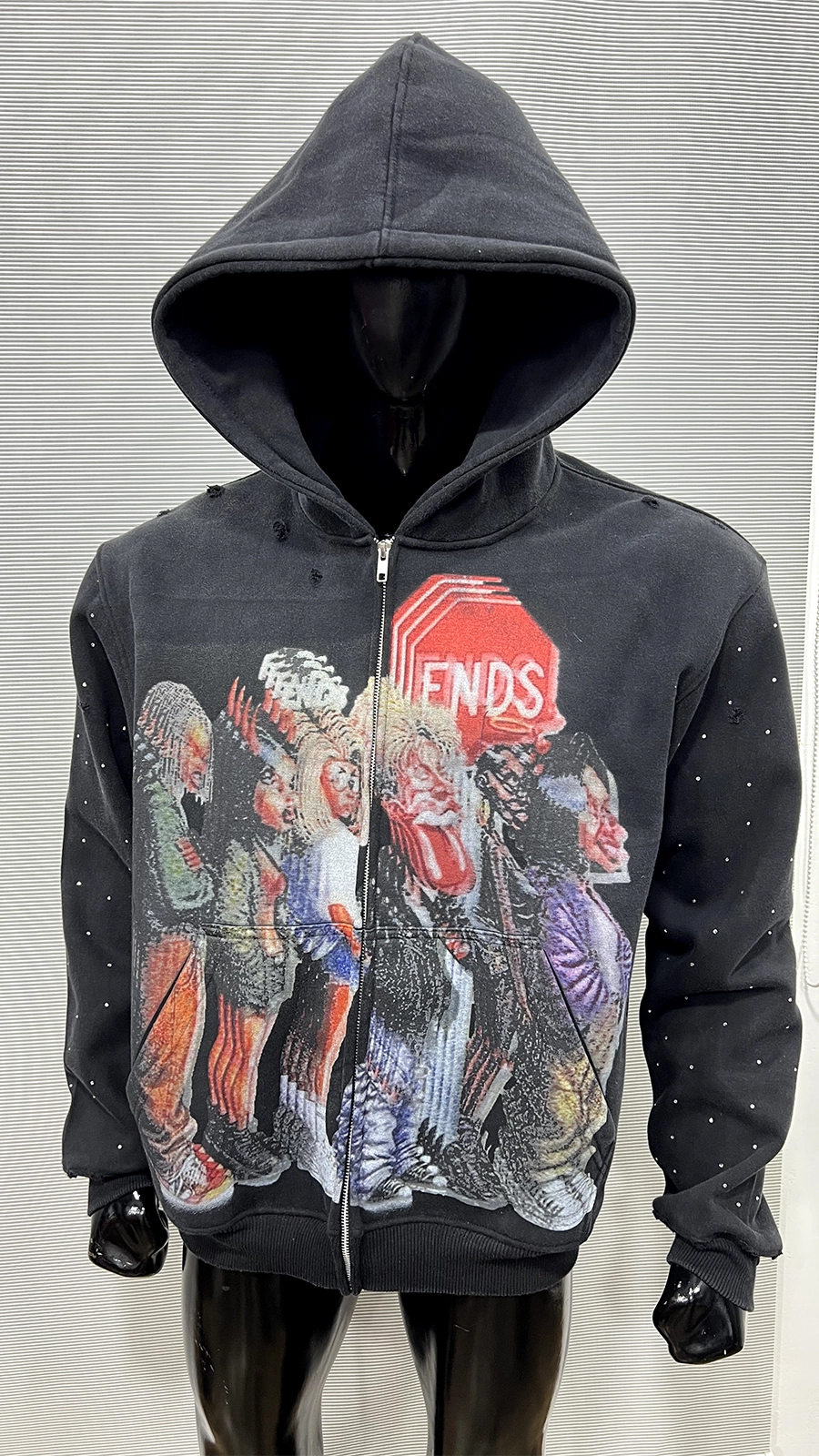
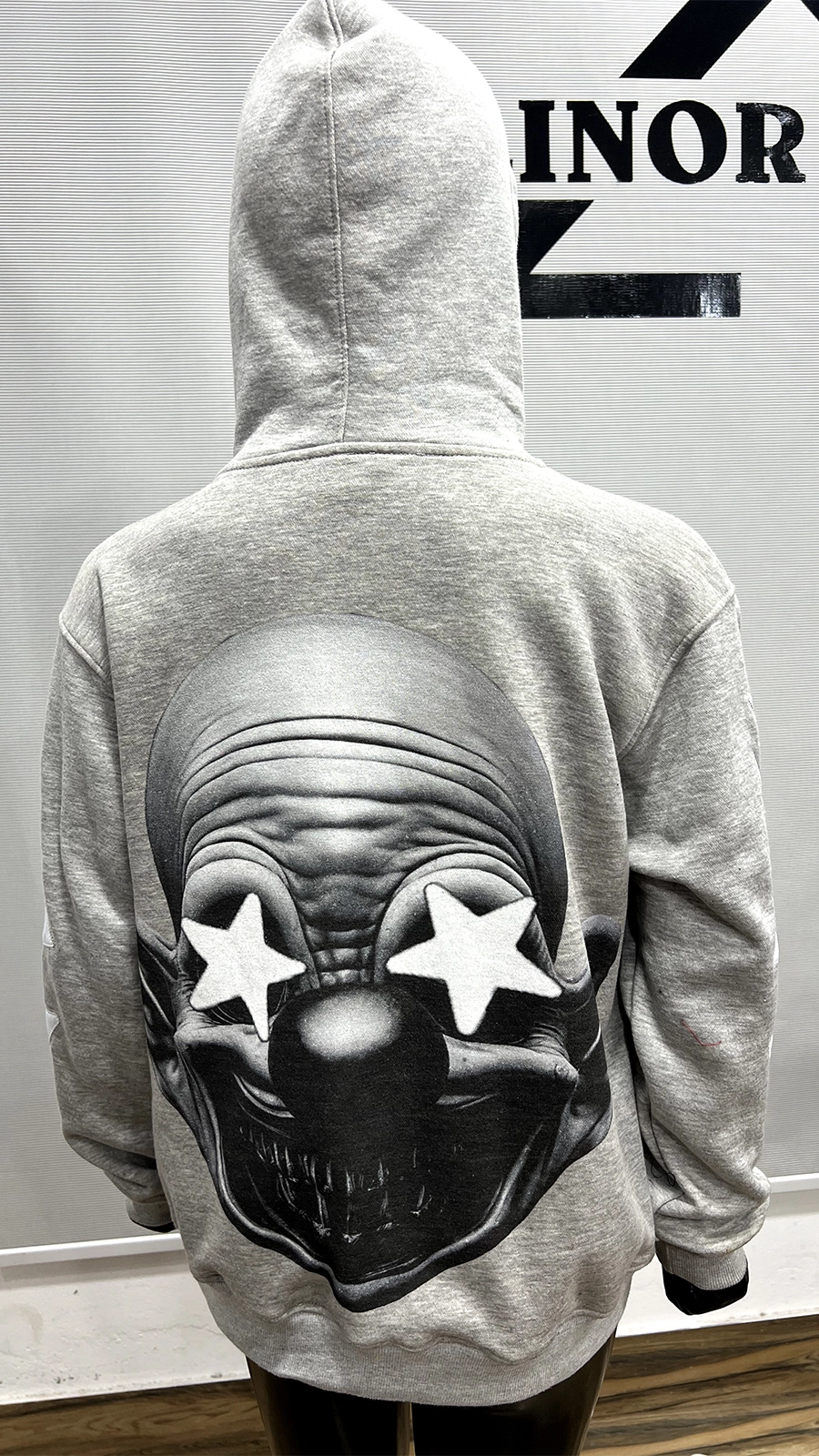
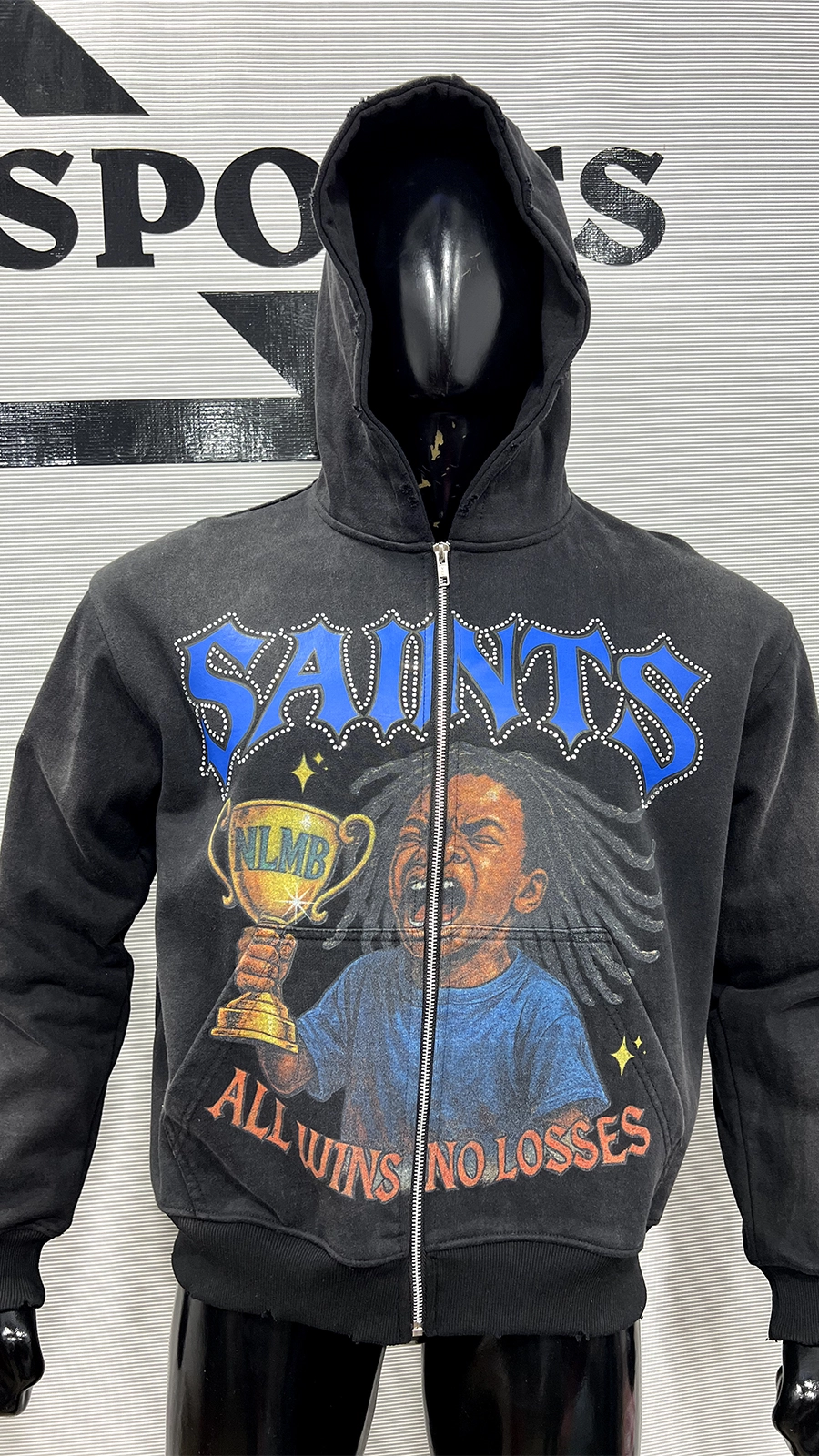
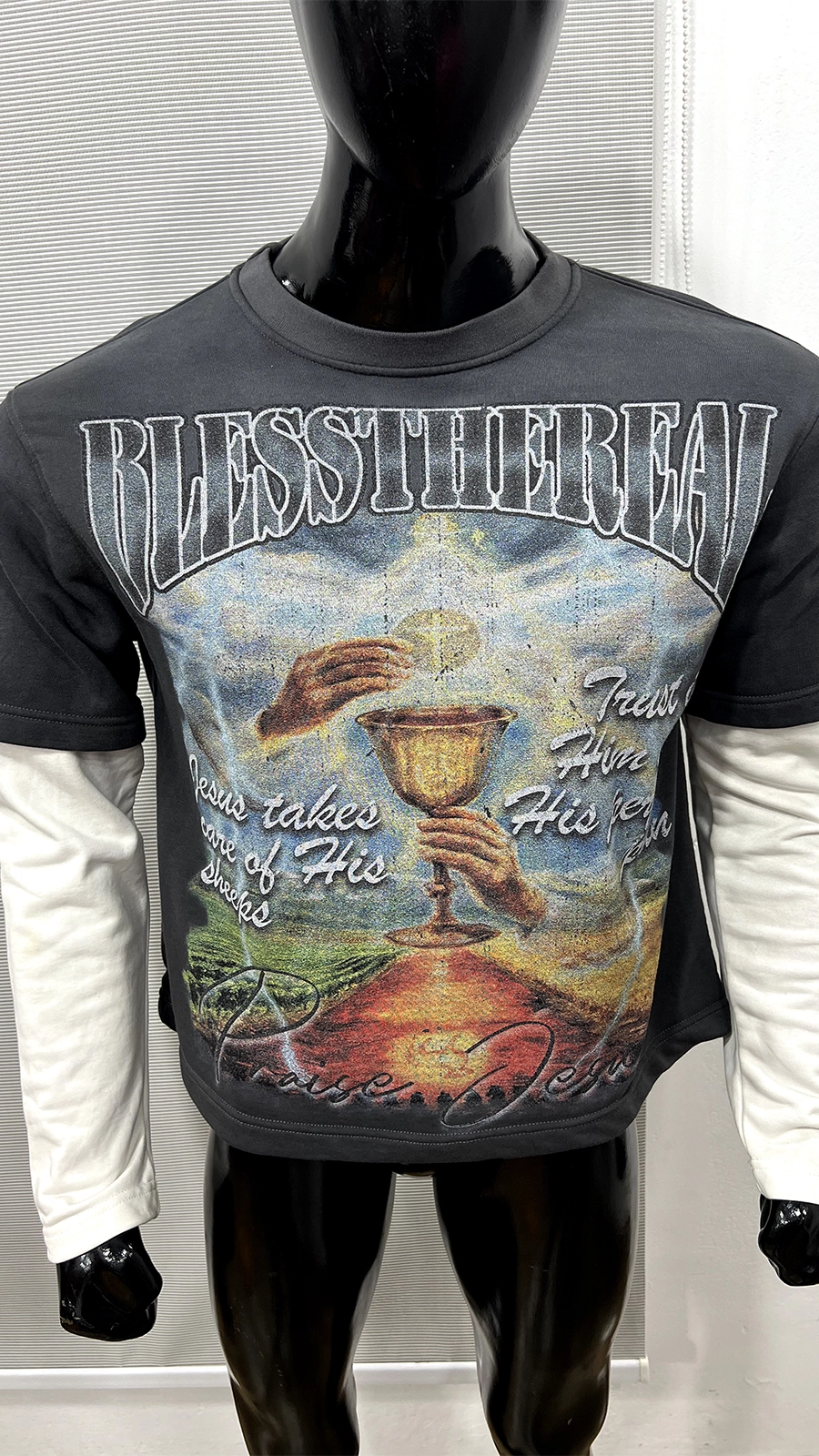
The pieces below are our own production samples, shot on the factory floor — not stock photos. Every order we run is fully custom to your spec, sizes, and branding.
01 — What DTG Printing Actually Involves on the Printer
What a DTG Printing Hoodie Manufacturer Actually Does on the Printer
DTG stands for direct-to-garment — an inkjet printer applies water-based ink straight onto the fabric surface, essentially printing on textile the way a desktop printer prints on paper. There are no screens, no per-color setup, and no practical limit on how many colors or how complex a gradient your design uses, since the printer just lays down whatever pixels the file contains.
The step that makes or breaks the result is pretreatment. Before printing, we spray the garment with a pretreatment solution and heat-press it, which prepares the fibers to accept the ink instead of letting it sink in unevenly or sit loosely on the surface. Skip this step, or under-apply it, and the print looks dull and washed-out from the start — no amount of good design work fixes a pretreatment problem after the fact.
02 — Fabric and Construction: Why Cotton Content Matters More Than GSM
Fabric and Construction: Why Cotton Content Matters More Than GSM
| Fabric | Cotton Content | DTG Result |
|---|---|---|
| 100% cotton fleece | High | Best ink adhesion, most vibrant color |
| Cotton/poly blend (80/20) | Medium-high | Good adhesion, slight muting on the poly fibers |
| Heavy poly-blend fleece | Low | Ink sits poorly, more prone to cracking and fading |
Where screen printing and embroidery both care mainly about GSM, DTG cares more about fiber content. Water-based ink needs cotton fibers to actually absorb into — poly-heavy fleece resists that absorption, which is why a fabric that’s perfect for embroidery or screen printing can underperform for DTG. If a sharp, vibrant print is your priority, we’ll usually steer you toward a higher-cotton fleece option, even if that means a different weight than you’d choose for another technique.
03 — Design Placement, Resolution, and File Requirements
Design Placement, Resolution, and File Requirements
DTG’s real strength is detail — photographic images, smooth color gradients, and complex multi-color artwork all print at the same cost as a simple one-color logo, since there’s no per-color setup to scale with. Left-chest placement still runs 8–10cm by convention, but DTG is where a lot of brands push into full-color front and back graphics that screen printing would charge a premium for.
One real limit: our printer’s platen tops out around 40x50cm per pass, so an oversized full-back design needs to be planned within that ceiling — unlike screen printing, which can cover any size within the screen frame. Send us artwork as a high-resolution raster file (PNG, JPEG, or TIFF) at 300dpi minimum at the actual print size you want, not scaled up from a small web image — DTG is printing literal pixels, and a low-res source file shows every bit of that pixelation once it’s enlarged.
04 — What Separates a Sharp DTG Print From a Dull, Faded One
What Separates a Sharp DTG Print From a Dull, Faded One
Color vibrancy is the first tell. A properly pretreated, well-cured DTG print looks saturated and true to the file you sent; a poorly treated one looks grayed-out or faded even brand new, before a single wash. Look closely for banding — faint horizontal lines across a gradient or solid fill, which usually points to a printhead alignment issue rather than anything wrong with your artwork.
Run a rub test on the cured print with a damp cloth — properly cured ink won’t transfer or smear. And check the hand-feel: DTG should sit relatively soft and flat against the fabric, closer to how a screen print’s water-based ink feels than plastisol’s raised finish, unless a heavy white underbase was needed on a very dark garment.
05 — MOQ and Sampling: What to Expect
MOQ and Sampling With Your DTG Printing Hoodie Manufacturer
MOQ is 50 pieces per style, split across whatever size run you need. Sampling takes 6–10 days, and the full cost is credited against your bulk order once you move forward.
Because DTG carries no per-color screen cost, it’s a genuinely easier technique to iterate on at the sample stage — if you want to test two color variations of the same design, that’s a much smaller ask here than it would be if it meant burning two full sets of screens. Worth using that flexibility before you lock in a final file for bulk.
06 — What Actually Moves Your Price
What Actually Moves Your Price
Price on a DTG print moves less on color count than on print area size, fabric composition and prep required, and your total order volume. A complex multi-color design costs roughly the same to print as a simple one at the same size — the real cost drivers are how much surface area gets covered and how many pieces you’re ordering.
That said, if your design is simple — one or two colors, no gradients — and your volume is high, screen printing can end up cheaper per unit once its screen setup cost amortizes across a large run. We don’t publish flat pricing because these variables interact too much to be useful as a single number. Run your spec through our Instant Quote tool instead — it gives you a price estimate in 5 seconds, a downloadable PDF quote, and a direct line to WhatsApp with your quote pre-filled. Final pricing is confirmed by our team within 24 hours.
07 — Shipping to the UK and EU Duty-Free
Shipping to the UK and EU Duty-Free
Manufacturing in Pakistan carries a trade advantage worth factoring into your landed cost. Apparel made here enters the UK at 0% duty under the Developing Countries Trading Scheme, and the EU at 0% duty under GSP+, versus roughly 12% on equivalent goods sourced from China.
Details on eligibility and the current tariff schedule are on the UK government’s own guidance page: Developing Countries Trading Scheme (DCTS) — GOV.UK.
08 — When DTG Isn't the Right Call
When DTG Isn’t the Right Call
DTG isn’t the right call for very large full-back coverage that exceeds our printer’s platen size, or for high-volume orders of a simple one- or two-color design, where screen printing’s per-unit cost drops lower once screens are amortized across the run. It’s also not the best fit on heavy poly-blend fleece, where ink adhesion suffers regardless of how well the garment is pretreated. For high-volume simple designs, our Screen Printing Hoodie page is the more cost-effective starting point.
Table of Contents
Simple Process
From Spec to Shipped, in Four Steps
01
Quote & Spec
Run your GSM, fabric composition, and print area through the Instant Quote tool; get a price estimate and a downloadable PDF in 5 seconds.
02
Sample
We pretreat and print your physical sample in 6–10 days; you can join a live video call from the floor before it ships.
03
Approve & Bulk
Approve the sample (its cost is credited to your order) and we run your full size and quantity — production takes 12–15 days.
04
Ship
Finished hoodies go out via DHL/FedEx air (3–7 days) or sea freight for larger volumes, landing duty-free in the UK and EU.
Our Advantage
Why Brands Choose Malinor
Floor Video Call Before You Pay Anything
See your actual print run in production, not a stock photo, before you commit to bulk.
Sample Cost Credited in Full
Nothing you spend on sampling is wasted once you move to bulk.
In-House Pretreatment and Printing
No subcontracting a decoration step to a third shop, so your timeline doesn’t depend on someone else’s queue.
Fast, Direct Replies
Most quote and spec questions get answered within 2 hours during business hours.
Common Questions
Frequently Asked Questions
Can DTG print photographic images and gradients on a hoodie?+
Yes — that’s where DTG genuinely outperforms screen printing and embroidery. Because the printer applies ink pixel by pixel with no per-color setup, complex gradients, photographic detail, and unlimited colors all cost the same as a simple design at the same print size. It’s the technique to choose when your artwork is more complex than a flat-color logo.
Why does fabric composition matter more than GSM for DTG?+
Water-based DTG ink needs to absorb into cotton fibers to bond properly. A high-cotton fleece takes ink well regardless of its exact weight; a heavy poly-blend resists that absorption and can leave a print looking dull or prone to cracking, even at the right GSM for the garment otherwise. We’ll flag it if your chosen fabric isn’t ideal for DTG before you commit to a spec.
What’s the largest area DTG can print on a hoodie?+
Our printer’s platen tops out around 40x50cm per pass, so a full oversized back design needs to work within that ceiling. If you need coverage larger than that, screen printing handles bigger placements more easily, since it isn’t limited by a fixed print bed the way a DTG printer is.
Does DTG hold up as well as screen printing over time?+
With correct pretreatment and curing, DTG holds up well for years of normal wash and wear. It’s generally a thinner ink layer than plastisol screen printing, which some brands prefer for a softer hand-feel, but it does mean following care instructions — washing inside-out, avoiding high heat — matters more for DTG than it does for a heavier plastisol print.
What’s the minimum order quantity?+
50 pieces per style, with sizes split however your size run needs — you’re not locked into 50 of one size. A DTG-printed hoodie and a screen-printed hoodie in the same order each need their own 50-piece minimum, since they’re different styles.
How long does shipping take?+
DHL or FedEx air freight takes 3–7 days worldwide once your order is finished. For larger volumes, sea freight is available at a lower cost per unit but a longer transit time — we’ll walk you through both options once your bulk order is confirmed.
Run Your Spec Through the Instant Quote Tool
Get a price estimate in 5 seconds, a downloadable PDF, and a straight line to WhatsApp with your quote pre-filled. Before you pay anything, we’ll get you on a live video call from the production floor.